IB DP Chemistry - Structure 1.2 The nuclear atom - IB Style Questions For HL Paper 1A -FA 2025

Question

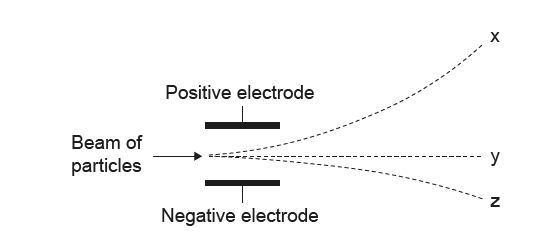
The diagram shows how protons, neutrons, and electrons behave when they move through an electric field.

Which option correctly identifies each of the particles?

OptionProtonsElectronsNeutrons
Ayzx
Bxyz
Czxy
Dxzy
▶️ Answer/Explanation
• The path bending strongly upward (toward the negative electrode) must be protons → z.
• The path bending strongly downward (toward the positive electrode) must be electrons → x.
• The straight path must be neutrons →y
Answer: (C)

Question

Which statements are correct about the molecular ion, \(M^+\), in a mass spectrum?
I. The \(M^+\) ion is not always the peak with highest intensity in the mass spectrum.
II. The \(M^+\) ion is always the most stable fragment formed during electron bombardment.
III. The \(m/z\) ratio of the \(M^+\) ion peak gives the relative molecular mass of the molecule.
(A) I and II only
(B) I and III only
(C) II and III only
(D) I, II and III
▶️ Answer/Explanation
Detailed solution

Correct option: (B)

Statement I: Correct. The \(M^+\) (molecular ion) peak is not always the most intense peak in a mass spectrum. Often, the base peak (highest intensity) corresponds to a particularly stable fragment ion, not the molecular ion.

Statement II: Incorrect. The \(M^+\) ion is not always the most stable fragment; it can readily break into smaller, more stable ions under electron bombardment.

Statement III: Correct. The \(m/z\) value of the \(M^+\) peak corresponds (for \(z = 1\)) to the relative molecular mass of the original molecule.

Therefore, only statements I and III are correct.
Answer: (B)

Question

What is the \(A_r\) of the element as determined from its mass spectrum below?
mass spectrum for Ar calculation
What is the relative atomic mass \(\left(A_r\right)\)?
(A) \(10.0\)
(B) \(10.2\)
(C) \(10.5\)
(D) \(10.8\)
▶️ Answer/Explanation
Detailed solution

The relative atomic mass \(\left(A_r\right)\) is the weighted average of the isotopic masses using their percentage abundances:
\[ A_r = \frac{80.1 \times 10 + 19.9 \times 11}{100} \]
\[ A_r = \frac{801 + 218.9}{100} = \frac{1019.9}{100} = 10.2 \]
Hence, the relative atomic mass of the element is \(10.2\).
Answer: (B)

Scroll to Top