
▶️ Answer/Explanation
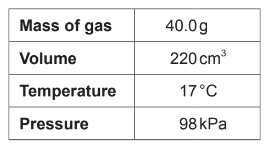
To calculate the molar mass of the gas, we start with the ideal gas law:
\[\mathrm{PV = nRT}\]
Rearranging to find the number of moles:
\[\mathrm{n = \frac{PV}{RT}}\]
Substituting the given values:
\[\mathrm{n = \frac{(98 \, kPa)(0.220 \, L)}{(8.31)(290\, K)}}\]
The molar mass \(M\) is then:
\[\mathrm{M = \frac{mass}{moles} = \frac{40.0}{n}}\]
Substituting the value of \(n\) gives:
\[\mathrm{M = \frac{40.0 \times 8.31 \times 290}{98 \times 0.220}}\]
Therefore:
✅ Answer: (A)
▶️ Answer/Explanation
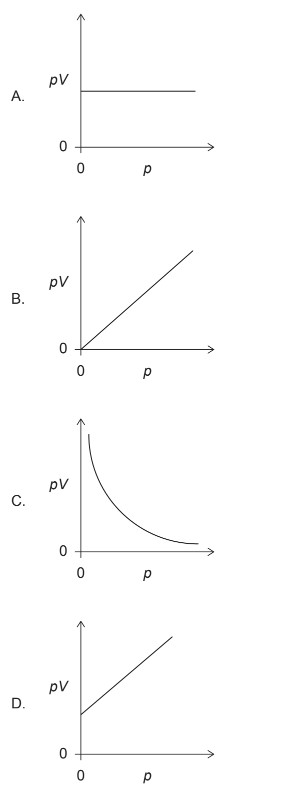
For a fixed mass of an ideal gas at constant temperature, Boyle’s Law states that:
\[ pV = \text{constant} \]
Since the product \(pV\) is constant, its value does not change as \(p\) changes. Therefore, a graph of \(pV\) (vertical axis) against \(p\) (horizontal axis) must be a horizontal line.
Among the given graphs, the only one that shows a constant value of \(pV\) as \(p\) increases is option (A).
✅ Answer: (A)