
Modelling the Economy
Economic models are simplified representations of reality used to understand how an economy functions. They help economists analyse relationships between different variables and predict the effects of changes in the economy.
One of the most important models in economics is the circular flow of income model, which shows how income and spending move between different sectors of the economy.
Model = Simplified representation of economic reality
Key Ideas:
- Models simplify complex economic interactions.
- They focus on key relationships and ignore less important details.
- Used to explain, analyse, and predict economic behaviour.
- The circular flow model shows the interdependence of economic agents.
The Circular Flow of Income Model
The circular flow of income model shows how money, goods, and services flow between households and firms in an economy. It highlights the continuous movement of income and expenditure.
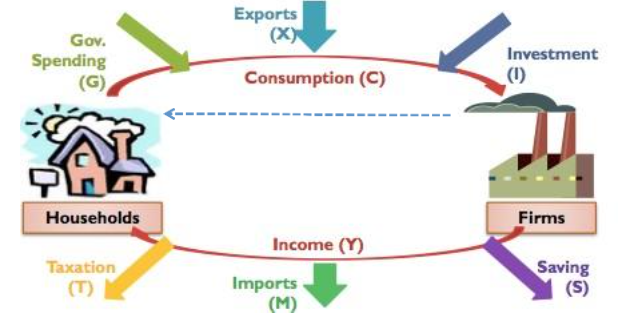
Basic Two-Sector Model:
- Households provide factors of production (labour, land, capital, entrepreneurship).

- Firms use these factors to produce goods and services.
- Households receive income (wages, rent, interest, profit).
- Households spend income on goods and services produced by firms.
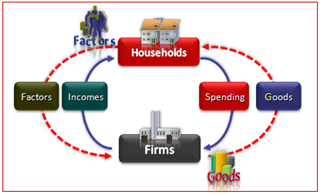
Households → Factors → Firms → Goods → Households
Real Flow and Money Flow:
| Flow Type | Description | Direction |
|---|---|---|
| Real Flow | Flow of goods, services, and factors of production | Households ↔ Firms |
| Money Flow | Flow of income and expenditure | Firms ↔ Households |
Leakages and Injections
In a more realistic model, the circular flow includes leakages and injections, which affect the level of economic activity.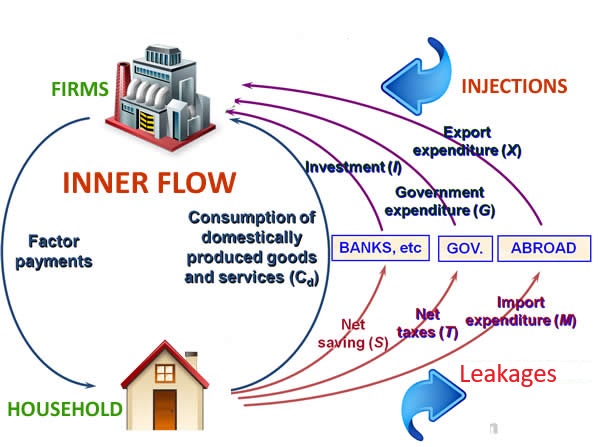
- Leakages — Withdrawal of income from the flow:
- Savings (S)
- Taxes (T)
- Imports (M)
- Injections — Additions to the flow:
- Investment (I)
- Government spending (G)
- Exports (X)
Equilibrium: Injections = Leakages
Key Ideas:
- The circular flow shows interdependence between sectors.
- Income = Expenditure = Output in equilibrium.
- Changes in injections or leakages affect economic activity.
- Used to understand national income and macroeconomic equilibrium.
Example 1
Explain the circular flow of income in a two-sector model.
▶️ Answer / Explanation
In a two-sector model, households provide factors of production to firms, such as labour.
Firms pay households wages, rent, interest, and profit, which is income.
Households then spend this income on goods and services produced by firms.
This creates a continuous circular flow of income and expenditure between households and firms.
Example 2
Using the circular flow model, explain how an increase in investment affects the economy.
▶️ Answer / Explanation
Investment is an injection into the circular flow of income.
An increase in investment increases spending in the economy, leading to higher demand for goods and services.
This encourages firms to increase production and hire more workers, increasing income.
As income rises, consumption also increases, further boosting economic activity.
Thus, increased investment leads to economic expansion.
Interdependence Between Economic Decision-Makers
In an economy, different groups of decision-makers interact continuously, creating a system of interdependence. This means that the actions of one group affect others, and all sectors rely on each other for the smooth functioning of the economy.
The main economic decision-makers are: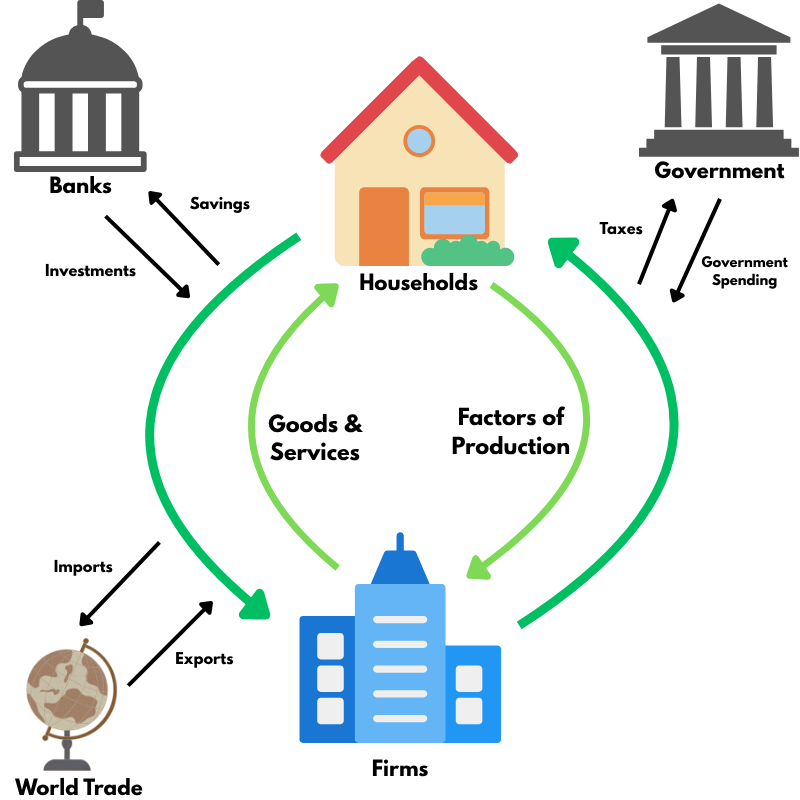
- Households
- Firms
- Government
- Banks and financial sector
- Foreign sector
Economy = Network of interdependent decision-makers
Key Ideas:
- All sectors are connected through flows of income, spending, and resources.
- A change in one sector creates ripple effects across the economy.
- Interdependence increases with globalization.
- Understanding these links is essential for analysing economic outcomes.
Households
Households are individuals or groups who provide factors of production and consume goods and services.
- Provide labour and other resources to firms.
- Receive income in the form of wages, rent, interest, and profit.
- Spend income on goods and services.
- Save money in banks and pay taxes to the government.
Firms
Firms are producers of goods and services in the economy.
- Hire factors of production from households.
- Produce goods and services for consumers.
- Pay wages and other incomes to households.
- Borrow from banks and pay taxes to the government.
Government
The government influences economic activity through policies and regulation.
- Collects taxes from households and firms.
- Provides public goods and services.
- Redistributes income to improve equity.
- Regulates economic activity and intervenes when necessary.
Banks and Financial Sector
The financial sector facilitates the flow of funds in the economy.
- Accepts savings from households.
- Provides loans and credit to firms and individuals.
- Supports investment and economic growth.
- Channels funds from savers to borrowers.
Foreign Sector
The foreign sector includes economic interactions with other countries.
- Exports goods and services to other countries.
- Imports goods and services from abroad.
- Allows access to wider markets and resources.
- Creates global interdependence between economies.
Interactions Between Economic Agents:
| Agents | Type of Interaction | Example |
|---|---|---|
| Households–Firms | Labour and wages; goods and spending | Workers earn wages and buy products |
| Firms–Banks | Loans and investment | Firm borrows to expand production |
| Government–Households | Taxes and public services | Income tax and free education |
| Domestic–Foreign Sector | Trade (exports and imports) | Importing oil from another country |
Example 1
Explain how households and firms are interdependent.
▶️ Answer / Explanation
Households provide factors of production such as labour to firms.
Firms use these resources to produce goods and services and pay wages and other incomes to households.
Households then use this income to purchase goods and services from firms.
This creates a continuous cycle of income and expenditure, showing interdependence.
Example 2
Using an example, explain how the foreign sector creates interdependence between countries.
▶️ Answer / Explanation
The foreign sector creates interdependence through trade between countries.
For example, a country may import oil from another country because it lacks sufficient domestic supply.
If the exporting country reduces supply, the importing country faces higher prices and shortages.
This shows that countries depend on each other for resources, making their economies interconnected.
Leakages and Injections
In the circular flow of income, leakages and injections are flows that affect the level of economic activity in an economy. They determine whether the economy expands, contracts, or remains in equilibrium.
Leakages reduce the flow of income, while injections add to it.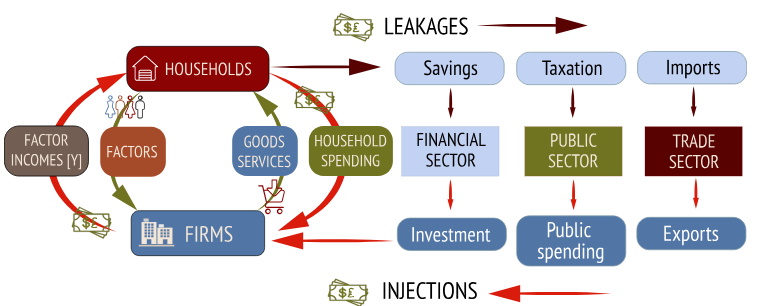
Equilibrium: Total Injections = Total Leakages
Key Ideas:
- Leakages withdraw income from the circular flow.
- Injections add income into the circular flow.
- The balance between them determines economic stability.
- Disequilibrium leads to changes in national income.
Leakages (Withdrawals)
Leakages are outflows of income from the circular flow that reduce spending in the economy.
- Savings (S) — Income not spent on consumption and saved in banks.
- Taxes (T) — Income taken by the government.
- Imports (M) — Spending on goods and services from abroad.
Leakages = S + T + M
Injections
Injections are additions of income into the circular flow that increase spending in the economy.
- Investment (I) — Spending by firms on capital goods.
- Government Spending (G) — Expenditure on public goods and services.
- Exports (X) — Income earned from selling goods and services abroad.
Injections = I + G + X
Equilibrium in the Circular Flow
The economy is in equilibrium when:
Injections = Leakages
- If injections > leakages → Economic activity increases (expansion).
- If leakages > injections → Economic activity decreases (contraction).
Comparison of Leakages and Injections:
| Aspect | Leakages | Injections |
|---|---|---|
| Definition | Withdraw income from the economy | Add income to the economy |
| Components | Savings, Taxes, Imports | Investment, Government Spending, Exports |
| Effect | Reduce economic activity | Increase economic activity |
Example 1
Explain what happens when injections are greater than leakages.
▶️ Answer / Explanation
When injections exceed leakages, more income is being added to the circular flow than withdrawn.
This leads to increased spending in the economy, encouraging firms to produce more goods and services.
As production increases, firms may hire more workers, increasing income and consumption.
This results in economic expansion and growth in national income.
Example 2
Using an example, explain how an increase in imports affects the circular flow of income.
▶️ Answer / Explanation
Imports are a leakage because they represent spending on foreign goods rather than domestic production.
For example, if consumers increase their demand for imported electronics, money flows out of the domestic economy.
This reduces income for domestic firms, leading to lower production and possibly fewer jobs.
Thus, an increase in imports reduces the circular flow of income and may slow economic activity.