
Opportunity Cost
Opportunity cost is the value of the next best alternative forgone when a choice is made. Since resources are scarce, choosing one option means giving up another, and this forgone alternative represents the true cost of the decision.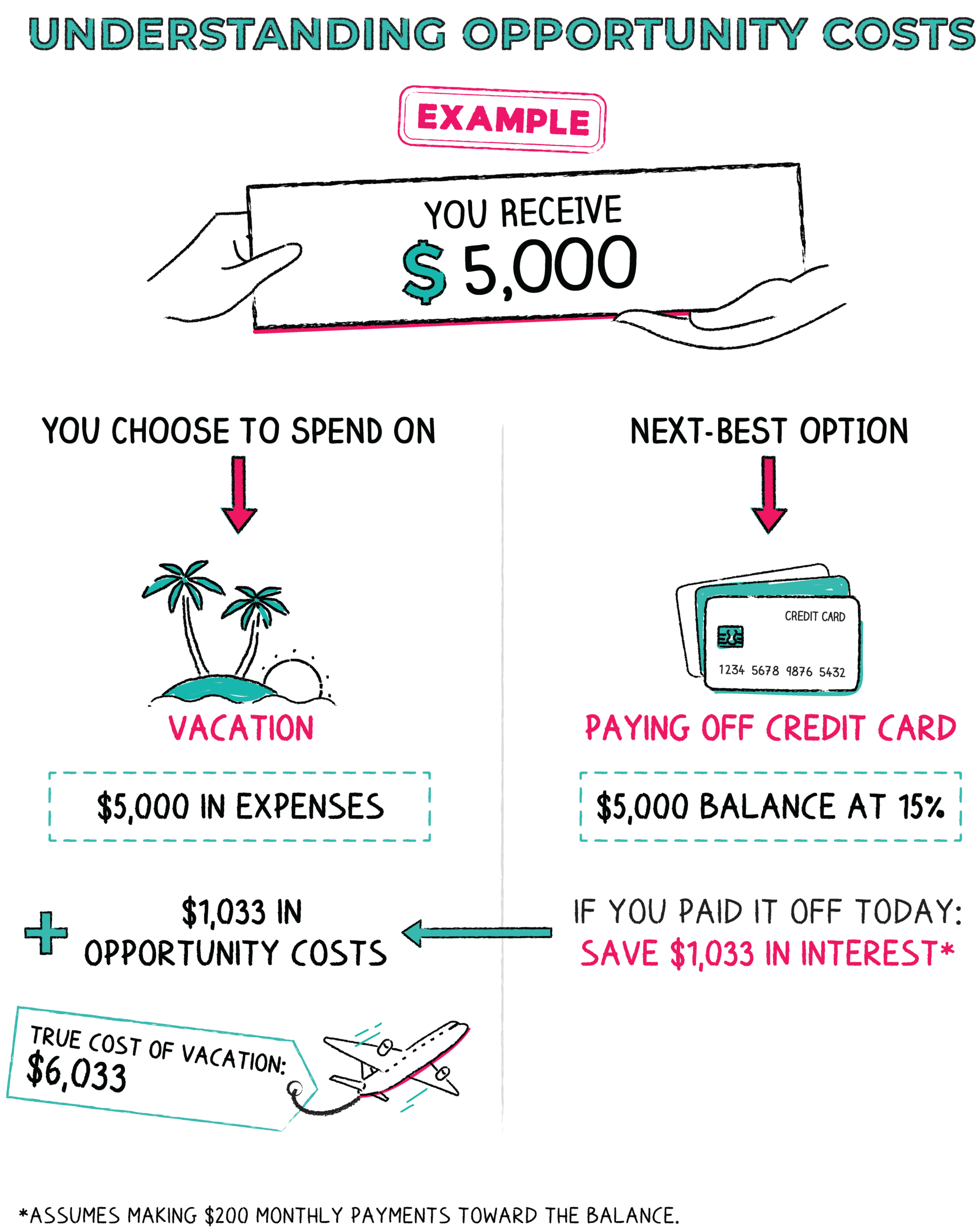
Opportunity cost is not always measured in money , it can include time, benefits, or satisfaction that could have been gained from the next best option.
This includes:
- Cost of choice : Every decision involves a trade-off.
- Next best alternative : Only the most valuable forgone option is considered.
- Non-monetary costs : Time, effort, or utility may also be sacrificed.
Opportunity Cost = Value of next best alternative forgone
Key Ideas:
- Opportunity cost arises due to scarcity.
- It applies to consumers, firms, and governments.
- Rational decision-making involves comparing benefits and opportunity costs.
- It is central to understanding economic efficiency.
Opportunity Cost as the Cost of Choice
In economics, the real cost of any decision is not just the financial expense but the opportunity cost. This highlights the importance of considering what is sacrificed when making choices.
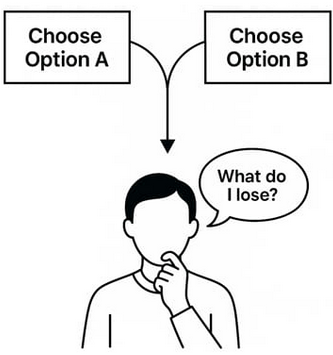
- Choosing more of one good means producing or consuming less of another.
- Governments face opportunity costs when allocating budgets.
- Firms consider opportunity costs when deciding production methods.
Free Goods
Free goods are goods that are not scarce and therefore have zero opportunity cost. Since they are available in abundance, using them does not require giving up another alternative.
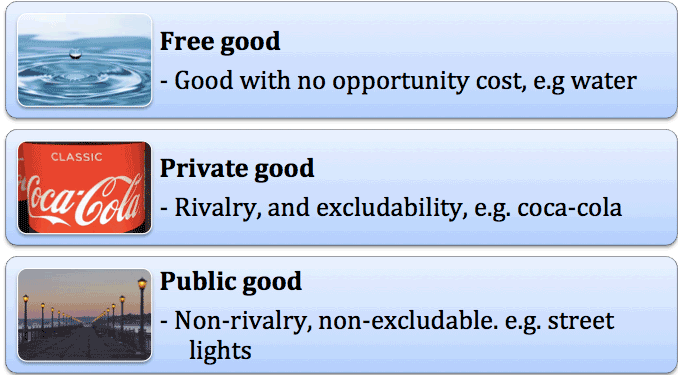
- Examples include air or sunlight (in most contexts).
- They are not priced in markets because they are not scarce.
- If a free good becomes scarce, it may gain an opportunity cost and become an economic good.
Free Goods → No scarcity → No opportunity cost
Comparison: Economic Goods vs Free Goods
| Aspect | Economic Goods | Free Goods |
|---|---|---|
| Scarcity | Scarce | Not scarce |
| Opportunity Cost | Positive | Zero |
| Price | Has a price | No price |
| Example | Food, cars, education | Air, sunlight |
Example 1
Explain the concept of opportunity cost using an example.
▶️ Answer / Explanation
Opportunity cost is the value of the next best alternative forgone when a choice is made.
For example, if a student chooses to study for an exam instead of working part-time, the opportunity cost is the income that could have been earned from working.
This shows that the real cost of the decision is not just studying, but the benefit that was sacrificed.
Example 2
Using an example, explain why free goods have no opportunity cost.
▶️ Answer / Explanation
Free goods are not scarce, so consuming them does not require giving up another alternative.
For example, in most cases, air is freely available in unlimited quantity. Using air for breathing does not prevent others from using it, and no alternative is sacrificed.
Therefore, the opportunity cost of using air is zero.
However, if air becomes scarce (such as in polluted cities requiring oxygen cylinders), it may gain an opportunity cost and become an economic good.