
Advantages of Large Firms with Significant Market Power (HL)
1. Economies of Scale (Including Natural Monopolies)
Economies of scale occur when a firm’s average cost (AC) falls as output increases. Large firms with significant market power can benefit from producing on a large scale, reducing costs and increasing efficiency.
Higher output → Lower average cost → Greater efficiency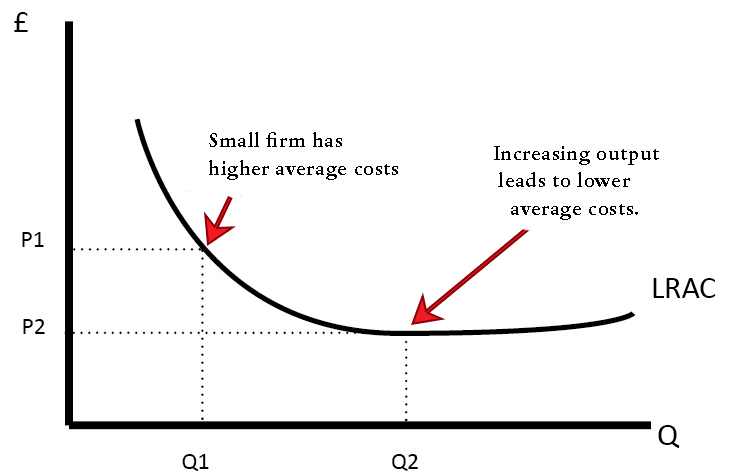
Explanation:
- Large firms can spread fixed costs over a greater level of output.
- They can invest in advanced technology and machinery.
- They benefit from specialization of labour.
- They may receive bulk purchasing discounts for inputs.
Types of Economies of Scale:
- Technical — use of efficient machinery and production methods.
- Managerial — specialization of management roles.
- Purchasing — buying inputs in bulk at lower prices.
- Financial — easier access to cheaper finance.
Natural Monopoly Connection:
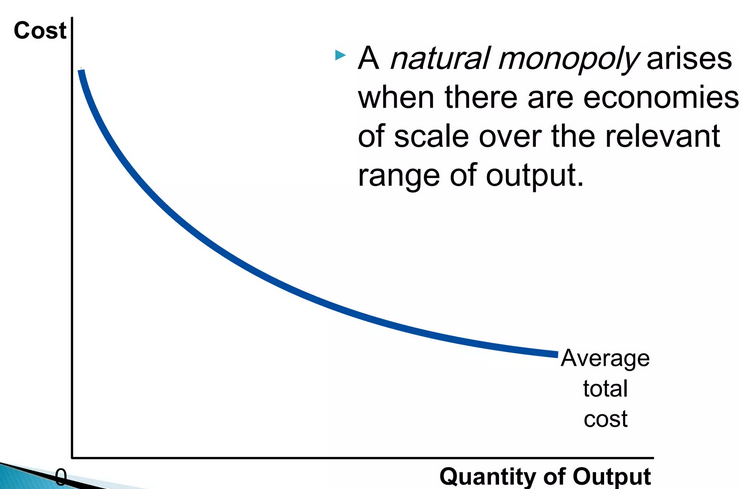
- In some industries, economies of scale are so large that one firm can supply the entire market at the lowest cost.
- This leads to a natural monopoly.
- Example industries include utilities such as electricity and water supply.
Advantages for Society:
- Lower costs of production
- Potentially lower prices for consumers
- Efficient use of resources
- Avoidance of duplication of infrastructure (in natural monopolies)
Economic Logic:
- Large-scale production leads to productive efficiency (minimum AC).
- Natural monopolies can be efficient in terms of cost, even if they have market power.
Evaluation:
- While costs are lower, firms may still charge high prices due to market power.
- Benefits depend on whether cost savings are passed on to consumers.
- Natural monopolies often require regulation.
Example 1
Explain how economies of scale reduce costs for large firms.
▶️ Answer / Explanation
Large firms spread fixed costs over more output.
They use efficient machinery and buy inputs in bulk.
This reduces average cost.
Thus, economies of scale improve efficiency.
Example 2
Evaluate whether natural monopolies are beneficial.
▶️ Answer / Explanation
Natural monopolies benefit from low costs due to economies of scale.
This makes production efficient.
However, they may charge high prices due to lack of competition.
Thus, they are efficient but may need regulation.
2. Abnormal Profits and Investment in Research & Development (R&D)
Firms with significant market power can earn abnormal (supernormal) profits, which can be used to finance research and development (R&D), leading to innovation.
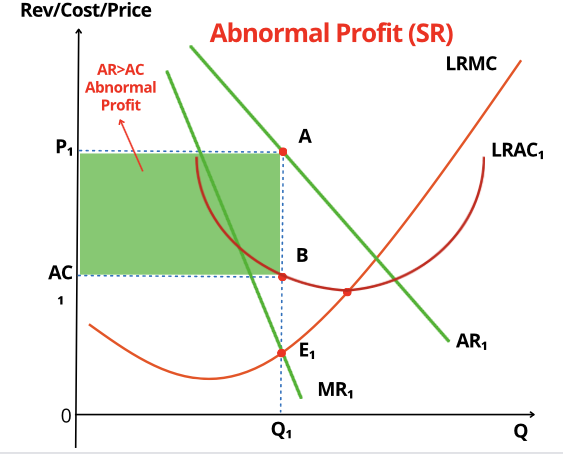
Abnormal profit → Investment in R&D → Innovation
Explanation:
- Large firms generate high profits due to limited competition.
- These profits provide funds for research, experimentation, and new technologies.
- R&D can lead to new products or improved production methods.
- This increases efficiency and competitiveness.
Types of Innovation:
- Product innovation — development of new or improved goods.
- Process innovation — improved methods of production, reducing costs.
Advantages for Society:
- Better quality products
- Technological progress
- Lower costs in the long run
- Economic growth and productivity improvement
HL Insight:
- Innovation requires significant funding and risk-taking.
- Only firms with abnormal profits can sustain long-term R&D investment.
- This links market power with dynamic efficiency (innovation over time).
Evaluation:
- Market power may encourage innovation due to available funds.
- However, lack of competition may reduce the incentive to innovate.
- Firms may become complacent without competitive pressure.
- Thus, innovation depends on the balance between profit incentives and competition.
Example 1
Explain how abnormal profits can lead to innovation.
▶️ Answer / Explanation
Firms earning abnormal profits have extra funds.
They can invest in research and development.
This leads to new products or better production methods.
Thus, innovation occurs.
Example 2
Evaluate whether market power always promotes innovation.
▶️ Answer / Explanation
Market power provides funds for R&D, encouraging innovation.
However, lack of competition may reduce the need to innovate.
Firms may become inefficient or complacent.
Thus, market power can both support and limit innovation.