
Assumptions Underlying the Law of Demand (HL)
The law of demand depends on key behavioural assumptions that explain why consumers buy more at lower prices and less at higher prices. These include the income effect, substitution effect, and the law of diminishing marginal utility.
The Income Effect
The income effect refers to the change in quantity demanded of a good caused by a change in its price, which affects the consumer’s real income (purchasing power).
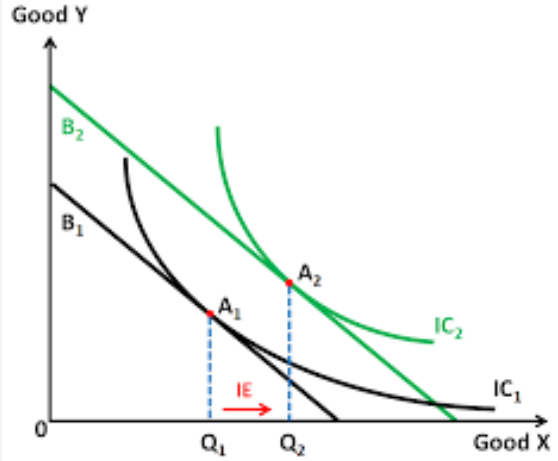
- When the price of a good falls, consumers can afford to buy more with the same income, so real income increases.
- When the price rises, real income falls, reducing purchasing power.
- For normal goods, demand increases when real income rises.
- For inferior goods, demand may decrease when real income rises.
- The income effect is stronger for goods that take up a large proportion of income.
Price ↓ → Real income ↑ → Quantity demanded ↑
HL Insight:
- For normal goods, income effect reinforces the law of demand.
- For inferior goods, it may partially offset the substitution effect.
- In rare cases (Giffen goods), it may dominate and reverse the law of demand.
The Substitution Effect
The substitution effect occurs when a change in price alters the relative price of a good compared to its substitutes, leading consumers to switch consumption.
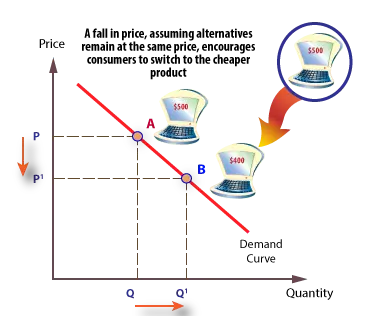
- If the price of a good falls, it becomes relatively cheaper than substitutes.
- Consumers substitute away from relatively expensive goods toward the cheaper good.
- If the price rises, consumers switch to alternatives.
- This effect always moves in the opposite direction of price.
Price ↓ → Good relatively cheaper → Quantity demanded ↑
HL Insight:
- The substitution effect is always negative (inverse relationship).
- It is the main reason why the demand curve slopes downward.
- Works for all goods, regardless of type.
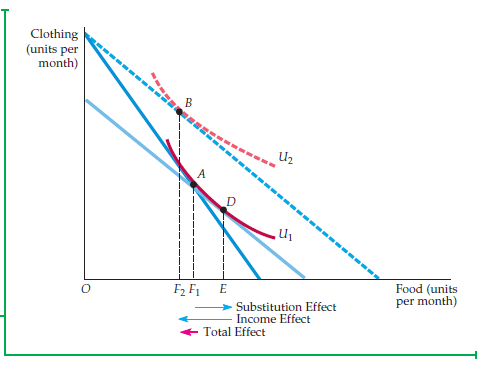
Income and Substitution Effects – Normal Good
A decrease in the price of a good (food) leads to both substitution and income effects.
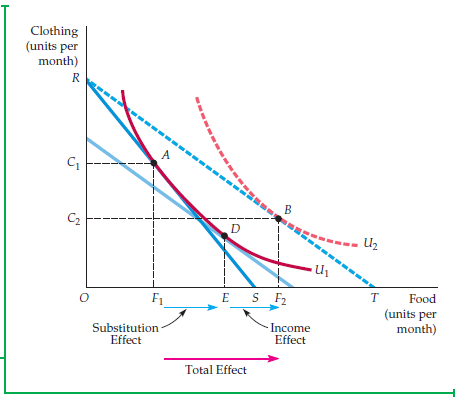
- The consumer is initially at point A on budget line RS.
- When the price of food falls, consumption increases from F₁ to F₂, moving to point B.
- Substitution effect (F₁E): Movement from A to D, where food becomes relatively cheaper and real income (satisfaction) is kept constant.
- Income effect (EF₂): Movement from D to B, where purchasing power increases.
- For a normal good, the income effect is positive.
Total effect = Substitution effect + Income effect
Income and Substitution Effects – Inferior Good
When the good is inferior, the income effect works in the opposite direction to the substitution effect.
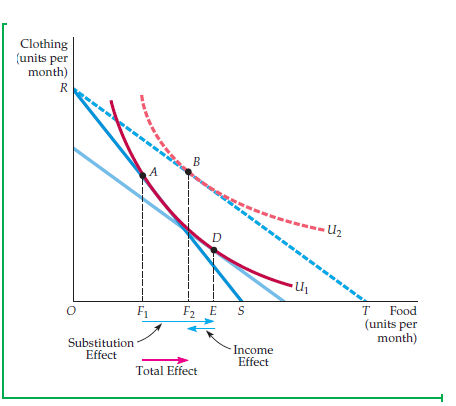
- The consumer starts at point A on budget line RS.
- After a fall in price, the consumer moves to point B.
- The total change in demand is divided into:
- Substitution effect (F₁E): Movement from A to D, increasing quantity demanded.
- Income effect (EF₂): Movement from D to B, which is negative for inferior goods.
- Although the income effect reduces demand, the substitution effect is stronger.
- Therefore, total demand still increases when price falls.
Upward-Sloping Demand Curve – Giffen Good
In the case of a Giffen good, the income effect is so strong that it outweighs the substitution effect.
- The consumer starts at point A.
- After a fall in price, the consumer moves to point B.
- Substitution effect (F₁E): Increases quantity demanded.
- Income effect (EF₂): Strong negative effect reduces demand significantly.
- The income effect is greater than the substitution effect.
- As a result, quantity demanded falls when price falls.
Giffen good → Income effect > Substitution effect → Upward-sloping demand curve
The Law of Diminishing Marginal Utility
The law of diminishing marginal utility states that as a consumer consumes more units of a good, the additional satisfaction (marginal utility) gained from each extra unit decreases.
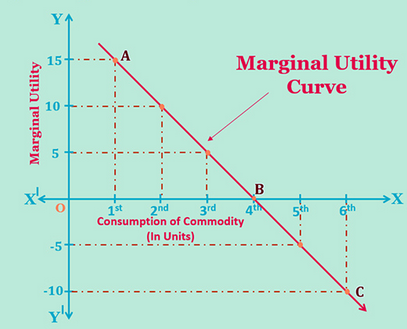
- The first unit provides high satisfaction.
- Each additional unit provides less additional satisfaction.
- Consumers are only willing to buy extra units if the price falls.
- This explains why demand curves slope downward.
More consumption → Lower marginal utility → Lower willingness to pay
Total Utility and Marginal Utility
Total utility (TU) is the total satisfaction a consumer gains from consuming a certain quantity of a good.
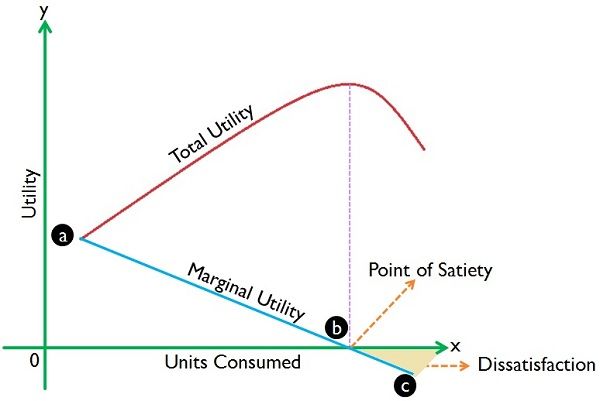
Marginal utility (MU) is the additional satisfaction gained from consuming one more unit of the good.
- Total utility increases at a decreasing rate as more units are consumed.
- Marginal utility decreases with each additional unit.
- When marginal utility becomes zero, total utility is maximum.
- If marginal utility becomes negative, total utility starts to fall.
MU = Change in TU from consuming one more unit
Relationship Between Total Utility and Marginal Utility:
| Units Consumed | Total Utility (TU) | Marginal Utility (MU) |
|---|---|---|
| 1 | High increase | Very high |
| 2 | Increases | Lower than before |
| 3 | Increases at decreasing rate | Further decreases |
| 4 | Maximum | Zero |
| 5 | Decreases | Negative |
HL Insight:
- Consumers maximize satisfaction where marginal utility equals price.
- As marginal utility falls, consumers require lower prices to consume more.
- This relationship provides a microeconomic foundation for the downward-sloping demand curve.
Overall Relationship
| Concept | Direction of Effect | Role in Law of Demand |
|---|---|---|
| Income Effect | Usually negative (price ↓ → demand ↑) | Supports or modifies demand behaviour |
| Substitution Effect | Always negative | Main reason for downward slope |
| Diminishing Marginal Utility | Leads to lower willingness to pay | Explains consumer behaviour |
Key Point:
- All three concepts together explain the downward-sloping demand curve.
- The substitution effect always supports the law of demand.
- The income effect varies depending on the type of good.
- Diminishing marginal utility explains why consumers value additional units less.
Example 1
Explain how the income and substitution effects together lead to the law of demand.
▶️ Answer / Explanation
When the price of a good falls, it becomes relatively cheaper compared to substitutes, causing consumers to switch toward it. This is the substitution effect.
At the same time, the fall in price increases consumers’ real income, allowing them to buy more. This is the income effect.
Both effects together increase quantity demanded when price falls, supporting the law of demand.
Example 2
Using an example, explain the law of diminishing marginal utility.
▶️ Answer / Explanation
When a consumer eats slices of pizza, the first slice provides high satisfaction.
As more slices are consumed, each additional slice provides less satisfaction.
Therefore, the consumer is only willing to buy more slices if the price decreases.
This demonstrates diminishing marginal utility and explains the downward-sloping demand curve.