
Assumptions Underlying the Law of Supply (HL)
The Law of Diminishing Marginal Returns
The law of diminishing marginal returns states that as more units of a variable factor of production (such as labour) are added to a fixed factor (such as capital), the additional output (marginal product) produced by each extra unit of the variable factor will eventually decrease.
This concept is fundamental in explaining why the supply curve slopes upward.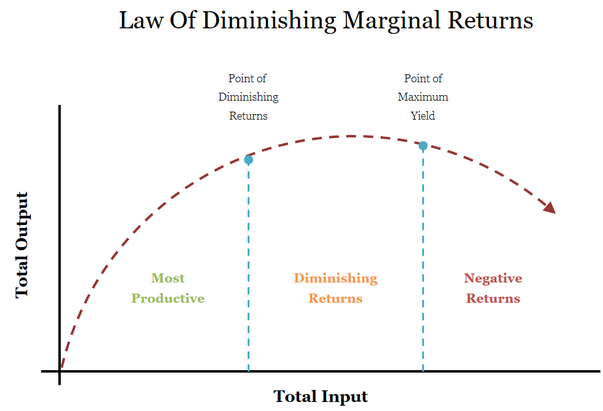
Explanation:
- In the short run, at least one factor of production is fixed.
- Initially, adding more workers increases output significantly due to better use of resources.
- After a certain point, additional workers contribute less and less extra output.
- This happens because fixed factors become overcrowded or overused.
More variable input → Smaller increase in output
Link to the Law of Supply:
- As marginal product decreases, firms must use more inputs to produce additional output.
- This increases the cost of producing extra units.
- Firms will only supply more if they receive a higher price.
- This creates the positive relationship between price and quantity supplied.
Illustrative Example:
- A factory has a fixed number of machines.
- As more workers are hired, output increases initially.
- Eventually, workers start getting in each other’s way, and output per worker falls.
- To increase production further, costs rise, so firms require higher prices.
Key Ideas:
- Diminishing marginal returns occur in the short run.
- It explains why producing more becomes less efficient.
- Leads to higher marginal costs.
- Forms a key assumption behind the upward-sloping supply curve.
Example
Explain how diminishing marginal returns lead to an upward-sloping supply curve.
▶️ Answer / Explanation
As more units of a variable factor are added to fixed factors, marginal product eventually decreases.
This means more inputs are needed to produce additional output, increasing production costs.
Firms will only supply more output if prices rise to cover these higher costs.
Therefore, diminishing marginal returns lead to an upward-sloping supply curve.
Assumptions Underlying the Law of Supply (HL)
Increasing Marginal Costs
Increasing marginal costs refer to the situation where the cost of producing each additional unit of output rises as output increases. This is a key assumption explaining why firms are willing to supply more only at higher prices.
Explanation:
- Marginal cost (MC) is the additional cost of producing one more unit of output.

- Initially, firms may experience low or constant marginal costs.
- However, as production increases, marginal costs begin to rise.
- This occurs because of diminishing marginal returns and increasing inefficiencies.
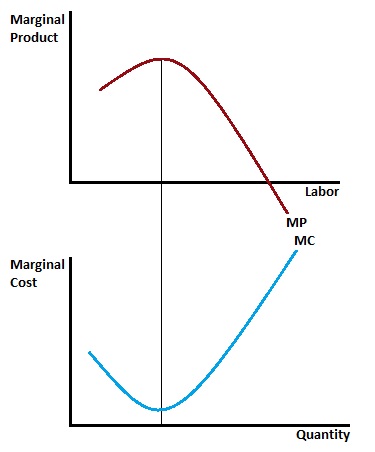
More output → Higher marginal cost
Reasons for Increasing Marginal Costs:
- Diminishing marginal returns — Additional inputs produce less output, raising cost per unit.
- Overutilization of fixed factors — Limited capital or space leads to inefficiencies.
- Higher input costs — Overtime wages or scarce resources increase production costs.
- Capacity constraints — Firms operating near full capacity face rising costs.
Link to the Law of Supply:
- As marginal costs rise, producing extra units becomes more expensive.
- Firms require higher prices to cover these additional costs.
- Therefore, firms are willing to supply more only at higher prices.
- This creates the direct relationship between price and quantity supplied.
MC ↑ → Price required ↑ → Quantity supplied ↑
Illustrative Example:
- A factory increases production by hiring more workers.
- Initially, costs rise slowly.
- As production expands further, workers become less efficient and overtime wages are paid.
- Each additional unit becomes more costly to produce.
- Firms will only continue increasing output if prices rise.
Key Ideas:
- Increasing marginal costs occur due to production constraints.
- They explain why supply curves are upward sloping.
- Closely linked to diminishing marginal returns.
- Essential for understanding firm behaviour and production decisions.
Example
Explain how increasing marginal costs lead to the law of supply.
▶️ Answer / Explanation
As a firm produces more output, marginal costs increase due to diminishing returns and inefficiencies.
This means producing additional units becomes more expensive.
Firms will only supply more output if prices rise to cover these higher costs.
Thus, increasing marginal costs result in an upward-sloping supply curve.