
Behavioural Economics in Action (HL)
Choice Architecture — Default, Restricted, and Mandated Choices
Choice architecture refers to the way in which choices are designed and presented to consumers, influencing their decisions without removing freedom of choice.
How choices are presented → Influences decisions
Explanation:
- Consumers do not always make fully rational decisions.
- The way options are structured can affect outcomes.
- Governments and firms use choice architecture to “nudge” behaviour.
- Nudges aim to improve decision-making without forcing choices.
1. Default Choices
Default choices are pre-selected options that take effect if the consumer does not actively choose otherwise.
Explanation:
- Consumers tend to stick with the default option due to inertia or convenience.
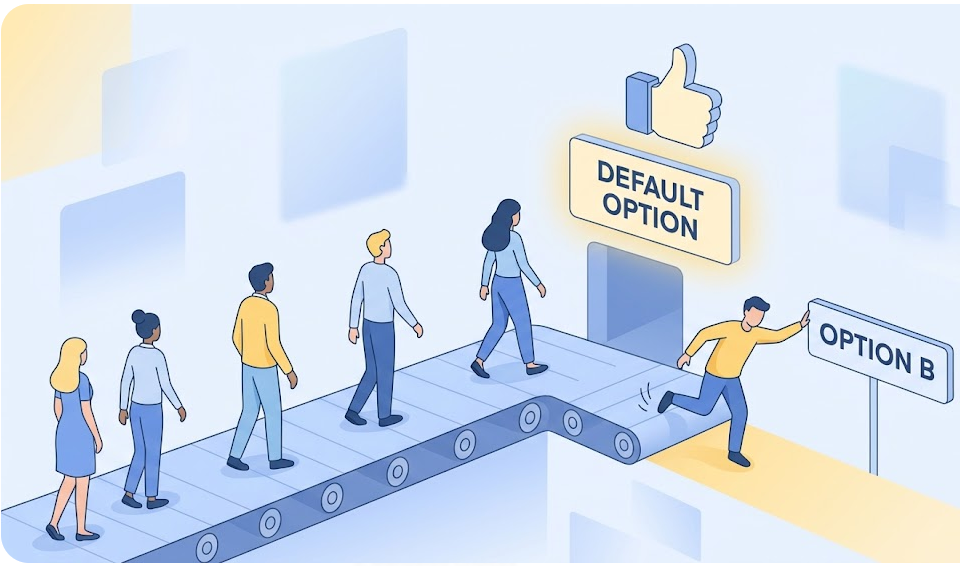
- Changing the default requires effort, so many people do not switch.
- This significantly influences behaviour while maintaining freedom of choice.
Why It Works:
- Linked to bounded rationality and decision fatigue.
- Consumers prefer the easiest option.
- Perceived as a recommended or “safe” choice.
Impact:
- Can increase participation in beneficial programs.
- Common in policies like automatic enrollment.
This illustration visualizes the concept of a pre-selected option. The consumer path (the conveyor belt) automatically guides the user toward the “Default Option,” which is already highlighted. While other paths (Option A and B) exist, they require an active effort to switch. The default choice is the path of least resistance.
2. Restricted Choices
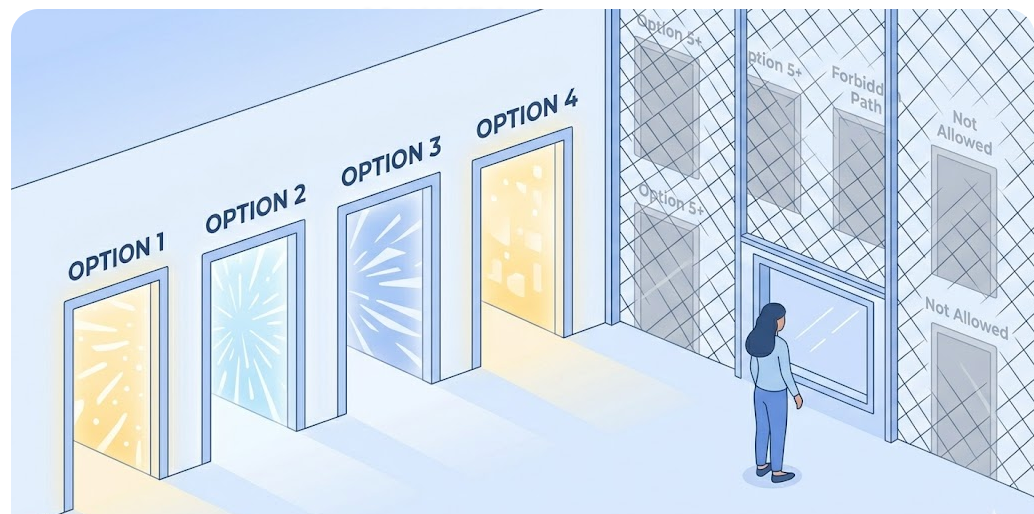
Restricted choices limit the number or type of options available to consumers.
Explanation:
- Consumers are not given full freedom of all possible choices.

- Options are narrowed to guide behaviour in a desired direction.
- Reduces complexity and decision overload.
Why It Works:
- Consumers struggle with too many choices.
- Limiting options simplifies decision-making.
- Encourages better or safer choices.
Impact:
- May improve outcomes (e.g. healthier food options).
- However, reduces consumer freedom.
For this concept, the image illustrates a visual filter. The environment (a museum setting) limits the type of options available. Instead of a overwhelming marketplace, the viewer is presented with a carefully curated selection (in this case, only ‘Art’ rather than ‘Sculpture’ or ‘Film’). The architecture itself acts as the restriction, focusing the decision-making field to a specific category.
3. Mandated Choices
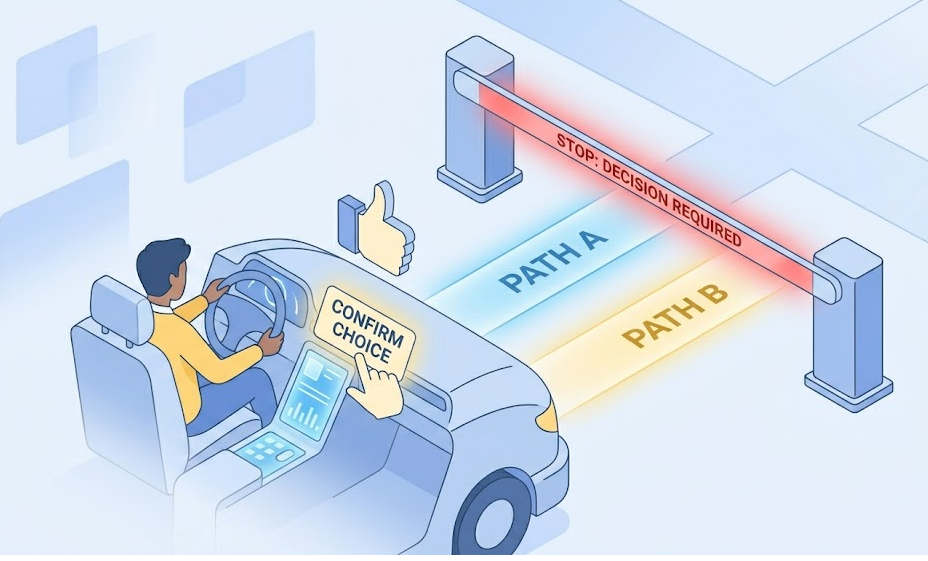
Mandated choices require consumers to actively make a decision before proceeding.
Explanation:
- No default option is provided.
- Consumers must explicitly choose between alternatives.
- Forces individuals to consider their decision carefully.
Why It Works:
- Prevents passive or uninformed decisions.
- Encourages active engagement.
- Reduces reliance on default bias.
Impact:
- Leads to more informed decision-making.
- However, may increase decision fatigue.
This image depicts a scenario where progress is impossible without a decision. The consumer (the driver) has reached a complete stop at a glowing barrier. They are presented with two distinct, equal paths (A and B). The illustration emphasizes the requirement to choose: a decision must be made actively before the driver can proceed. The barrier remains locked until one path is selected.
Economic Significance:
- Choice architecture helps correct behavioural biases.
- Used in public policy to improve outcomes (e.g. health, savings).
- Balances freedom of choice with guided decision-making.
Key Differences:
| Type | Definition | Level of Freedom |
|---|---|---|
| Default | Pre-selected option | High (can opt out) |
| Restricted | Limited options available | Reduced |
| Mandated | Must actively choose | High but forced decision |
Key Ideas:
- Choice architecture influences decisions without removing choice.
- Default, restricted, and mandated choices guide behaviour differently.
- Important tool in behavioural economics and policy design.
- Helps improve decision-making in the presence of biases.
Example 1
Explain how default choices influence consumer behaviour.
▶️ Answer / Explanation
Default choices are pre-selected options that apply if consumers do not change them.
Many consumers stick with defaults due to convenience or inertia.
This influences behaviour without restricting freedom.
For example, automatic enrollment in pension schemes increases participation.
Example 2
Evaluate the effectiveness of restricted choices in improving consumer decisions.
▶️ Answer / Explanation
Restricted choices reduce the number of options available to consumers.
This simplifies decision-making and reduces confusion.
It can lead to better outcomes, such as healthier food choices.
However, it limits freedom and may not suit all consumers.
Thus, it is effective but involves a trade-off between efficiency and choice.
Nudge Theory (HL)
Definition
Nudge theory refers to the use of subtle changes in choice architecture to influence consumer behaviour in a predictable way, without restricting freedom of choice.
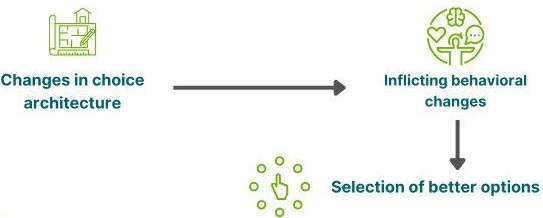
Nudge → Influence behaviour without force
Explanation:
- Nudges guide people toward better decisions while keeping all options available.
- They take advantage of behavioural biases such as inertia and framing.
- Used by governments and firms to improve outcomes in areas like health, savings, and environment.
Key Features of Nudges: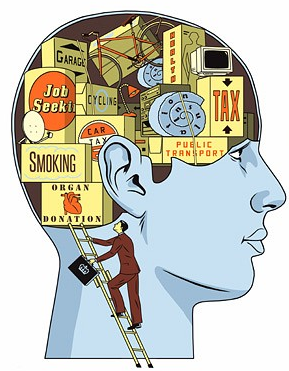
- Non-coercive — do not force decisions.
- Preserve freedom of choice — individuals can opt out.
- Low-cost interventions — easy to implement.
- Based on insights from behavioural economics.
Types of Nudges (Link to Choice Architecture):
- Default nudges — automatic enrollment in pension schemes.
- Framing nudges — presenting information in a positive or negative way.
- Salience nudges — highlighting important information.
- Social norm nudges — showing what others are doing.
Examples of Nudge Theory:
- Placing healthy food at eye level to encourage better eating choices.
- Automatic savings plans to increase retirement savings.
- Energy bills comparing usage with neighbours to reduce consumption.
Economic Logic :
- Nudges correct for bounded rationality and biases.
- They help individuals make decisions closer to their long-term best interest.
- They improve outcomes without heavy government intervention.
Advantages of Nudge Theory:
- Maintains individual freedom.
- Cost-effective and easy to implement.
- Can significantly improve decision-making.
- Useful in addressing market failures.
Limitations (Evaluation):
- May be seen as manipulative or paternalistic.
- Effectiveness depends on design and context.
- Does not fully solve deeper structural problems.
- Some consumers may ignore nudges.
Example 1
Explain how nudge theory can improve consumer decision-making.
▶️ Answer / Explanation
Nudge theory uses subtle changes in how choices are presented.
For example, setting automatic enrollment in pension schemes increases savings.
Consumers are guided toward better decisions without being forced.
This improves outcomes while maintaining freedom of choice.
Example 2
Evaluate the effectiveness of nudge theory as a policy tool.
▶️ Answer / Explanation
Nudge theory is effective because it influences behaviour at low cost and preserves freedom.
It can improve outcomes in areas such as health and savings.
However, it may be seen as manipulative and may not work for all individuals.
It also does not address deeper economic issues.
Thus, it is useful but not a complete solution.