
Business Objectives (HL)
Profit Maximization
Profit maximization is the primary objective of many firms, where the firm aims to produce the level of output that generates the maximum possible profit.
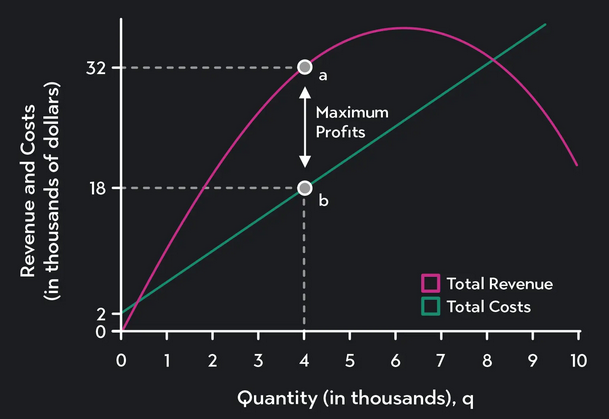
Profit = Total Revenue − Total Cost
Explanation:
- Firms seek to maximize the difference between total revenue (TR) and total cost (TC).

- Profit is highest at the output level where this difference is greatest.
- This objective assumes firms are rational and aim to achieve the best financial outcome.
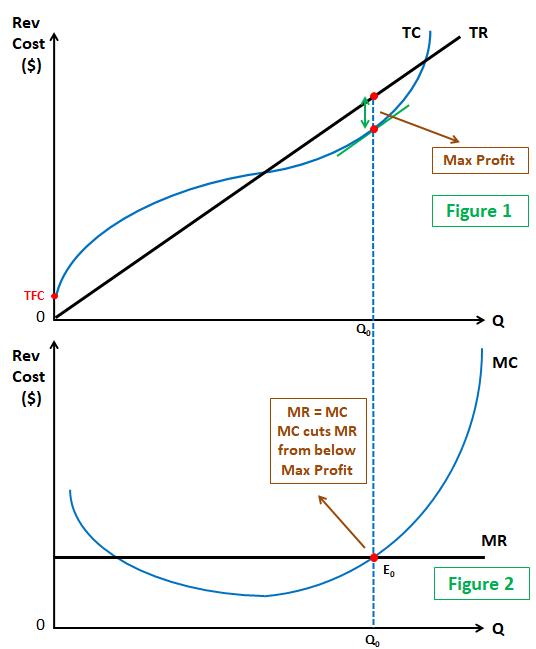
Profit Maximization Condition (HL):
MR = MC
- Marginal revenue (MR) is the additional revenue from selling one more unit.
- Marginal cost (MC) is the additional cost of producing one more unit.
- Profit is maximized when MR equals MC.
Why MR = MC Maximizes Profit:
- If MR > MC, producing more increases profit.
- If MR < MC, producing more reduces profit.
- Therefore, the optimal output occurs where MR = MC.
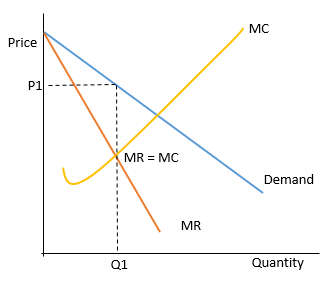
MR > MC → Increase output
MR < MC → Decrease output
Assumptions:
- Firms have the goal of maximizing profit.
- They have sufficient information about costs and revenue.
- They operate in a rational manner.
Short Run vs Long Run:
- In the short run, firms may earn abnormal or normal profit.
- In the long run, profits may be competed away in highly competitive markets.
Limitations (Evaluation):
- Not all firms aim to maximize profit (e.g. social enterprises).
- Managers may pursue revenue maximization or growth instead.
- Separation of ownership and control may lead to different objectives.
- Behavioural factors may limit perfect decision-making.
Example 1
Explain why a firm produces at the level where MR equals MC.
▶️ Answer / Explanation
A firm maximizes profit where marginal revenue equals marginal cost.
If MR is greater than MC, producing more increases profit.
If MR is less than MC, producing more reduces profit.
Thus, MR = MC gives the profit-maximizing output.
Example 2
Evaluate the realism of profit maximization as a business objective.
▶️ Answer / Explanation
Profit maximization assumes firms aim to achieve the highest possible profit.
However, in reality, firms may pursue other objectives such as growth or market share.
Managers may have different goals from owners.
Behavioural factors also limit perfect decision-making.
Thus, while useful for theory, it may not always reflect real-world behaviour.
Alternative Business Objectives (HL)
While profit maximization is a key objective, many firms pursue alternative objectives depending on their goals, market conditions, and stakeholder interests.
1. Corporate Social Responsibility (CSR)
Corporate social responsibility (CSR) refers to firms aiming to operate in a way that is socially and environmentally responsible, beyond just making profit.
Explanation:
- Firms consider the impact of their actions on society and the environment.
- They may reduce pollution, improve working conditions, or support communities.
- Profit is still important but balanced with ethical considerations.
- Often linked to long-term sustainability.
Why Firms Pursue CSR:
- Improve brand image and reputation.
- Respond to consumer and government pressure.
- Achieve long-term profitability.
Impact:
- May increase costs in the short run.
- Can improve demand and loyalty in the long run.
- Helps address market failures such as negative externalities.
2. Market Share
Market share refers to the proportion of total sales in a market that a firm controls.
Explanation: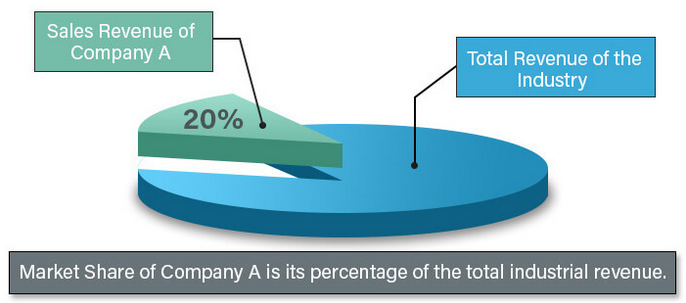
- Firms aim to increase their share of the market.
- May involve lowering prices, advertising, or improving quality.
- Often prioritizes sales volume over short-term profit.
- Important in competitive industries.
Why Firms Pursue Market Share:
- Achieve economies of scale.
- Increase market power.
- Discourage entry of competitors.
Impact:
- May reduce profit in the short run.
- Can lead to higher profits in the long run.
- Strengthens competitive position.
3. Satisficing
Satisficing refers to firms aiming for a satisfactory level of profit, rather than maximum profit.
Explanation:
- Firms set a minimum acceptable level of profit.
- Once achieved, they may pursue other objectives.
- Reflects bounded rationality and managerial behaviour.
- Common in large firms with separation of ownership and control.

Why Firms Satisfice:
- Managers may prioritize job security or stability.
- Reduce risk and uncertainty.
- Avoid pressure of maximizing profit.
Impact:
- Less aggressive competition.
- Stable but not optimal outcomes.
- May lead to inefficiency.
4. Growth
Growth refers to firms aiming to expand in terms of size, output, or market presence.
Explanation:
- Firms reinvest profits to increase capacity or enter new markets.
- Growth may be internal (expansion) or external (mergers/acquisitions).
- Often prioritized over short-term profit.
- Linked to long-term success and competitiveness.

Why Firms Pursue Growth:
- Increase market power.
- Benefit from economies of scale.
- Enhance brand recognition.
Impact:
- Short-term profits may decrease.
- Long-term profitability may increase.
- Can lead to market dominance.
Key Ideas:
- Firms do not always maximize profit.
- Objectives vary based on goals and conditions.
- Different objectives involve trade-offs.
- Important for analysing real-world firm behaviour.
Example 1
Explain why a firm might prioritize market share over profit.
▶️ Answer / Explanation
A firm may lower prices to increase sales and capture a larger market share.
This reduces short-term profit but increases long-term competitiveness.
Higher market share can lead to economies of scale and higher future profits.
Example 2
Evaluate the importance of corporate social responsibility as a business objective.
▶️ Answer / Explanation
CSR improves a firm’s reputation and may increase demand.
It helps address environmental and social issues.
However, it may increase costs and reduce short-term profits.
Thus, CSR is important for long-term sustainability but involves trade-offs.