
Consumer Surplus and Producer Surplus
Consumer surplus and producer surplus are key concepts used to measure the welfare (benefits) gained by consumers and producers in a market.
Total welfare = Consumer surplus + Producer surplus
Consumer Surplus (CS)
Consumer surplus is the difference between what consumers are willing to pay for a good and what they actually pay (the market price).
CS = Willingness to pay − Price
Explanation:
- Some consumers are willing to pay a higher price than the market price.
- However, they only pay the equilibrium price.
- The difference represents a benefit or surplus gained by consumers.
Graphical Interpretation:
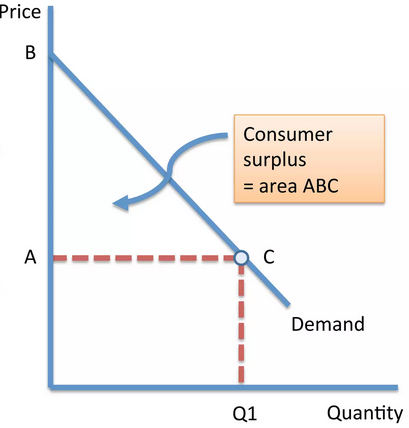
- Consumer surplus is the area under the demand curve and above the market price.
Producer Surplus (PS)
Producer surplus is the difference between the price producers receive and the minimum price they are willing to accept (cost of production).
PS = Price − Cost of production
Explanation:
- Some producers are willing to supply at lower prices.
- However, they receive the market price.
- The difference represents a benefit or surplus gained by producers.
Graphical Interpretation:
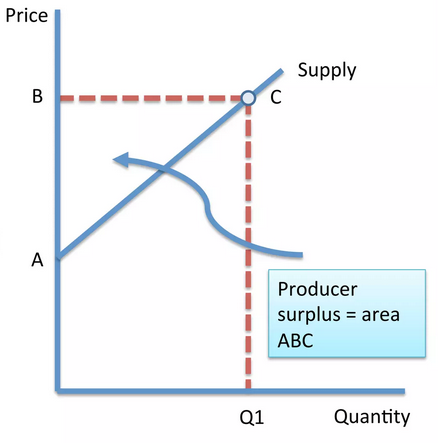
- Producer surplus is the area above the supply curve and below the price level.
Total Surplus (Economic Welfare)
The total benefit to society from a market is the sum of consumer and producer surplus.
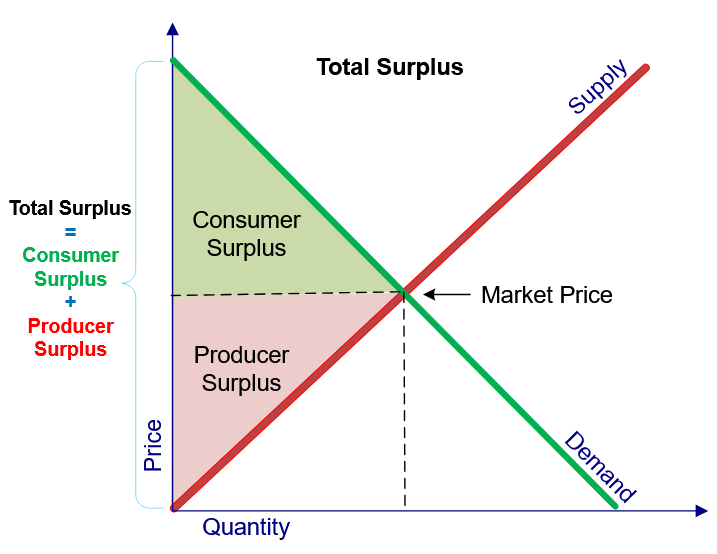
Total surplus = CS + PS
- Represents total welfare in the market.
- Maximized at market equilibrium in a free market.
Economic Logic:
- Consumer surplus reflects utility gained by consumers.
- Producer surplus reflects profit or benefit to producers.
- Efficient markets maximize total surplus.
- Government intervention may increase or decrease total welfare.
Key Differences:
| Aspect | Consumer Surplus | Producer Surplus |
|---|---|---|
| Definition | Willingness to pay − Price | Price − Cost |
| Represents | Benefit to consumers | Benefit to producers |
| Graph | Above price, below demand curve | Below price, above supply curve |
Key Ideas:
- Both surpluses measure economic welfare.
- They depend on market price and equilibrium.
- Important for analysing efficiency and policy impacts.
- Used to evaluate government intervention.
Example 1
Explain consumer surplus using an example.
▶️ Answer / Explanation
A consumer is willing to pay $100 for a product but buys it at $70.
The consumer surplus is $30.
This represents the extra benefit gained by the consumer.
Example 2
Evaluate the effect of a price increase on consumer and producer surplus.
▶️ Answer / Explanation
A rise in price reduces consumer surplus because consumers pay more.
Producer surplus may increase as firms receive higher prices.
However, if quantity demanded falls significantly, total producer surplus may not increase.
Thus, the overall effect depends on the elasticity of demand.