
Degrees of Market Power (HL)
Market power refers to the ability of a firm to influence or control the price of a good or service in the market.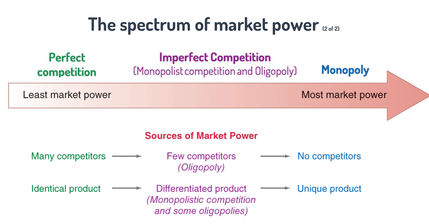
Market power → Control over price → Not a price taker
Explanation:
- A firm with market power can set prices above marginal cost.
- It is not forced to accept the market price.
- The degree of market power depends on the level of competition in the market.
Key Determinants of Market Power:
- Number of firms Fewer firms → greater market power.
- Barriers to entry Higher barriers → less competition → more power.
- Product differentiation More differentiation → greater ability to set prices.
- Availability of substitutes Fewer substitutes → higher market power.
Degrees of Market Power Across Market Structures:
| Market Structure | Degree of Market Power | Firm Behaviour |
|---|---|---|
| Perfect Competition | None | Price taker |
| Monopolistic Competition | Low | Some price control |
| Oligopoly | Moderate to high | Strategic behaviour |
| Monopoly | Very high | Price maker |
Economic Logic:
- Market power arises when firms face a downward-sloping demand curve.
- The more inelastic the demand, the greater the market power.
- High market power may lead to higher prices and lower output.
Implications of Market Power:
- Firms can earn abnormal profits.
- May lead to allocative inefficiency (P > MC).
- Can reduce consumer welfare.
- However, may encourage innovation in some cases.
Example 1
Explain what is meant by market power.
▶️ Answer / Explanation
Market power is the ability of a firm to influence the price of a good.
A firm with high market power can set prices above marginal cost.
This occurs when there is limited competition.
Example 2
Evaluate how market power affects consumers.
▶️ Answer / Explanation
Firms with high market power can charge higher prices.
This reduces consumer surplus.
However, firms may invest in innovation.
Thus, market power has both negative and positive effects.
Perfect Competition (HL)
No Market Power — Firm as Price Taker
In perfect competition, firms have no market power and are price takers, meaning they must accept the market price determined by demand and supply.
Firm → Cannot influence price → Takes market price
Explanation:
- There are many firms producing identical products.
- Each firm is too small to influence market price.
- If a firm raises its price, consumers switch to other firms.
- Thus, the firm faces a perfectly elastic demand curve at the market price.
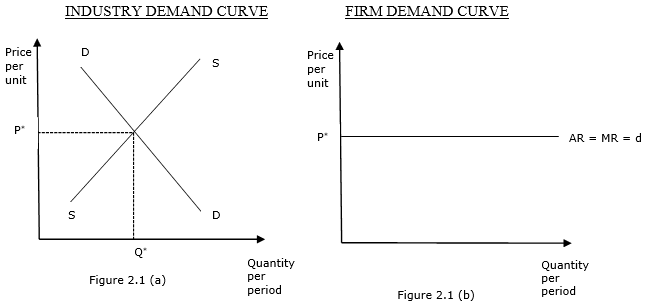
AR = MR = Price
Profit Maximization in Perfect Competition
Firms maximize profit where:
MC = MR
1. Short Run Profit Maximization
In the short run, firms can earn abnormal profit, normal profit, or losses.
Explanation:
- Firm produces where MC = MR.
- Since MR = AR = price, equilibrium occurs where MC = Price.
- Profit depends on the relationship between AR and AC:
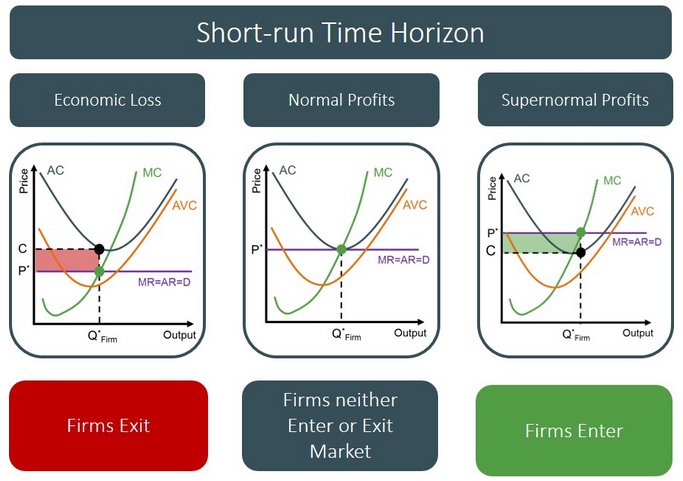
- If AR > AC → Abnormal profit
- If AR = AC → Normal profit
- If AR < AC → Loss
Economic Logic:
- Firms adjust output to maximize profit at given market price.
- No control over price, only over output.
2. Long Run Profit Maximization
In the long run, firms earn only normal profit.
Explanation:
- If firms earn abnormal profit → new firms enter the market.
- Entry increases supply → price falls.
- If firms make losses → firms exit the market.
- Exit reduces supply → price rises.
- This process continues until:
AR = AC → Normal profit
Long Run Equilibrium Condition:
MC = MR = AR = AC
- Firms earn zero economic profit.
- Market is stable with no incentive to enter or exit.
Economic Significance:
- Perfect competition leads to efficient outcomes.
- Firms produce at the lowest possible cost.
- Resources are allocated optimally.
Example 1
Explain how a perfectly competitive firm maximizes profit in the short run.
▶️ Answer / Explanation
The firm produces where MC equals MR.
Since MR equals price, equilibrium occurs where MC equals price.
Profit depends on the relationship between AR and AC.
The firm may earn profit, normal profit, or loss.
Example 2
Explain why firms earn only normal profit in the long run under perfect competition.
▶️ Answer / Explanation
If firms earn abnormal profit, new firms enter the market.
This increases supply and reduces price.
If firms make losses, firms exit and price rises.
The process continues until AR equals AC.
Thus, firms earn only normal profit.
Allocative Efficiency (HL)
Meaning and Necessary Conditions
Allocative efficiency occurs when resources are allocated in a way that maximizes total benefit to society. This happens when the goods and services produced are those most desired by consumers.
Allocative efficiency → Producing what society wants most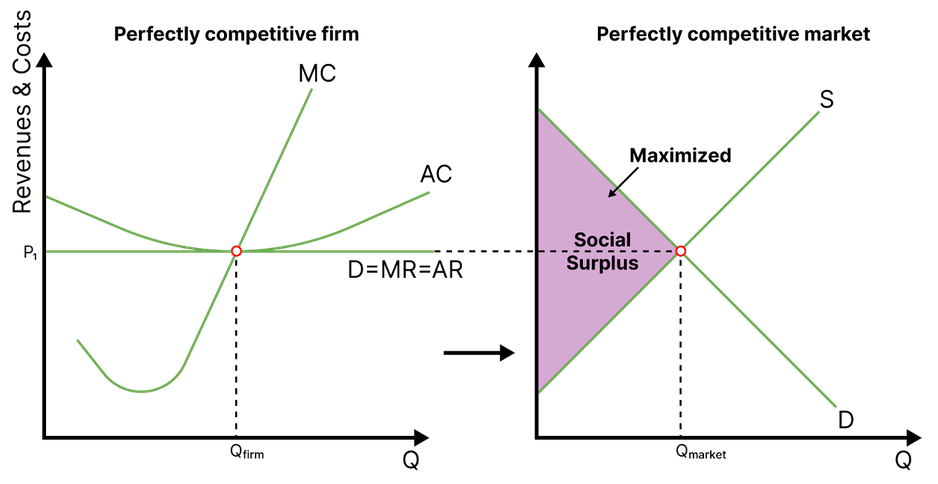
Meaning:
- Resources are used to produce goods that provide the highest possible satisfaction.
- The value consumers place on a good equals the cost of producing it.
- There is no underproduction or overproduction.
Marginal Benefit (MB) = Marginal Cost (MC)
Necessary Conditions:
1. Price Equals Marginal Cost
- In a competitive market, price (P) represents marginal benefit (MB).
- Marginal cost (MC) represents the cost of producing one more unit.
- Allocative efficiency occurs when:
P = MC
- This ensures the benefit to consumers equals the cost to society.
2. No Market Failure
- Markets must operate without externalities, public goods, or information failure.
- Otherwise, prices do not reflect true social costs or benefits.
3. Competitive Market Conditions
- Firms must be price takers.
- No firm should have significant market power.
- Ensures price reflects true market conditions.
What Happens If Conditions Are Not Met:
- If P > MC → Underproduction (society values more output).
- If P < MC → Overproduction (resources are wasted).
P ≠ MC → Inefficiency (deadweight loss)
Economic Significance:
- Allocative efficiency maximizes social (community) surplus.
- Achieved in perfect competition in the long run.
- Often not achieved in real markets due to market power or externalities.
Example 1
Explain what is meant by allocative efficiency.
▶️ Answer / Explanation
Allocative efficiency occurs when resources are used to produce goods that maximize satisfaction.
It happens when marginal benefit equals marginal cost.
In markets, this is when price equals marginal cost.
Example 2
Evaluate whether allocative efficiency is always achieved in real markets.
▶️ Answer / Explanation
Allocative efficiency requires price to equal marginal cost.
In perfect competition, this condition is met.
However, in monopoly or with externalities, price does not equal marginal cost.
This leads to inefficiency.
Thus, allocative efficiency is not always achieved.
Imperfect Competition (HL)
Varying Degrees of Market Power — Firm as Price Maker
In imperfect competition, firms have varying degrees of market power, meaning they can influence the price of their product. Unlike perfect competition, firms are price makers rather than price takers.
Imperfect competition → Market power → Price maker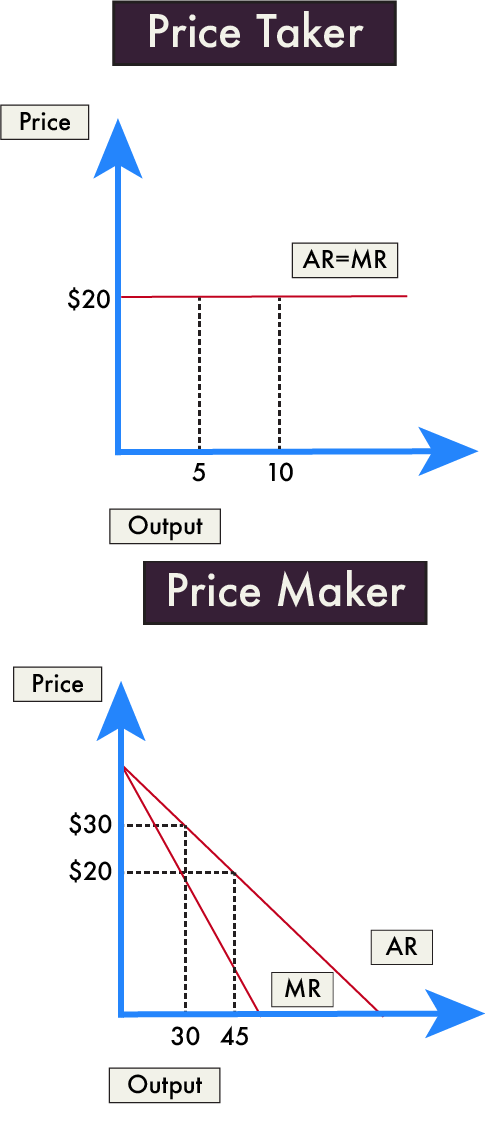
Explanation:
- Firms face a downward-sloping demand curve.
- To sell more output, firms must lower the price.
- This gives firms control over pricing decisions.
- The degree of control depends on the level of competition.
Price Maker Behaviour:
- Firms choose both price and output.
- They maximize profit where:
MC = MR
- Price is then determined from the demand (AR) curve.
- Thus, price is usually:
P > MR
Degrees of Market Power:
- Monopolistic competition → Low market power (many firms, differentiated products).
- Oligopoly → Moderate to high market power (few firms, interdependence).
- Monopoly → Very high market power (single firm, no close substitutes).
Economic Logic (HL Insight):
- Market power arises from barriers to entry and product differentiation.
- Firms can restrict output to raise price.
- This leads to:
- Higher prices
- Lower output
- Potential inefficiency
Implications of Price Maker Behaviour:
- Firms can earn abnormal profit in the long run.
- Price is greater than marginal cost:
P > MC
- Leads to allocative inefficiency.
- Creates deadweight loss (loss of social welfare).
Example 1
Explain why firms in imperfect competition are price makers.
▶️ Answer / Explanation
Firms face a downward-sloping demand curve.
They must lower price to sell more output.
This gives them control over pricing decisions.
Thus, they are price makers.
Example 2
Evaluate the effects of market power on efficiency.
▶️ Answer / Explanation
Firms with market power set prices above marginal cost.
This leads to underproduction.
It creates deadweight loss and reduces social welfare.
However, firms may invest in innovation.
Thus, market power has both negative and positive effects.