
Government Intervention in Response to Externalities and Common Pool Resources
Governments intervene in markets when externalities and common pool resources lead to market failure, where resources are not allocated efficiently.
Key Problem
- With externalities:
- Market equilibrium occurs at:
\( \mathrm{MPB = MPC} \)
- But social optimum is:
\( \mathrm{MSB = MSC} \)
- Market equilibrium occurs at:
- This leads to:
- Overproduction (negative externalities)
- Underproduction (positive externalities)
- With common pool resources:
- Overuse due to non-excludability
- Leads to tragedy of the commons
Key Aim of Government Intervention
Move output from market equilibrium → socially optimal level
\( \mathrm{MSB = MSC} \)
How Governments Intervene
- To internalise externalities (make private agents consider social costs/benefits).
- To reduce overuse of common pool resources.
- To achieve allocative efficiency and maximise social welfare.
Types of Intervention
- Market-based policies (taxes, subsidies, permits)
- Regulatory policies (laws, quotas)
- Behavioural policies (nudges, education)
- Global cooperation (international agreements)
Government Intervention in Response to Externalities and Common Pool Resources
1. Indirect (Pigouvian) Taxes
Pigouvian taxes are taxes imposed on goods that generate negative externalities, equal to the external cost per unit.
Economic Explanation:
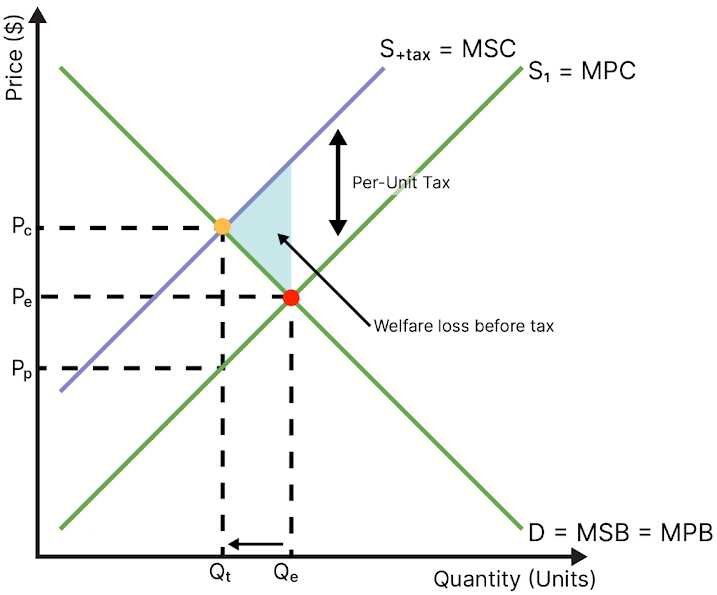
- Negative externalities mean:
\( \mathrm{MSC > MPC} \)
- A tax increases firms’ costs, shifting the supply curve left.
- This reduces output from the market level to the socially optimal level where:
\( \mathrm{MSB = MSC} \)
Tax → Internalise external cost → Reduce overproduction
Evaluation:
- Difficult to measure exact external cost.
- May reduce firm profitability.
| Advantages | Disadvantages |
|---|---|
| Internalises external costs | Difficult to measure exact external cost |
| Reduces overproduction | May increase prices for consumers |
| Generates government revenue | May reduce firm profitability |
2. Carbon Taxes
A carbon tax is a specific type of indirect tax imposed on activities that emit carbon dioxide (CO₂).
Economic Explanation:
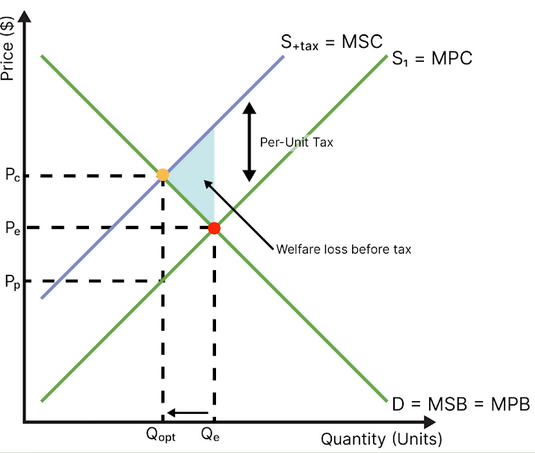
- Targets climate change caused by emissions.
- Increases cost of polluting activities.
- Encourages firms to:
- Reduce emissions
- Invest in cleaner technologies
- Reduces production of harmful goods.
Higher emissions cost → Lower pollution
Evaluation:
- May increase production costs and prices.
- Effectiveness depends on elasticity and global cooperation.
| Advantages | Disadvantages |
|---|---|
| Reduces carbon emissions | Increases production costs |
| Encourages cleaner technology | May lead to higher prices |
| Promotes sustainability | Depends on global cooperation |
3. Legislation and Regulation
Legislation and regulation involve laws and rules that directly control economic activity.
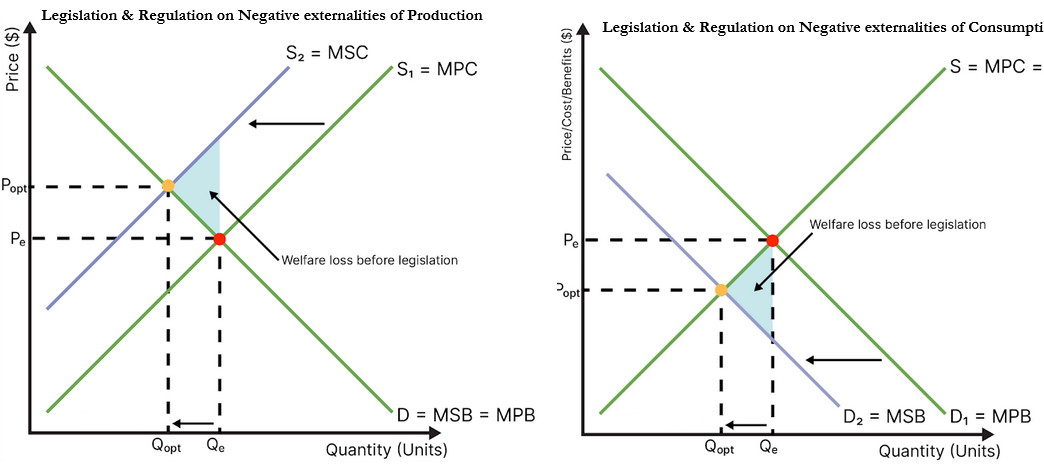
Economic Explanation:
- Governments set limits on harmful behaviour (e.g. pollution caps).
- Firms must comply or face penalties.
- Directly reduces negative externalities without using price mechanisms.
Rules → Controlled production → Reduced external harm
Evaluation:
- Effective but may increase costs for firms.
- Requires monitoring and enforcement.
| Advantages | Disadvantages |
|---|---|
| Directly reduces harmful activities | High monitoring and enforcement costs |
| Clear rules for firms | May reduce efficiency |
| Effective in controlling behaviour | Risk of over-regulation |
Example 1
Explain how a Pigouvian tax can correct negative externalities.
▶️ Answer / Explanation
A Pigouvian tax increases production costs.
This shifts supply left and reduces output.
Output moves closer to the socially optimal level.
Thus, overproduction and welfare loss are reduced.
Example 2
Evaluate the effectiveness of carbon taxes in reducing emissions.
▶️ Answer / Explanation
Carbon taxes increase the cost of polluting activities.
Firms reduce emissions and invest in cleaner technology.
This helps reduce environmental damage.
However, firms may pass costs to consumers.
Effectiveness depends on global cooperation.
4. Education and Awareness Creation
Government provision of information campaigns to influence consumer and producer behaviour.
Economic Explanation:
- Addresses information failure.
- Helps consumers understand true social costs and benefits.
- Encourages reduction in consumption of demerit goods and increase in merit goods.
- Shifts demand toward socially optimal level.
Better information → Better decisions → Reduced market failure
Evaluation:
- Low cost and non-intrusive.
- Effect may be slow or limited.
| Advantages | Disadvantages |
|---|---|
| Low cost intervention | Slow impact |
| Non-intrusive | Effect may be limited |
| Improves decision making | Relies on behavioural change |
5. Tradable Permits (Cap and Trade)
A system where the government sets a limit (cap) on total pollution and issues permits that can be bought and sold.
Economic Explanation: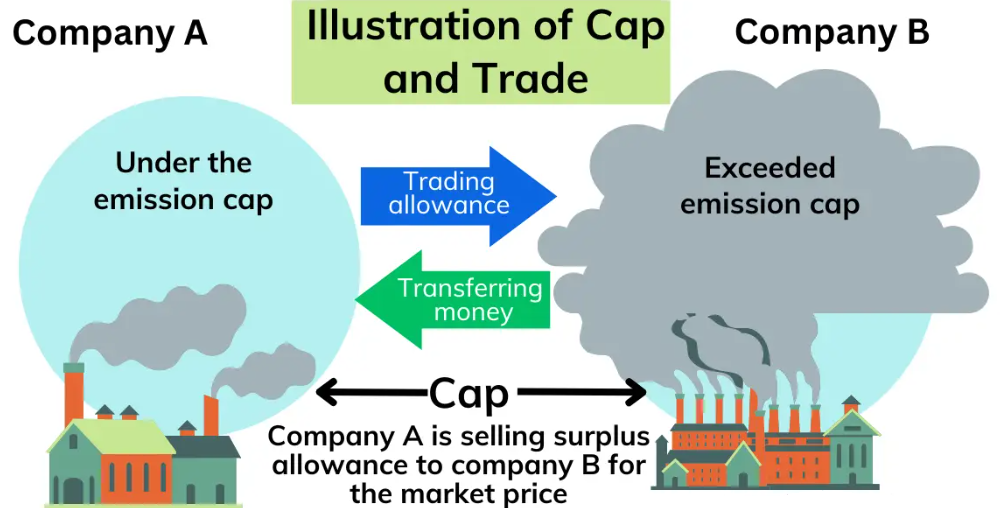
- Firms must hold permits to pollute.
- Firms that reduce emissions can sell excess permits.
- Creates a market-based incentive to reduce pollution.
- Ensures pollution stays within a fixed limit.
Cap → Limit pollution | Trade → Efficiency
Evaluation:
- Efficient and flexible.
- Difficult to set correct cap level.
| Advantages | Disadvantages |
|---|---|
| Flexible and market-based | Difficult to set correct cap |
| Encourages efficiency | May create uncertainty |
| Limits total pollution | Complex to administer |
6. International Agreements
Cooperation between countries to address global externalities such as climate change.
Economic Explanation:
- Many externalities are global in nature (e.g. carbon emissions).
- Individual countries may lack incentive to act alone.
- Agreements set targets and commitments for reduction.
Global problem → Collective action required
Evaluation:
- Difficult to enforce compliance.
- Free-rider problem may occur.
| Advantages | Disadvantages |
|---|---|
| Addresses global issues | Difficult to enforce |
| Encourages cooperation | Free-rider problem |
| Sets global targets | Conflicts between countries |
Example 1
Explain how information campaigns can reduce consumption of demerit goods.
▶️ Answer / Explanation
Information campaigns increase awareness of harmful effects.
Consumers better understand true costs.
This reduces demand for demerit goods.
Consumption moves closer to the socially optimal level.
Example 2
Evaluate how tradable permits help control pollution.
▶️ Answer / Explanation
The government sets a cap on total emissions.
Firms must hold permits to pollute.
Firms that reduce emissions can sell permits.
This creates an incentive to cut pollution efficiently.
However, setting the correct cap is challenging.
7. Collective Self-Governance
Collective self-governance occurs when users of a resource organise and manage it themselves without direct government control.
Economic Explanation:
- Users agree on rules and limits for resource use.
- Encourages cooperation and shared responsibility.
- Helps prevent the tragedy of the commons.
- Internalises external costs through community enforcement.
Community control → Sustainable use
Evaluation:
- Effective in small, local communities.
- Difficult to implement for large or global resources.
| Advantages | Disadvantages |
|---|---|
| Promotes sustainability | Hard to implement in large groups |
| Encourages cooperation | Requires trust among users |
| Low government cost | Limited scalability |
8. Subsidies
A subsidy is a payment by the government to producers or consumers to encourage production or consumption.
Economic Explanation:
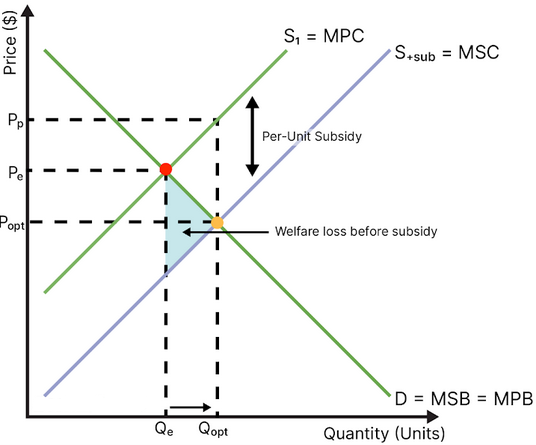
- Used to correct positive externalities.
- Lowers production costs or prices.
- Shifts supply curve right.
- Increases output toward socially optimal level.
Subsidy → Lower price → Higher output
Evaluation:
- Improves welfare by increasing beneficial consumption.
- Leads to government expenditure.
| Advantages | Disadvantages |
|---|---|
| Encourages positive externalities | High government expenditure |
| Increases output | Risk of overproduction |
| Improves welfare | Opportunity cost of funds |
9. Government Provision
Government provision involves the state directly supplying goods and services.
Economic Explanation: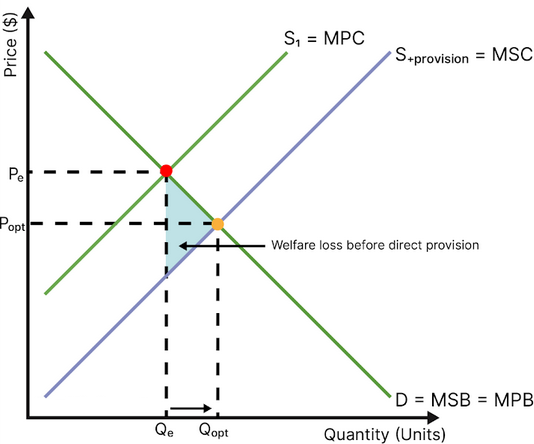
- Used when markets fail to provide sufficient goods.
- Ensures provision of public goods and merit goods.
- Output is provided at or near the socially optimal level.
Government supply → Correct underprovision
Evaluation:
- Ensures access and equity.
- May lead to inefficiency and high costs.
| Advantages | Disadvantages |
|---|---|
| Ensures access and equity | Risk of inefficiency |
| Corrects underprovision | High costs |
| Provides essential goods | Bureaucratic issues |
Example 1
Explain how collective self-governance can prevent overuse of resources.
▶️ Answer / Explanation
Users agree on rules for resource use.
This limits overexploitation.
Each user considers long-term sustainability.
Thus, the tragedy of the commons is reduced.
Example 2
Evaluate how subsidies correct positive externalities.
▶️ Answer / Explanation
Subsidies lower prices and increase consumption.
This raises output toward the socially optimal level.
Welfare loss is reduced.
However, subsidies increase government spending.