
Government Intervention in Response to Public Goods
Public goods are goods that are non-rivalrous and non-excludable. Because of these characteristics, private markets tend to underprovide or not provide them at all, leading to market failure.
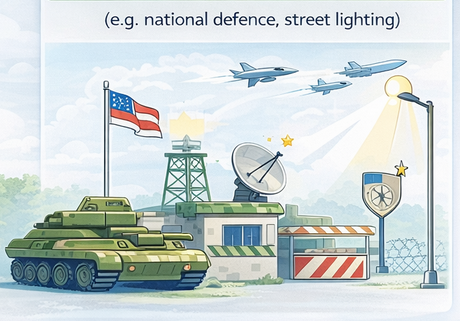
This creates a need for government intervention to ensure that such goods are produced and made available to society.
Public goods → Market failure → Government intervention
Direct Provision
Direct provision occurs when the government produces and provides public goods itself, using public funds collected through taxation.
- The government is responsible for both financing and supplying the good.
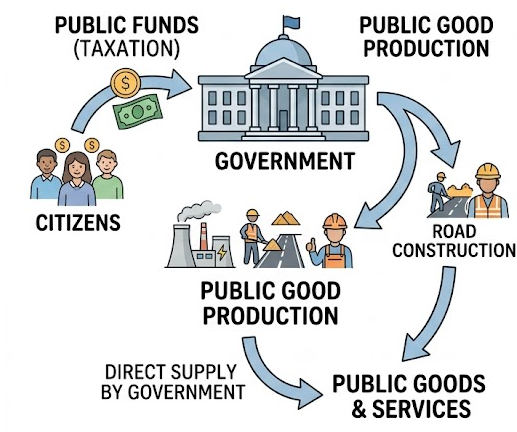
- Goods are provided free at the point of use or at a subsidized cost.
- Ensures that all individuals can access the good, regardless of income.
- Common for essential public goods such as national defense, street lighting, and public roads.
Advantages:
- Ensures universal access.
- Reduces inequality and promotes equity.
- Solves the free-rider problem.
Limitations:
- May lead to government inefficiency.
- High cost to taxpayers.
- Lack of competition may reduce quality or innovation.
Contracting Out to the Private Sector
Contracting out occurs when the government hires private firms to produce or deliver public goods, while still funding and overseeing the service.
- The government pays private firms to provide the service.
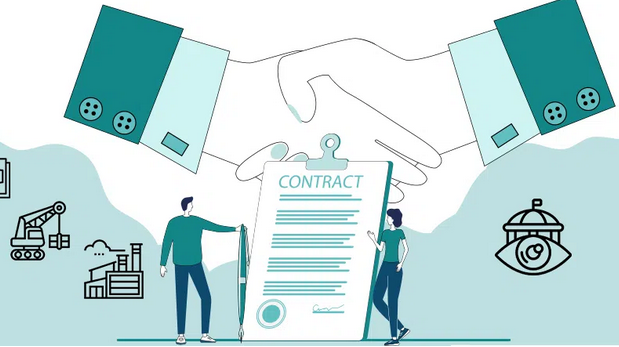
- The service remains publicly funded but privately delivered.
- The government sets standards and monitors performance.
- Common in services like waste collection, public transport, and infrastructure projects.
Advantages:
- Encourages efficiency and cost reduction through competition.
- Utilizes private sector expertise.
- Reduces burden on government resources.
Limitations:
- Risk of profit prioritization over quality.
- Requires strong regulation and monitoring.
- May lead to inequality in service quality if poorly managed.
Comparison of the Two Approaches:
| Aspect | Direct Provision | Contracting Out |
|---|---|---|
| Provider | Government | Private firms |
| Funding | Government | Government |
| Efficiency | May be lower | Often higher |
| Control | Full government control | Shared control |
Key Point:
- Public goods are underprovided by markets due to the free-rider problem.
- Government intervention ensures efficient and equitable provision.
- Choice between methods depends on trade-offs between efficiency and equity.
- Most economies use a combination of both approaches.
Example 1
Explain why governments directly provide public goods.
▶️ Answer / Explanation
Public goods are non-excludable and non-rivalrous, so private firms cannot charge consumers effectively.
This leads to the free-rider problem, where individuals benefit without paying.
As a result, private firms have no incentive to provide such goods.
Governments intervene by directly providing these goods using tax revenue.
Example 2
Using an example, explain contracting out of public goods.
▶️ Answer / Explanation
Contracting out occurs when the government hires private firms to provide a service.
For example, a government may hire a private company to manage waste collection.
The government pays the firm, but the service is provided to the public.
This allows the government to benefit from private sector efficiency while ensuring public access.