
Government Intervention in Response to Abuse of Significant Market Power (HL)
When firms with significant market power exploit consumers or restrict competition, governments intervene to protect consumers and ensure efficient market outcomes.
Market power abuse → Government intervention → Improved fairness & efficiency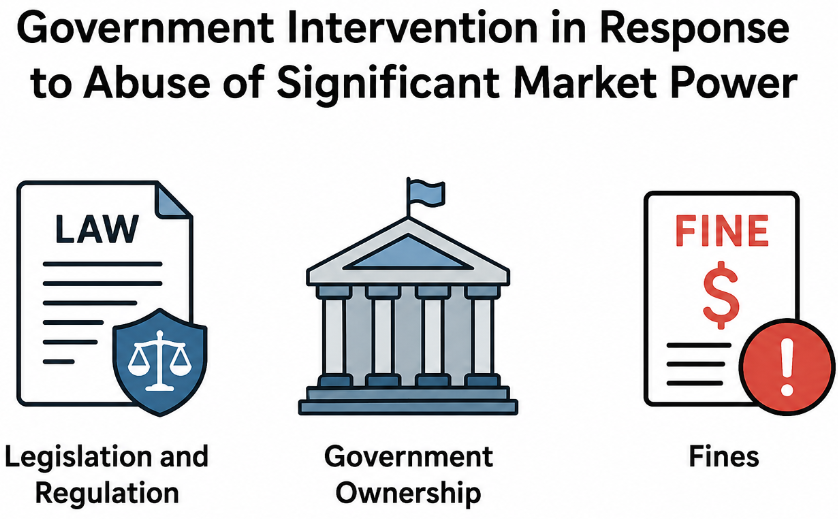
1. Legislation and Regulation
Legislation and regulation involve laws and rules designed to control the behaviour of firms and promote competition.
Explanation:
- Governments introduce competition laws (antitrust laws).
- Firms may be prevented from engaging in collusion, price fixing, or predatory pricing.
- Regulators may impose price controls (e.g. price caps).
- Firms may be required to provide fair access to essential services.
Objectives:
- Promote competition
- Protect consumers
- Prevent abuse of market power
Evaluation:
- ✔Reduces monopolistic behaviour
- ✔ Improves efficiency and fairness
- ✖ Can be costly and complex to enforce
- ✖ Risk of over-regulation reducing efficiency
2. Government Ownership
Government ownership (nationalization) occurs when the government takes control of firms, especially in industries with natural monopolies.
Explanation:
- The government owns and operates the firm.
- Aims to provide goods and services in the public interest rather than profit.
- Common in utilities such as water, electricity, and transport.
Objectives:
- Ensure fair pricing
- Provide universal access
- Reduce exploitation of consumers
Evaluation:
- ✔ Can ensure lower prices and greater access
- ✔ Focus on social welfare
- ✖ May lead to inefficiency due to lack of competition
- ✖ Risk of bureaucratic inefficiency
3. Fines
Fines are financial penalties imposed on firms that engage in anti-competitive or illegal behaviour.
Explanation:
- Firms are penalized for actions such as cartel formation, abuse of dominance, or misleading consumers.
- Acts as a deterrent against future misconduct.
- Encourages firms to comply with competition laws.
Objectives:
- Punish anti-competitive behaviour
- Deter future violations
- Promote fair competition
Evaluation:
- ✔ Provides strong deterrence
- ✔ Encourages compliance
- ✖ May not be effective if fines are too small
- ✖ Firms may still engage in illegal behaviour if profits exceed fines
HL Insight:
- Government intervention aims to reduce allocative inefficiency (P > MC).
- It promotes competitive outcomes and protects consumer welfare.
- However, intervention must balance efficiency and regulation.
Example 1
Explain how regulation can reduce market power.
▶️ Answer / Explanation
Regulation imposes rules on firms.
It prevents practices such as price fixing and collusion.
This increases competition and protects consumers.
Example 2
Evaluate the effectiveness of fines in controlling market power.
▶️ Answer / Explanation
Fines punish firms for anti-competitive behaviour.
They act as a deterrent.
However, if fines are small, firms may ignore them.
Thus, effectiveness depends on size and enforcement.