
Imperfect Competition (HL)
Oligopoly — Few Large Firms, High Barriers to Entry, Interdependence
An oligopoly is a market structure characterized by a small number of large firms dominating the market. These firms are interdependent, meaning each firm’s decisions affect and are affected by the actions of others.
Few firms → Interdependence → Strategic behaviour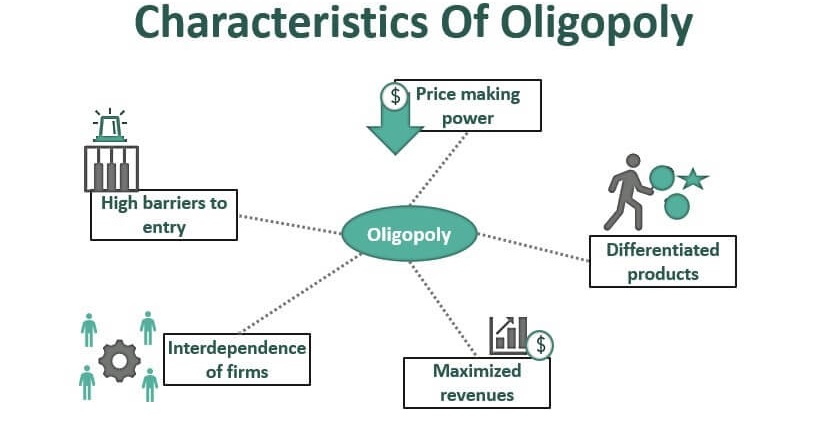
1. Few Large Firms
In an oligopoly, the market is controlled by a small number of dominant firms.
Explanation:
- Each firm has a significant market share.
- Firms are large enough to influence market conditions.
- There is limited competition compared to perfect competition.
Impact:
- Firms may have market power.
- Possibility of collusion or strategic pricing.
- Consumers have limited choices.
2. High Barriers to Entry
Oligopolistic markets have significant barriers to entry, preventing new firms from entering easily.
Explanation:
- High start-up costs and economies of scale.
- Strong brand loyalty and advertising.
- Legal barriers such as patents.
- Control over key resources or technology.
Impact:
- Protects existing firms from competition.
- Allows firms to maintain long-term profits.
- Limits market contestability.
3. Interdependence
Interdependence means that firms must consider the likely reactions of competitors when making decisions.
Explanation:
- Each firm’s pricing, output, and marketing decisions affect others.
- Firms anticipate competitors’ responses before acting.
- Leads to strategic behaviour.
Impact:
- Firms may avoid price wars.
- Possibility of collusion (formal or informal agreements).
- Price rigidity may occur (sticky prices).
Key Point:
- Few dominant firms control the market.
- High barriers limit entry.
- Firms are interdependent.
- Leads to strategic and sometimes collusive behaviour.
Example 1
Explain why firms in an oligopoly are interdependent.
▶️ Answer / Explanation
In an oligopoly, there are only a few firms in the market.
Each firm’s decisions affect the others.
Firms must consider how competitors will react before changing price or output.
This creates interdependence.
Example 2
Evaluate the impact of high barriers to entry in an oligopoly.
▶️ Answer / Explanation
High barriers prevent new firms from entering the market.
This allows existing firms to maintain market power and profits.
However, it reduces competition and may harm consumers.
Thus, barriers protect firms but may reduce efficiency.
Imperfect Competition (HL)
Monopolistic Competition — Many Firms, Free Entry, Product Differentiation
Monopolistic competition is a market structure with many firms, free entry and exit, and differentiated products. Firms have some market power due to product differentiation but still face competition.
Many firms + Differentiation → Some market power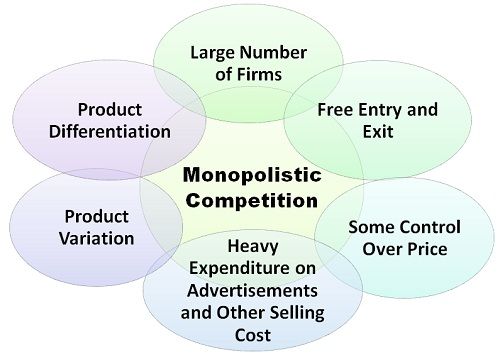
1. Many Firms
There are a large number of firms in the market.
Explanation:
- Each firm has a relatively small market share.
- Firms compete with many close rivals.
- No single firm dominates the market.
Impact:
- Limits the extent of market power.
- Encourages competition.
- Firms must attract customers actively.
2. Free Entry and Exit
There are no significant barriers to entering or leaving the market.
Explanation:
- New firms can enter when profits exist.
- Firms exit when losses occur.
- Ensures dynamic competition.
Impact:
- In the long run, firms earn only normal profit.
- Increases competition over time.
- Promotes efficiency.
3. Product Differentiation
Product differentiation means that each firm offers a product that is slightly different from others.
Explanation:
- Differences may be in quality, branding, design, or location.
- Products are close substitutes but not identical.
- Firms can build brand loyalty.
Impact:
- Firms have some control over price.
- Demand curve is downward sloping.
- Encourages non-price competition (advertising, branding).
Economic Logic :
- Product differentiation gives firms limited market power.
- Free entry removes abnormal profit in the long run.
- Firms operate between perfect competition and monopoly.
Example 1
Explain why firms in monopolistic competition have some market power.
▶️ Answer / Explanation
Firms sell differentiated products.
Consumers may prefer one brand over another.
This gives firms some control over price.
Thus, they are not price takers.
Example 2
Evaluate the role of product differentiation in monopolistic competition.
▶️ Answer / Explanation
Product differentiation allows firms to attract customers and build brand loyalty.
It gives firms some pricing power.
However, it increases costs due to advertising and marketing.
It may also lead to inefficiency.
Thus, it has both benefits and drawbacks.