
Importance of International Cooperation
Many environmental and sustainability issues are global in nature, meaning that actions in one country affect others. Problems such as climate change and resource depletion involve cross-border externalities, making international cooperation essential to achieve:
\( \mathrm{MSB = MSC} \) at a global level
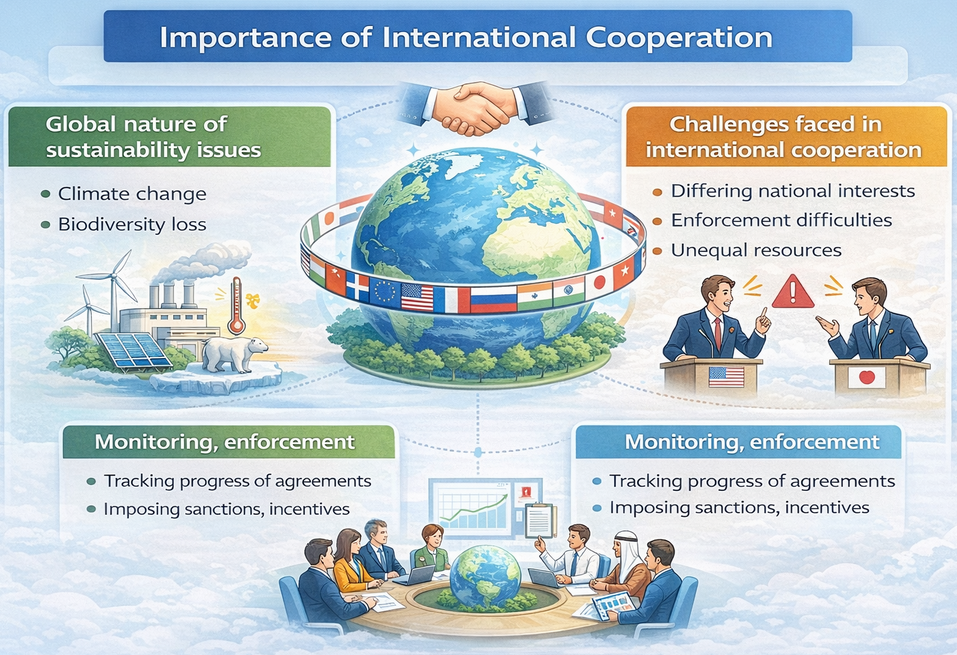
1. Global Nature of Sustainability Issues
Sustainability issues extend beyond national boundaries because environmental systems are interconnected.
Transboundary pollution:
- Carbon emissions released in one country contribute to global climate change.
- Air and water pollution can spread across borders.
Global common pool resources:
- Oceans, atmosphere, and biodiversity are shared resources.
- They are rivalrous and non-excludable, leading to overuse.
Interdependence of economies:
- Production and consumption in one country affect environmental outcomes elsewhere.
- Global supply chains increase interconnected impacts.
Economic Insight:
- Individual countries acting alone cannot internalise global externalities.
- Without cooperation, countries may continue to produce where:
\( \mathrm{MSC > MPC} \)
- This results in global overproduction and welfare loss.
Global externality → Requires coordinated global policy
2. Challenges Faced in International Cooperation
Achieving cooperation between countries is complex due to differing incentives and priorities.
Free-rider problem:
- Countries may benefit from others reducing emissions without taking action themselves.
- Leads to under-provision of global public goods such as environmental protection.
Differences in economic development:
- Developing countries prioritise economic growth and poverty reduction.
- Developed countries have greater responsibility due to historical emissions.
Conflicting national interests:
- Countries may disagree on emission targets, timelines, and responsibilities.
- Short-term national interests may conflict with long-term global benefits.
Opportunity cost of cooperation:
- Reducing emissions may require sacrificing economic growth.
- Countries weigh costs versus global benefits.
Economic Insight:
- Incentives are misaligned across countries.
- Global agreements are difficult to negotiate and sustain.
Different incentives → Weak cooperation → Continued market failure
3. Monitoring and Enforcement
Even when agreements are reached, ensuring compliance is a major challenge.
Monitoring difficulties:
- Accurate measurement of emissions and environmental impact is complex.
- Requires reliable data and transparency.
Lack of global authority:
- No single institution can enforce rules across all countries.
- Compliance is largely voluntary.
Weak enforcement mechanisms:
- Penalties for non-compliance are often limited or absent.
- Countries may ignore commitments without significant consequences.
Trust and credibility issues:
- Countries may doubt whether others will follow agreements.
- This reduces willingness to commit.
Economic Insight:
- Weak enforcement reduces the effectiveness of policies.
- Leads to continued divergence from:
\( \mathrm{MSB = MSC} \)
Weak monitoring + weak enforcement → Limited impact
Evaluation:
- International cooperation is essential to address global externalities.
- However, its effectiveness is limited by:
- Free-rider behaviour
- Conflicting interests
- Weak enforcement
- Successful cooperation requires:
- Fair burden-sharing
- Strong monitoring systems
- Incentives for participation
Example 1
Evaluate why international cooperation is necessary to address climate change.
▶️ Answer / Explanation
Climate change is a global externality affecting all countries.
Individual countries cannot internalise the full social cost of emissions.
International cooperation ensures coordinated reduction in emissions.
However, free-rider problems and weak enforcement reduce effectiveness.
Thus, cooperation is essential but requires strong global institutions.
Example 2
Explain why the free-rider problem makes international agreements on climate change difficult to implement.
▶️ Answer / Explanation
Climate change mitigation is a global public good.
Countries benefit from reduced emissions regardless of whether they contribute.
This creates an incentive to avoid the costs of reducing emissions.
As a result, some countries may rely on others to take action.
This leads to under-provision of environmental protection.
Therefore, international agreements become difficult to enforce and sustain.