
Importance of Price Elasticity of Demand (PED) for Firms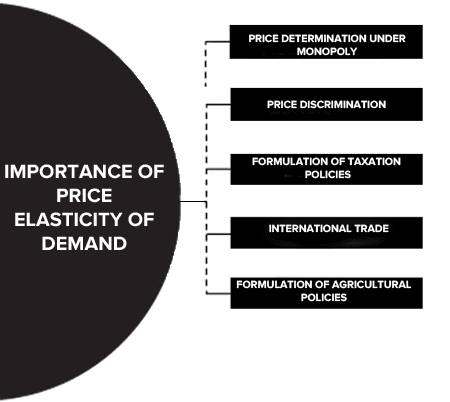
Price elasticity of demand (PED) is a crucial tool for firms because it helps them understand how consumers respond to price changes. This allows firms to make better decisions regarding pricing, revenue, and strategy.
1. Pricing Decisions
Firms use PED to determine whether to increase or decrease prices.
If demand is elastic (\( \mathrm{PED > 1} \)):
- Firms should lower prices to increase total revenue.
If demand is inelastic (\( \mathrm{PED < 1} \)):
- Firms can increase prices to increase total revenue.
Insight:
- Correct pricing maximizes revenue and profitability.
2. Revenue and Profit Maximization
PED helps firms predict how changes in price will affect total revenue (TR).
- Firms aim to operate where revenue is maximized.
- Total revenue is maximized when:
\( \mathrm{PED = 1} \)
- Understanding elasticity helps firms avoid pricing decisions that reduce revenue.
3. Price Discrimination
Firms use PED to charge different prices to different consumer groups.
- Consumers with inelastic demand can be charged higher prices.
- Consumers with elastic demand are charged lower prices.
Explanation:
- This allows firms to increase overall revenue.
- Common in industries like airlines, cinemas, and public transport.
4. Marketing and Advertising Strategies
Firms use advertising and branding to influence PED and consumer responsiveness.
- Effective advertising creates brand loyalty.
- This reduces the availability of perceived substitutes.
- Demand becomes more inelastic (\( \mathrm{PED < 1} \)).
- Firms gain greater pricing power and can charge higher prices.
Branding → Fewer substitutes → More inelastic demand
5. Production and Output Decisions
PED helps firms decide the optimal level of output and how changes in production affect revenue.
Elastic demand (\( \mathrm{PED > 1} \)):
- Increasing output (lower price) leads to a large increase in sales.
- Total revenue increases significantly.
Inelastic demand (\( \mathrm{PED < 1} \)):
- Increasing output leads to only a small increase in sales.
- Revenue may fall if price decreases.
Elastic → Expand output | Inelastic → Restrict output
6. Competitive Strategy
Firms use PED to respond strategically to competitors’ pricing decisions.
In markets with elastic demand:
- Consumers are highly sensitive to price differences.
- Firms must keep prices competitive.
In markets with inelastic demand:
- Consumers are less responsive to price changes.
- Firms have greater pricing power.
Elastic market → High competition | Inelastic market → Price control
Key Ideas:
- PED helps firms make effective pricing decisions.
- It is essential for maximizing revenue and profit.
- Used in price discrimination and marketing.
- Provides insight into consumer behaviour.
Example 1
Explain why a firm selling a product with elastic demand may lower its price.
▶️ Answer / Explanation
If demand is elastic (\( \mathrm{PED > 1} \)), consumers are highly responsive to price changes.
A fall in price leads to a large increase in quantity demanded.
This increases total revenue.
Therefore, firms lower prices to increase revenue.
Example 2
Evaluate how a firm can use PED to implement price discrimination.
▶️ Answer / Explanation
A firm identifies different consumer groups with different elasticities.
For example, students may have more elastic demand, while business travelers have inelastic demand.
The firm charges lower prices to elastic consumers and higher prices to inelastic consumers.
This increases total revenue.
However, price discrimination requires market separation and may raise fairness concerns.
Importance of Price Elasticity of Demand (PED) for Government Decision-Making
Governments use price elasticity of demand (PED) to predict how consumers will respond to price changes caused by policies such as taxes, subsidies, and regulations. This helps in designing effective economic policies.
1. Taxation Policy
Governments use PED to decide which goods to tax and how effective taxes will be.
Goods with inelastic demand (\( \mathrm{PED < 1} \)):
- Tax increases lead to a small fall in quantity demanded.
- Government can raise more tax revenue.
Goods with elastic demand (\( \mathrm{PED > 1} \)):
- Tax increases lead to a large fall in quantity demanded.
- Tax revenue may be low or unstable.
Insight:
- Governments often tax goods like cigarettes or fuel because demand is relatively inelastic.
2. Correcting Negative Externalities
Governments use PED to reduce consumption of harmful goods.
- If demand is inelastic, taxes may not significantly reduce consumption.
- Higher taxes or additional policies (e.g. regulations, education) may be required.
- If demand is elastic, taxes are more effective in reducing consumption.
Insight:
- PED helps determine how effective taxes will be in changing behaviour.
3. Subsidy Policy
Governments provide subsidies to encourage consumption of beneficial goods.
- If demand is elastic, subsidies lead to a large increase in consumption.
- If demand is inelastic, subsidies have a smaller effect.
Insight:
- PED helps governments decide where subsidies will be most effective.
4. Revenue Generation
Governments use PED to determine how much tax revenue can be generated.
Inelastic demand (\( \mathrm{PED < 1} \)):
- Small fall in quantity demanded after tax.
- High and stable tax revenue.
Elastic demand (\( \mathrm{PED > 1} \)):
- Large fall in quantity demanded after tax.
- Lower and less reliable revenue.
Inelastic goods → Best for taxation
5. Price Controls and Regulation
PED helps governments predict the impact of price ceilings and price floors.
Inelastic demand:
- Quantity demanded changes very little.
- Limited impact on shortages/surpluses.
Elastic demand:
- Quantity demanded changes significantly.
- Can lead to large shortages or surpluses.
6. Policy Effectiveness and Planning
PED helps governments evaluate how effective policies will be.
- Predicts consumer response to price changes.
- Improves policy design and targeting.
- Helps allocate resources efficiently.
PED → Better policy decisions
Key Ideas:
- PED is essential for designing tax and subsidy policies.
- It helps governments predict consumer behaviour.
- Important for revenue generation and policy effectiveness.
- Used in addressing market failures.
Example 1
Explain why governments often tax goods with inelastic demand.
▶️ Answer / Explanation
Goods with inelastic demand have a low responsiveness to price changes.
When taxes increase prices, quantity demanded falls only slightly.
This allows governments to generate higher tax revenue.
Therefore, governments prefer taxing inelastic goods.
Example 2
Evaluate how PED influences the effectiveness of a tax on sugary drinks.
▶️ Answer / Explanation
If demand for sugary drinks is elastic, a tax will significantly reduce consumption.
This helps improve public health outcomes.
If demand is inelastic, consumption will not fall much, reducing the policy’s effectiveness.
In this case, additional measures such as education campaigns may be needed.
Thus, PED determines how effective the tax will be.