
Importance of Income Elasticity of Demand (YED) — For Firms (HL)
Income elasticity of demand (YED) is important for firms because it helps them understand how demand for their products will change as consumer incomes rise or fall. This is essential for planning production, pricing, and long-term strategy.
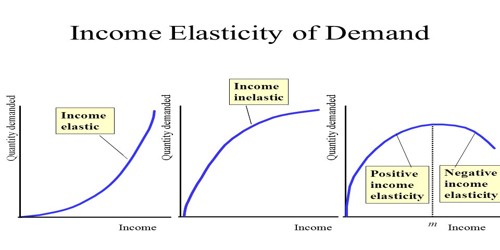
1. Demand Forecasting
Firms use YED to predict how demand will change with economic growth or recession.
- If \( \mathrm{YED > 1} \) (luxury goods):
- Demand increases rapidly when income rises.
- If \( \mathrm{0 < YED < 1} \) (necessities):
- Demand increases slowly as income rises.
- If \( \mathrm{YED < 0} \) (inferior goods):
- Demand falls when income rises.
Income ↑ → Demand depends on YED value
2. Production and Investment Decisions
Firms use YED to decide how much to produce and where to invest.
- Firms producing luxury goods may expand production during economic growth.
- Firms producing inferior goods may prepare for reduced demand as incomes rise.
- Helps firms allocate resources efficiently.
3. Market Targeting and Product Strategy
YED helps firms identify which income groups to target.
- Luxury firms target high-income consumers.
- Necessity goods target mass markets.
- Firms may reposition products as income levels change.
4. Business Cycle Planning
Firms use YED to prepare for economic booms and recessions.
- During economic growth:
- Luxury goods experience rapid demand growth.
- During recession:
- Demand for inferior goods may increase.
- Luxury goods may experience a sharp fall in demand.
5. Risk Management
YED helps firms assess how vulnerable they are to income changes.
- High YED → demand is unstable and sensitive to economic conditions.
- Low YED → demand is stable and predictable.
Higher YED → Higher risk
Key Ideas:
- YED helps firms predict future demand trends.
- Essential for production and investment planning.
- Helps firms respond to economic growth and recession.
- Important for targeting markets and managing risk.
Example 1
Explain why firms producing luxury goods benefit during economic growth.
▶️ Answer / Explanation
Luxury goods have high YED (\( \mathrm{YED > 1} \)).
As income increases, demand rises more than proportionately.
This leads to a large increase in sales and revenue.
Therefore, firms benefit significantly during economic growth.
Example 2
Evaluate why firms producing inferior goods may perform better during a recession.
▶️ Answer / Explanation
Inferior goods have negative YED (\( \mathrm{YED < 0} \)).
As income falls during a recession, demand for these goods increases.
Consumers switch to cheaper alternatives.
Thus, firms producing inferior goods may experience higher demand.
However, this depends on availability of substitutes and market conditions.
Income Elasticity of Demand (YED) and Sectoral Structure of the Economy (HL)
The concept of income elasticity of demand (YED) helps explain how an economy’s sectoral structure changes as it develops and incomes rise over time.
Sectoral Structure of the Economy
The economy is divided into three main sectors:
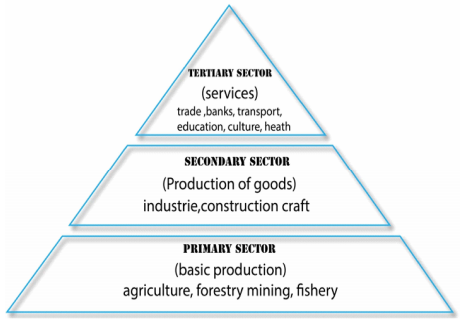
- Primary sector — extraction of raw materials (e.g. agriculture, mining)
- Secondary sector — manufacturing and industrial production
- Tertiary sector — services (e.g. education, healthcare, tourism)
Key Idea:
As income rises → Demand shifts across sectors
1. Primary Sector (Low YED)
Goods produced in the primary sector are mostly necessities.

- \( \mathrm{0 < YED < 1} \)
- Demand increases less than proportionately as income rises.
- Share of income spent on these goods falls over time.
Result:
- The importance of the primary sector declines in developed economies.
2. Secondary Sector (Moderate YED)
Manufactured goods have moderate YED.

- Demand increases as income rises, but not as rapidly as services.
- Growth is significant during industrialisation.
Result:
- The secondary sector grows during the development phase of an economy.
3. Tertiary Sector (High YED)
Services are often luxury goods with high income elasticity.

- \( \mathrm{YED > 1} \)
- Demand increases more than proportionately as income rises.
- Consumers spend more on education, healthcare, travel, and entertainment.
Result:
- The tertiary sector becomes dominant in developed economies.
Overall Structural Change
- Low-income countries → Dominated by primary sector
- Middle-income countries → Growth of secondary sector
- High-income countries → Dominance of tertiary sector
Development → Shift: Primary → Secondary → Tertiary
Economic Explanation:
- As income rises, spending patterns change.
- Consumers spend proportionally less on necessities and more on luxuries.
- This shifts demand toward sectors with higher YED.
Key Ideas:
- YED explains structural transformation in economies.
- Primary sector declines due to low YED.
- Tertiary sector expands due to high YED.
- Important for understanding economic development.
Example 1
Explain why the tertiary sector becomes dominant as an economy develops.
▶️ Answer / Explanation
Services have high income elasticity of demand (\( \mathrm{YED > 1} \)).
As income rises, demand for services increases more than proportionately.
Consumers spend more on education, healthcare, and leisure.
Thus, the tertiary sector grows and becomes dominant.
Example 2
Evaluate why the primary sector becomes less important in developed economies.
▶️ Answer / Explanation
Primary goods are necessities with low YED (\( \mathrm{0 < YED < 1} \)).
As income rises, demand increases only slightly.
Consumers spend a smaller proportion of income on these goods.
As a result, the relative importance of the primary sector declines.
However, it remains essential for providing raw materials.