
Relationship Between Individual Supply and Market Supply
In supply analysis, it is important to distinguish between individual supply and market supply. Market supply is derived from the production decisions of all individual firms in the market.
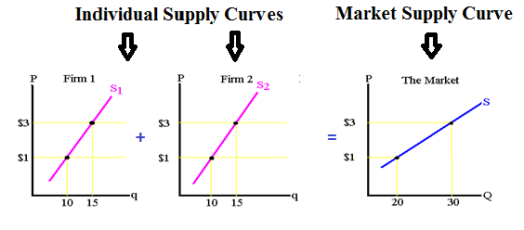
Market Supply = Sum of Individual Supplies (at each price)
Individual Supply
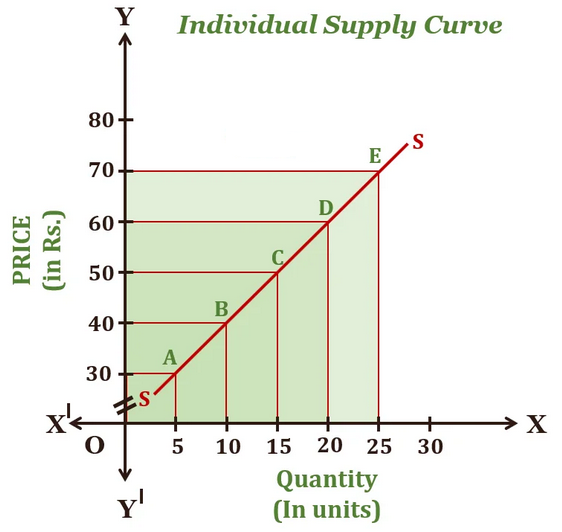
Individual supply refers to the quantity of a good or service that a single producer (firm) is willing and able to supply at different price levels over a given period of time.
- It is based on the firm’s costs of production, technology, and profit objectives.
- It follows the law of supply, showing a direct relationship between price and quantity supplied.
- Represented by an individual supply curve, which is upward sloping.
- Each firm has a different supply curve depending on its efficiency and cost structure.
Further Explanation:
- A firm produces where price = marginal cost to maximize profit.
- If price rises, the firm increases output as more units become profitable.
- If price falls, the firm reduces output.
- Changes in costs or technology shift the individual supply curve.
Key Idea:
- Individual supply reflects firm-level production decisions.
Market Supply
Market supply refers to the total quantity of a good or service that all producers in the market are willing and able to supply at different price levels over a given period of time.
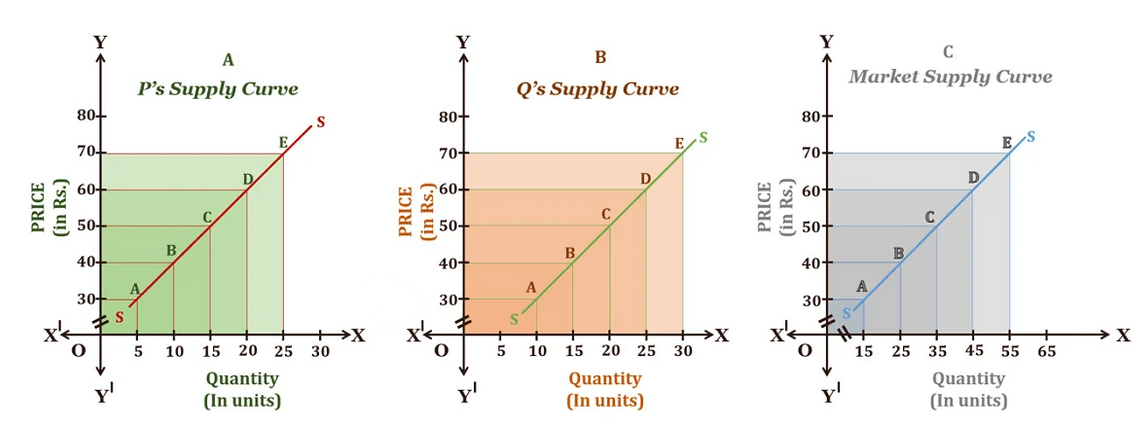
- It is the aggregate (sum) of all individual firm supplies.
- Also follows the law of supply.
- Represented by a market supply curve.
- Influenced by factors affecting all firms such as input costs, taxes, subsidies, and technology.
Further Explanation:
- Derived through horizontal summation of individual supply curves.
- At each price, outputs of all firms are added.
- The curve is usually flatter because multiple firms respond to price changes.
- Entry of firms increases supply, while exit reduces it.
Key Idea:
- Market supply reflects total production in the economy.
Relationship Between Individual and Market Supply
- Market supply is the sum of all individual firm supplies.
- A change in one firm has a small effect on market supply.
- Changes affecting many firms cause a significant shift in market supply.
- Market outcomes depend on collective firm behaviour.
Key Differences:
| Aspect | Individual Supply | Market Supply |
|---|---|---|
| Definition | Supply of one firm | Total supply of all firms |
| Basis | Firm-level decisions | Aggregate of firms |
| Curve | Individual supply curve | Horizontal sum of curves |
| Impact | Limited | Determines market supply |
Example 1
Explain how market supply is derived from individual supply.
▶️ Answer / Explanation
Market supply is calculated by adding the quantities supplied by all firms at each price.
For example, if Firm A supplies 5 units and Firm B supplies 7 units at a price of $10, total market supply is 12 units.
This process is repeated for all price levels to construct the market supply curve.
Example 2
Evaluate how a decrease in production costs across an industry affects market supply.
▶️ Answer / Explanation
A decrease in production costs, such as cheaper raw materials, reduces costs for all firms.
Each firm can now supply more at every price level, shifting individual supply curves to the right.
When all firms increase supply, the market supply curve also shifts to the right.
This leads to an increase in total market supply and may result in a lower equilibrium price.
Thus, changes affecting many firms have a significant impact on market supply.