
The Law of Demand
The law of demand states that there is an inverse relationship between the price of a good and the quantity demanded, ceteris paribus (all other factors held constant).
This means that:
- When the price increases, the quantity demanded decreases.
- When the price decreases, the quantity demanded increases.

Price ↑ → Quantity Demanded ↓
Price ↓ → Quantity Demanded ↑
Reason for the Inverse Relationship
- Substitution effect — As price rises, consumers switch to cheaper alternatives.
- Income effect — Higher prices reduce purchasing power, lowering demand.
- Diminishing marginal utility — Each additional unit gives less satisfaction, so consumers are only willing to buy more at lower prices.
Demand Curve
The law of demand is represented by a downward-sloping demand curve, showing the inverse relationship between price and quantity demanded.
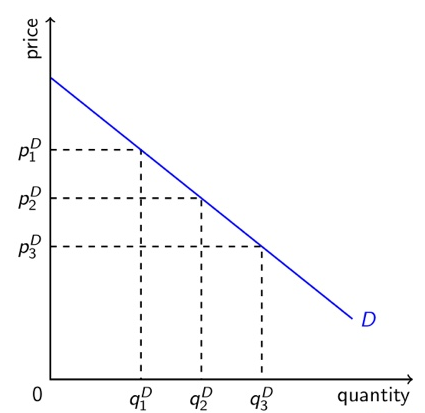
- Price is shown on the vertical axis.
- Quantity demanded is shown on the horizontal axis.
- The curve slopes downward from left to right.
Key Ideas:
- The law of demand applies ceteris paribus.
- It reflects rational consumer behaviour.
- Forms the basis of demand analysis in microeconomics.
- Used to explain price determination in markets.
Exceptions to the Law of Demand
In some cases, demand may not follow the usual inverse relationship between price and quantity demanded. These exceptions occur due to specific consumer behavior or market conditions:
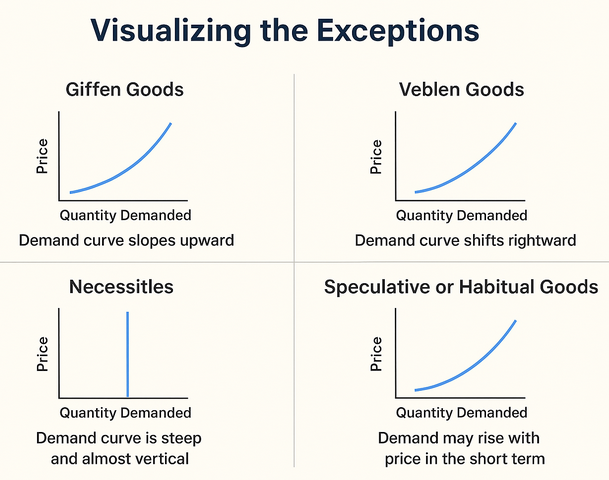
- Giffen goods — Demand increases as price rises because the income effect outweighs the substitution effect. Typically applies to inferior goods where consumers cannot afford better alternatives.
- Veblen goods — Higher prices make goods more desirable as they signal status or prestige. Consumers perceive them as luxury items.
- Necessities — Demand is highly inelastic and the demand curve is very steep. Quantity demanded changes very little even when price changes.
- Speculative or habitual goods — Demand may increase with price in the short term due to expectations of future price rises or strong habits (for example, addictive goods).
In exceptions → Price ↑ may lead to Demand ↑
Key Idea:
- These cases are rare and specific, and the law of demand still applies in most situations.
- They highlight the role of income effects, expectations, and consumer psychology.
Example 1
Explain the law of demand using an example.
▶️ Answer / Explanation
The law of demand states that as price decreases, quantity demanded increases, ceteris paribus.
For example, if the price of a pizza falls, consumers are more likely to buy more pizzas.
This is because it becomes more affordable and may replace other food options.
Thus, lower prices lead to higher quantity demanded.
Example 2
Using an example, explain one reason for the inverse relationship between price and quantity demanded.
▶️ Answer / Explanation
One reason is the substitution effect.
For example, if the price of tea increases, consumers may switch to coffee, which is relatively cheaper.
This reduces the quantity demanded of tea.
Thus, higher prices lead to lower demand due to substitution.