
The Law of Supply
The law of supply states that there is a direct relationship between the price of a good and the quantity supplied, ceteris paribus (all other factors held constant).
This means that: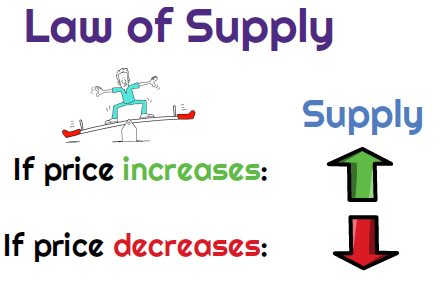
- When the price increases, the quantity supplied increases.
- When the price decreases, the quantity supplied decreases.
Price ↑ → Quantity Supplied ↑
Price ↓ → Quantity Supplied ↓
Explanation of the Direct Relationship
The positive relationship between price and quantity supplied exists due to the behaviour of firms aiming to maximize profit.
- Profit incentive — Higher prices increase potential profits, encouraging firms to produce more.
- Higher marginal cost — Producing additional units often increases costs, so firms require higher prices to supply more.
- Entry of firms — Higher prices attract new firms into the market, increasing total supply.
Supply Curve
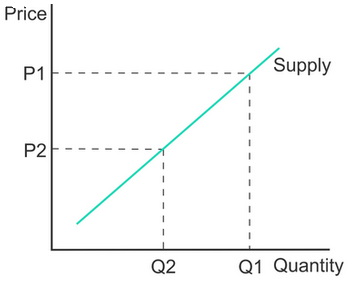
The law of supply is represented by an upward-sloping supply curve, showing the direct relationship between price and quantity supplied.
- Price is shown on the vertical axis.

- Quantity supplied is shown on the horizontal axis.
- The curve slopes upward from left to right.
Key Ideas:
- The law of supply applies under ceteris paribus.
- Firms respond to price changes due to profit motives.
- The supply curve reflects cost conditions and production decisions.
- Forms the basis of market supply and price determination.
Assumptions of the Law of Supply
- Firms aim to maximize profit.
- Costs of production follow typical patterns (increasing marginal cost).
- Technology remains constant.
- No significant changes in external factors such as taxes or regulations.
Exceptions to the Law of Supply
Although the law of supply generally states that higher prices lead to higher quantity supplied, there are important exceptions where this relationship may not hold. These cases arise due to practical constraints, expectations, or specific characteristics of goods.
Fixed Supply
Some goods have a perfectly inelastic (fixed) supply, meaning their quantity cannot be increased regardless of price.
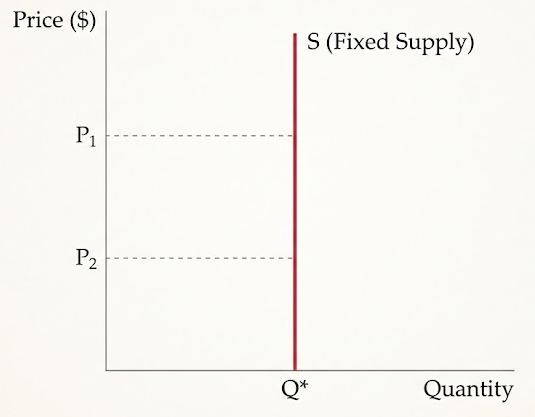
- Examples include original artworks, rare antiques, or land.
- The supply is limited by nature or uniqueness.
- Even if price rises significantly, quantity supplied remains unchanged.
Explanation:
- Producers cannot create more of these goods.
- The supply curve is perfectly vertical.
- Thus, price does not influence quantity supplied.
Perishable Goods
For perishable goods, producers may supply more even when prices fall, contradicting the law of supply.
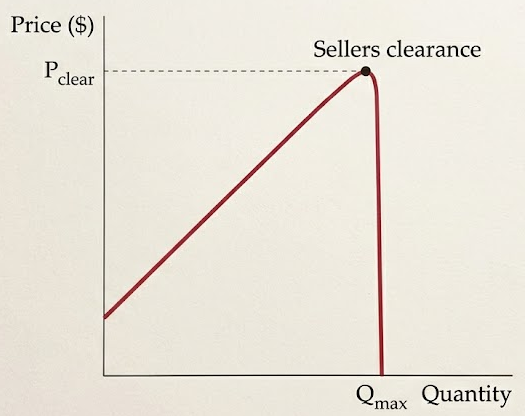
- Examples include fresh fruits, vegetables, dairy products.
- These goods cannot be stored for long periods.
- Sellers may accept lower prices to avoid total loss.
Explanation:
- If goods are not sold quickly, they lose value or become unusable.
- Producers prioritize selling stock over waiting for higher prices.
- This leads to increased supply even at lower prices.
Expectations of Future Prices
Producers’ expectations about future prices can influence current supply decisions.
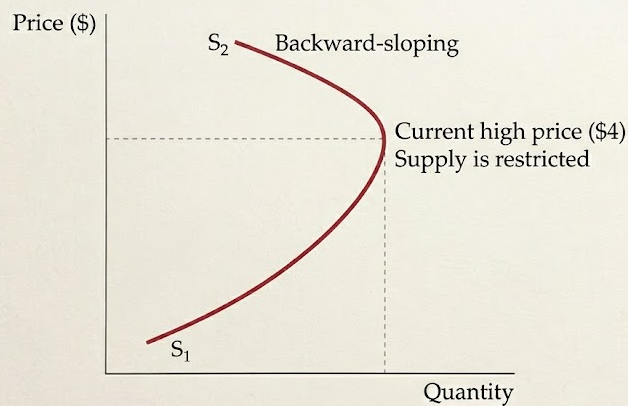
- If prices are expected to rise in the future, producers may withhold supply now.
- If prices are expected to fall, producers may increase current supply.
Explanation:
- Producers aim to maximize future profits.
- Holding back supply reduces current quantity supplied despite high prices.
- This creates a temporary deviation from the law of supply.
Expected price ↑ → Current supply ↓
Example 1
Explain the law of supply using an example.
▶️ Answer / Explanation
The law of supply states that as price increases, quantity supplied increases.
For example, if the price of smartphones rises, firms are more willing to produce and supply more smartphones because profits increase.
This results in a higher quantity supplied at higher prices.
Example 2
Using an example, explain why the supply curve slopes upward.
▶️ Answer / Explanation
The supply curve slopes upward because firms need higher prices to produce more output.
For example, producing additional units may require overtime labour or less efficient resources, increasing costs.
Firms will only supply these extra units if prices rise to cover higher costs.
This creates a positive relationship between price and quantity supplied.