
Reasons Why PED for Primary Commodities is Lower than for Manufactured Products (HL)
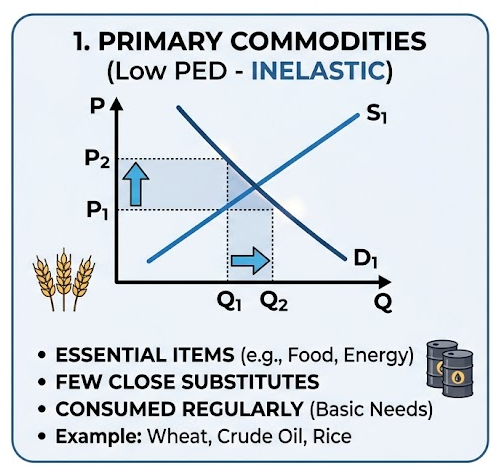
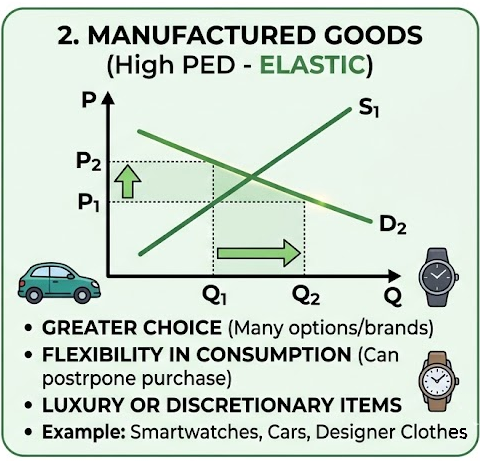
The price elasticity of demand (PED) for primary commodities (e.g. food, raw materials) is generally lower (more inelastic) than for manufactured goods. This is because of differences in necessity, substitutes, and consumer behaviour.
1. Necessity vs Luxury


- Primary commodities are often necessities (e.g. food, basic raw materials).

- Consumers must continue buying them even if prices rise.
- Manufactured goods are often luxuries or non-essential goods.
- Consumers can reduce consumption when prices increase.
Necessities → Inelastic | Luxuries → Elastic
2. Fewer Close Substitutes
- Primary commodities usually have few or no close substitutes.
- For example, staple foods cannot be easily replaced.
- Manufactured goods often have many close substitutes (brands, alternatives).
Fewer substitutes → Lower PED
3. Small Proportion of Income (Some Cases)
- Some primary goods (e.g. basic food items) take up a small proportion of income.
- Price changes have limited impact on consumer decisions.
- Manufactured goods (e.g. cars, electronics) often take up a larger share of income.
- Consumers are more sensitive to price changes.
4. Habitual Consumption
- Primary commodities are often part of daily consumption habits.
- Consumers find it difficult to change behaviour quickly.
- Manufactured goods are more discretionary and easier to adjust.
5. Limited Scope to Delay Consumption
- Primary goods are needed regularly and cannot be easily postponed.
- Manufactured goods can often be delayed or postponed if prices rise.
Cannot delay → Inelastic | Can delay → Elastic
Key Comparison:
| Factor | Primary Commodities | Manufactured Goods |
|---|---|---|
| Nature | Necessities | Often luxuries |
| Substitutes | Few | Many |
| Consumption | Habitual | Flexible |
| Postponement | Not possible | Possible |
Conclusion:
Primary commodities have low PED because they are essential, have few substitutes, and are consumed regularly. In contrast, manufactured goods tend to have higher PED due to greater choice and flexibility in consumption.
Example 1
Explain why demand for staple food is inelastic.
▶️ Answer / Explanation
Staple food is a necessity required for survival.
It has few substitutes and is consumed regularly.
Even if prices rise, consumers must continue buying it.
Therefore, demand is inelastic.
Example 2
Evaluate why manufactured goods tend to have elastic demand.
▶️ Answer / Explanation
Manufactured goods often have many close substitutes and are not essential.
Consumers can switch brands or delay purchases when prices rise.
This leads to a large change in quantity demanded.
Thus, demand is elastic.
However, some manufactured goods may still be inelastic if they are essential.