
Reasons Why PES for Primary Commodities is Lower than for Manufactured Products (HL)
The price elasticity of supply (PES) for primary commodities (e.g. agricultural products, raw materials) is generally lower (more inelastic) than for manufactured goods.
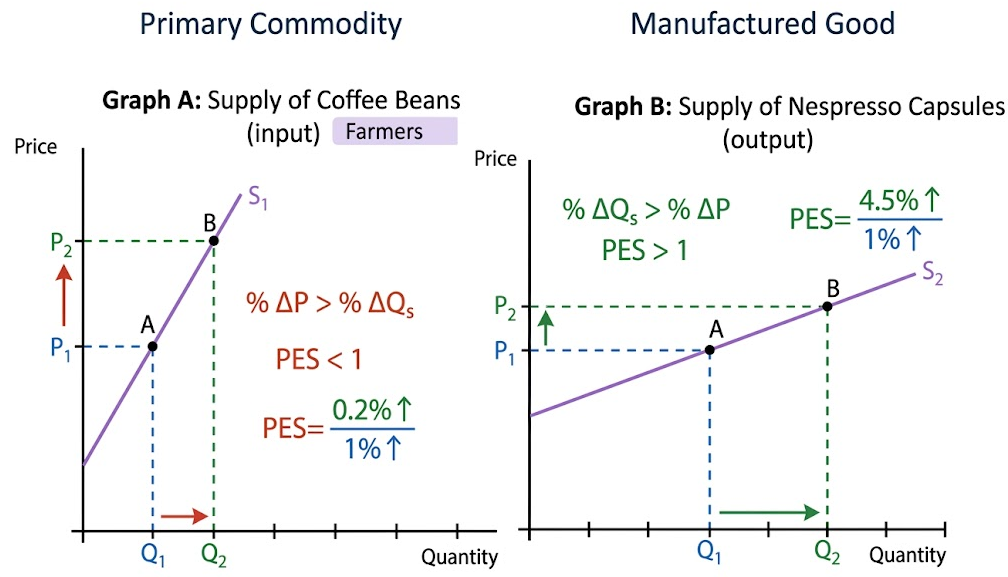
This is due to several structural and production-related factors.
1. Time Constraints in Production
- Primary production often depends on biological processes (e.g. crop growth, livestock rearing).
- Output cannot be increased quickly in response to price changes.
- Manufactured goods can be produced more quickly by adjusting labour or machinery.
Primary → Slow response → Inelastic supply
2. Low Mobility of Factors of Production
- Factors such as land are fixed and immobile in primary production.
- Farmers cannot easily switch land use in the short run.
- Manufacturing resources (labour, capital) are generally more flexible and transferable.
3. Limited Spare Capacity
- Primary producers often operate close to full capacity.
- There is little unused land or resources to expand output quickly.
- Manufacturing firms may have unused capacity, allowing rapid increases in production.
4. Dependence on Natural Factors
- Primary commodities depend on weather, climate, and natural conditions.
- These factors are unpredictable and limit supply responsiveness.
- Manufactured goods are less dependent on nature and more controllable.
5. Perishability and Storage Limitations
- Many primary goods are perishable (e.g. fruits, vegetables).
- Producers cannot store output easily to respond to price changes.
- Manufactured goods are often storable, increasing flexibility.
6. Slow Adjustment of Supply
- Primary production cannot be easily scaled up or down in the short run.
- Manufacturing firms can adjust output by changing working hours, hiring labour, or increasing production shifts.
Key Comparison:
| Factor | Primary Commodities | Manufactured Goods |
|---|---|---|
| Time flexibility | Low | High |
| Factor mobility | Low | High |
| Spare capacity | Limited | Often available |
| Dependence on nature | High | Low |
| Storage ability | Limited | Better |
Conclusion:
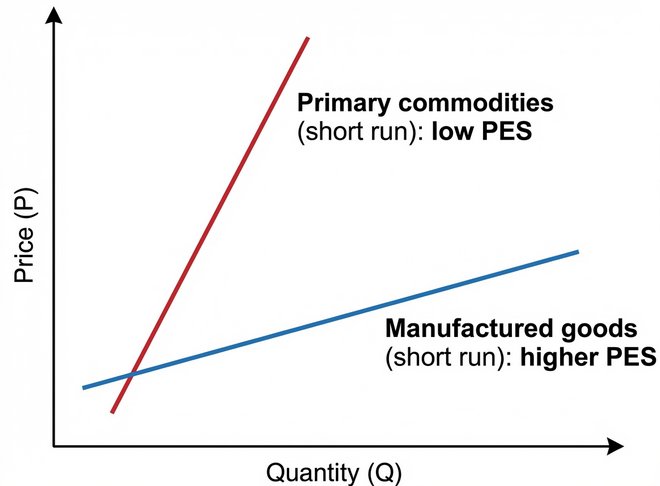
Primary commodities have low PES because production is constrained by time, nature, and limited flexibility. In contrast, manufactured goods have higher PES due to greater control over production and resource allocation.
Example 1
Explain why agricultural products tend to have inelastic supply.
▶️ Answer / Explanation
Agricultural production depends on time and natural conditions.
Farmers cannot quickly increase output after crops are planted.
Land is also fixed and cannot be easily expanded.
Therefore, supply is relatively inelastic.
Example 2
Evaluate why manufactured goods generally have more elastic supply than primary goods.
▶️ Answer / Explanation
Manufacturing firms can adjust production using labour and machinery.
They often have spare capacity and can increase output quickly.
They are less dependent on natural factors.
This makes supply more responsive to price changes.
However, in the short run, even manufactured goods may face capacity constraints.