
Socially Optimum Output
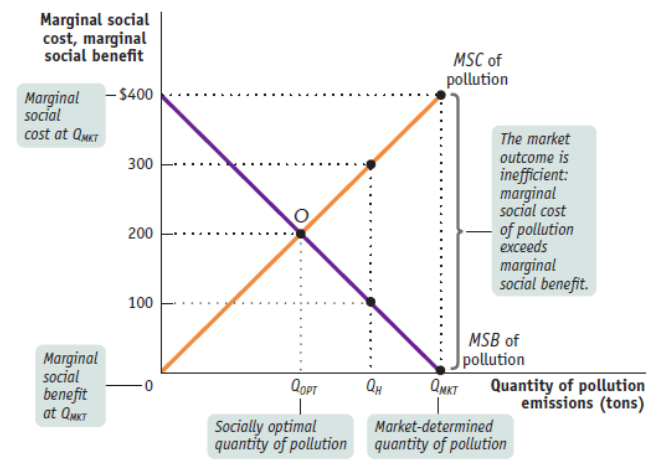
The socially optimum level of output occurs where:
\( \mathrm{MSB = MSC} \)
Definitions
Marginal Social Benefit (MSB):
- The additional benefit to society from consuming one more unit of a good.
- Includes private benefit + external benefit.
Marginal Social Cost (MSC):
- The additional cost to society from producing one more unit of a good.
- Includes private cost + external cost.
Key Idea:
Optimal output → Maximum social welfare
Economic Explanation
- At \( \mathrm{MSB = MSC} \), society’s total welfare is maximised.
- Producing beyond this point:
- \( \mathrm{MSC > MSB} \) → overproduction → welfare loss.
- Producing below this point:
- \( \mathrm{MSB > MSC} \) → underproduction → missed benefits.
Market Failure Context
- In a free market, equilibrium occurs at:
\( \mathrm{MPB = MPC} \)
- If externalities exist:
- Market output ≠ socially optimal output.
Types of Market Failure
Negative externalities (e.g. pollution):
- \( \mathrm{MSC > MPC} \)
- Market leads to overproduction.
Positive externalities (e.g. education):
- \( \mathrm{MSB > MPB} \)
- Market leads to underproduction.
Diagram Interpretation
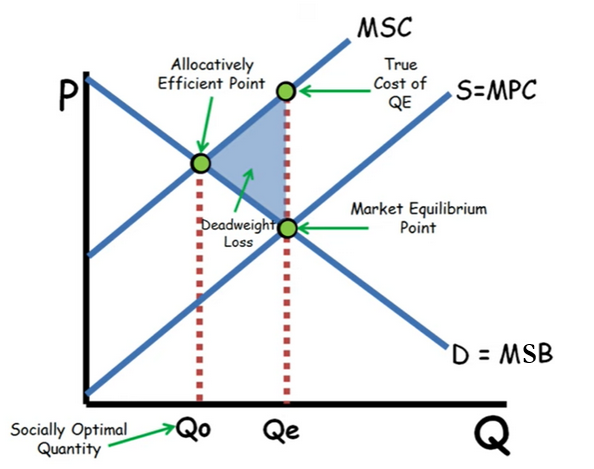
- Intersection of MSB and MSC → socially optimal output.
- Difference between market and social equilibrium → deadweight loss.
Role of Government
- Use taxes to reduce overproduction (negative externalities).
- Use subsidies to increase production (positive externalities).
- Aim to move output toward \( \mathrm{MSB = MSC} \).
Key Ideas:
- Social optimum occurs where \( \mathrm{MSB = MSC} \).
- Maximises total welfare.
- Market equilibrium may differ due to externalities.
- Government intervention helps achieve optimal allocation.
Example 1
Explain why negative externalities lead to overproduction.
▶️ Answer / Explanation
Firms consider only private costs (MPC), ignoring external costs.
Thus, market equilibrium occurs where MPB = MPC.
However, true cost is higher (MSC).
This leads to production beyond the socially optimal level.
Hence, overproduction occurs.
Example 2
Evaluate how subsidies help achieve socially optimal output.
▶️ Answer / Explanation
Subsidies increase the benefits received by producers or consumers.
This shifts MPB toward MSB.
Output increases toward the socially optimal level.
Thus, underproduction is corrected.
However, subsidies involve government cost.
(MSB = MSC): Allocative Efficiency and Social/Community Surplus Maximized
Allocative efficiency occurs when resources are allocated in a way that maximises total social (community) surplus.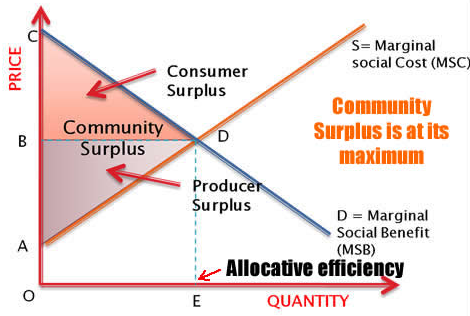
\( \mathrm{MSB = MSC} \)
Marginal Social Benefit (MSB):
- The additional benefit to society from consuming one more unit.
Marginal Social Cost (MSC):
- The additional cost to society of producing one more unit.
Social (Community) Surplus:
- The sum of consumer surplus + producer surplus + external benefits − external costs.
Key Idea:
At \( \mathrm{MSB = MSC} \) → Social welfare is maximized
Economic Explanation
- At this point, the value society places on the last unit consumed equals the cost of producing it.
- There is no underallocation or overallocation of resources.
- Any deviation leads to welfare loss (deadweight loss).
Positive Externalities of Consumption and Production
Positive externalities occur when the consumption or production of a good creates external benefits to third parties.
1. Positive Externalities of Consumption
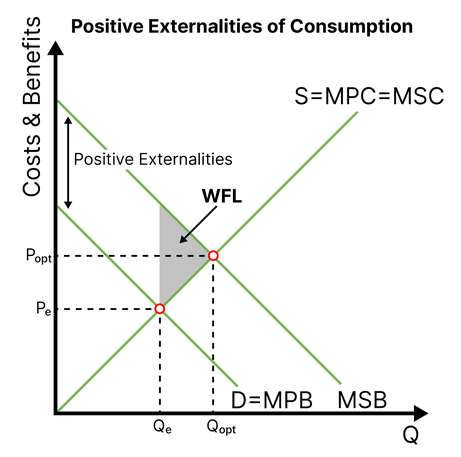
- MSB > MPB
- Consumers underestimate the true benefit of the good.
- Leads to underconsumption.
Examples:
- Education
- Healthcare
2. Positive Externalities of Production
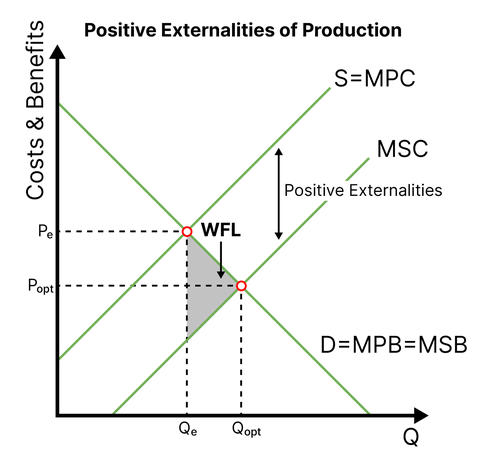
- MSB > MPB (due to spillover benefits)
- Firms do not consider benefits to society.
- Leads to underproduction.
Examples:
- Research and development
- Infrastructure investment
Welfare Loss (Underproduction)
- Market equilibrium occurs at:
\( \mathrm{MPB = MPC} \)
- Social optimum occurs at:
\( \mathrm{MSB = MSC} \)
- Since \( \mathrm{MSB > MPB} \):
- Market output is lower than socially optimal.
- Society misses out on potential benefits.
Diagram Interpretation
- MSB curve lies above MPB.
- Market equilibrium is left of social optimum.
- Triangle between MSB and MSC shows welfare loss.
Government Intervention
- Subsidies to increase consumption/production.
- Direct provision (e.g. public education).
- Information campaigns to raise awareness.
Goal → Move output from market level to socially optimal level
Example 1
Explain why education is underprovided in a free market.
▶️ Answer / Explanation
Education creates positive externalities such as a more skilled workforce.
Consumers consider only private benefits (MPB).
Social benefits (MSB) are higher than MPB.
Thus, demand is underestimated.
This leads to underconsumption and welfare loss.
Example 2
Evaluate how subsidies can correct positive externalities.
▶️ Answer / Explanation
Subsidies lower the price for consumers or increase producer revenue.
This increases quantity consumed or produced.
Output moves closer to the socially optimal level.
Thus, welfare loss is reduced.
However, subsidies involve government cost.
Negative Externalities of Production and Consumption and Welfare Loss
Negative externalities occur when the production or consumption of a good imposes external costs on third parties who are not directly involved in the market transaction.
1. Negative Externalities of Production
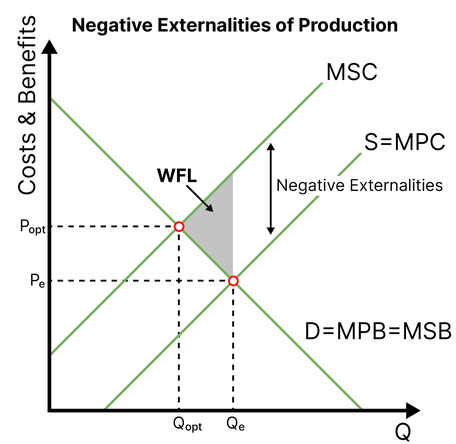
When firms impose costs on society during production.
- Marginal Social Cost (MSC) > Marginal Private Cost (MPC)
- Firms ignore external costs such as pollution.
- Leads to overproduction.
Examples:
- Factory emissions causing air pollution
- Industrial waste contaminating water
2. Negative Externalities of Consumption
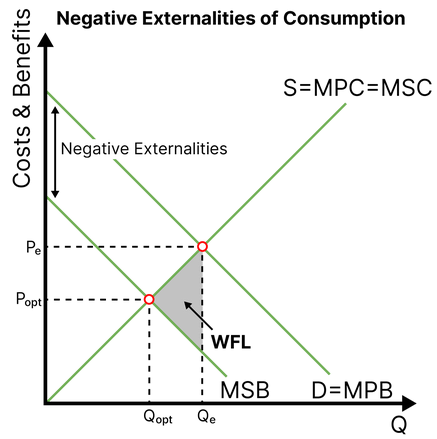
When consumption imposes costs on others.
- Marginal Social Benefit (MSB) < Marginal Private Benefit (MPB)
- Consumers ignore negative effects on others.
- Leads to overconsumption.
Examples:
- Smoking causing passive smoking
- Alcohol consumption leading to social harm
Welfare Loss (Deadweight Loss)
- Market equilibrium occurs at:
\( \mathrm{MPB = MPC} \)
- Socially optimal output occurs at:
\( \mathrm{MSB = MSC} \)
- Since external costs exist:
- Market output is greater than socially optimal.
- This creates overproduction.
Overproduction → Welfare loss
Diagram Interpretation
- MSC curve lies above MPC.
- Market equilibrium is to the right of social optimum.
- The triangle between MSC and MSB shows welfare loss.
Government Intervention
- Indirect taxes to reduce production/consumption.
- Regulation (e.g. pollution limits).
- Tradable permits to control emissions.
Goal → Reduce output to socially optimal level
Example 1
Explain why pollution leads to overproduction.
▶️ Answer / Explanation
Firms consider only private costs (MPC).
They ignore external costs such as environmental damage.
Thus, production occurs where MPB = MPC.
However, true cost is higher (MSC).
This leads to output above the socially optimal level.
Therefore, overproduction occurs.
Example 2
Evaluate how taxes can reduce negative externalities.
▶️ Answer / Explanation
Taxes increase production costs or prices.
This reduces quantity produced and consumed.
Output moves closer to the socially optimal level.
Welfare loss is reduced.
However, taxes may reduce producer profits and consumer welfare.
Merit Goods and Demerit Goods
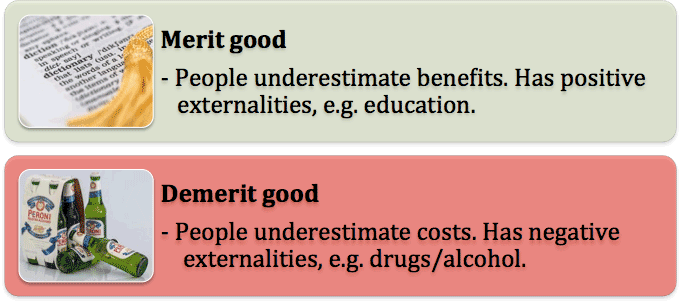
1. Merit Goods
Merit goods are goods that are underconsumed in a free market because consumers underestimate their true benefits.
Key Characteristics
- Generate positive externalities.
- MSB > MPB
- Consumers lack information or undervalue long-term benefits.
- Lead to underconsumption in a free market.
Examples:
- Education
- Healthcare
- Vaccinations
Welfare Implication
- Market equilibrium at:
\( \mathrm{MPB = MPC} \)
- Social optimum at:
\( \mathrm{MSB = MSC} \)
- Since \( \mathrm{MSB > MPB} \):
- Market output is less than optimal.
- Creates welfare loss due to underconsumption.
Government Intervention
- Subsidies to lower price.
- Direct provision (e.g. public schools).
- Information campaigns.
Goal → Increase consumption to optimal level
2. Demerit Goods
Demerit goods are goods that are overconsumed in a free market because consumers underestimate their true costs.
Key Characteristics
- Generate negative externalities.
- MSB < MPB
- Consumers ignore harmful effects.
- Lead to overconsumption.
Examples:
- Cigarettes
- Alcohol
- Fast food (in excess)
Welfare Implication
- Market equilibrium at:
\( \mathrm{MPB = MPC} \)
- Social optimum at:
\( \mathrm{MSB = MSC} \)
- Since \( \mathrm{MSB < MPB} \):
- Market output is greater than optimal.
- Creates welfare loss due to overconsumption.
Government Intervention
- Indirect taxes to raise price.
- Regulation (e.g. age limits, bans).
- Information campaigns.
Goal → Reduce consumption to optimal level
Key Comparison:
| Aspect | Merit Goods | Demerit Goods |
|---|---|---|
| Consumption | Underconsumed | Overconsumed |
| Externality | Positive | Negative |
| Relationship | \( \mathrm{MSB > MPB} \) | \( \mathrm{MSB < MPB} \) |
| Government Action | Subsidies, provision | Taxes, regulation |
Key Points:
- Merit goods → underconsumption → welfare loss.
- Demerit goods → overconsumption → welfare loss.
- Both are forms of market failure.
- Government intervention aims to achieve allocative efficiency.
Example 1
Explain why merit goods are underconsumed in a free market.
▶️ Answer / Explanation
Consumers consider only private benefits (MPB).
They ignore external benefits such as societal gains.
Thus, demand is underestimated.
Output is below the socially optimal level.
This leads to welfare loss.
Example 2
Evaluate how taxes reduce overconsumption of demerit goods.
▶️ Answer / Explanation
Taxes increase the price of demerit goods.
This reduces quantity demanded.
Consumption moves closer to the socially optimal level.
Welfare loss is reduced.
However, if demand is inelastic, the effect may be limited.
Common Pool Resources
Common pool resources (CPRs) are resources that are:
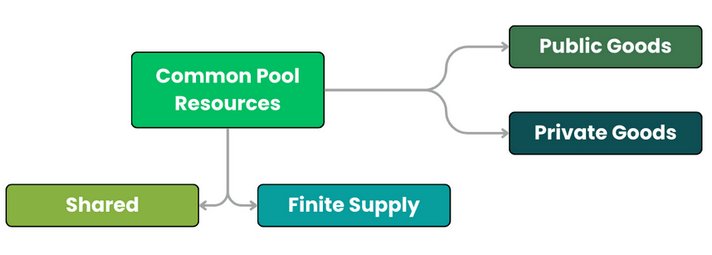
- Rivalrous → one person’s use reduces availability for others.
- Non-excludable → difficult to prevent people from using them.
Rivalrous + Non-excludable → Common pool resource
Examples:
- Fisheries
- Forests
- Clean air and water
Key Problem: Tragedy of the Commons
The tragedy of the commons occurs when individuals overuse a shared resource because they act in their own self-interest, leading to resource depletion.
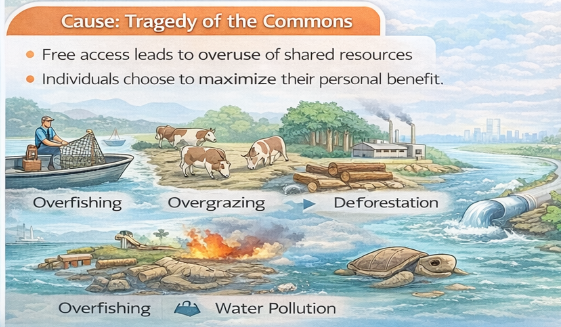
Economic Explanation
- Individuals gain full benefit from using the resource.
- However, the cost is shared by society.
- This leads to overuse and depletion.
Private benefit > Private cost → Overuse
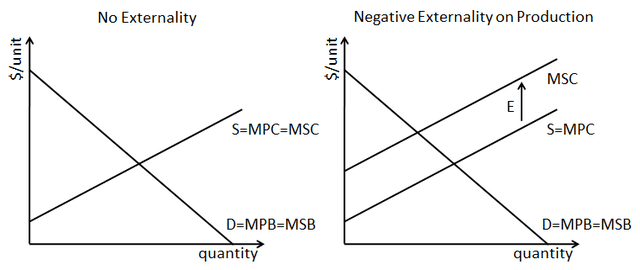
Connection to Negative Externalities

- Use of CPRs creates negative externalities.
- MSC > MPC
- Results in overproduction/overconsumption.
- Leads to welfare loss.
Unsustainable Production
- Resources are used faster than they can regenerate.
- Future availability is reduced.
- Causes long-term environmental damage.
Overuse → Depletion → Sustainability problem
Government Intervention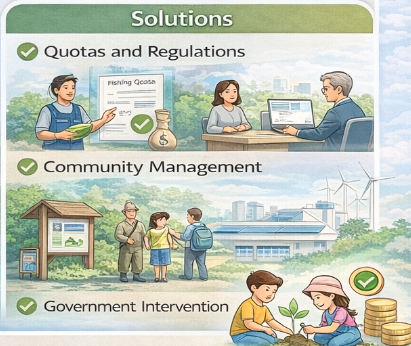
- Regulation (e.g. quotas, fishing limits).
- Taxes to reduce usage.
- Tradable permits (cap-and-trade systems).
- Privatisation to assign property rights.
Evaluation:
- Regulation can be effective but costly to enforce.
- Taxes provide incentives but may be difficult to set correctly.
- Privatisation may improve efficiency but reduce equity.
Example 1
Explain why fisheries are prone to the tragedy of the commons.
▶️ Answer / Explanation
Fisheries are non-excludable, so anyone can fish.
They are rivalrous, as fish caught by one reduces availability for others.
Fishermen act in self-interest and overfish.
This leads to depletion of fish stocks.
Thus, the tragedy of the commons occurs.
Example 2
Evaluate how tradable permits can solve the problem of common pool resources.
▶️ Answer / Explanation
Tradable permits limit total resource use.
Firms must hold permits to use resources.
This reduces overuse and promotes efficiency.
However, setting the correct limit is difficult.
There may also be issues of fairness.