
Monopolistic Competition (HL)
Profit Maximization
Firms in monopolistic competition maximize profit where marginal cost (MC) equals marginal revenue (MR), but due to product differentiation, they have some control over price.
MC = MR
1. Short Run Profit Maximization
In the short run, firms can earn abnormal profit, normal profit, or losses.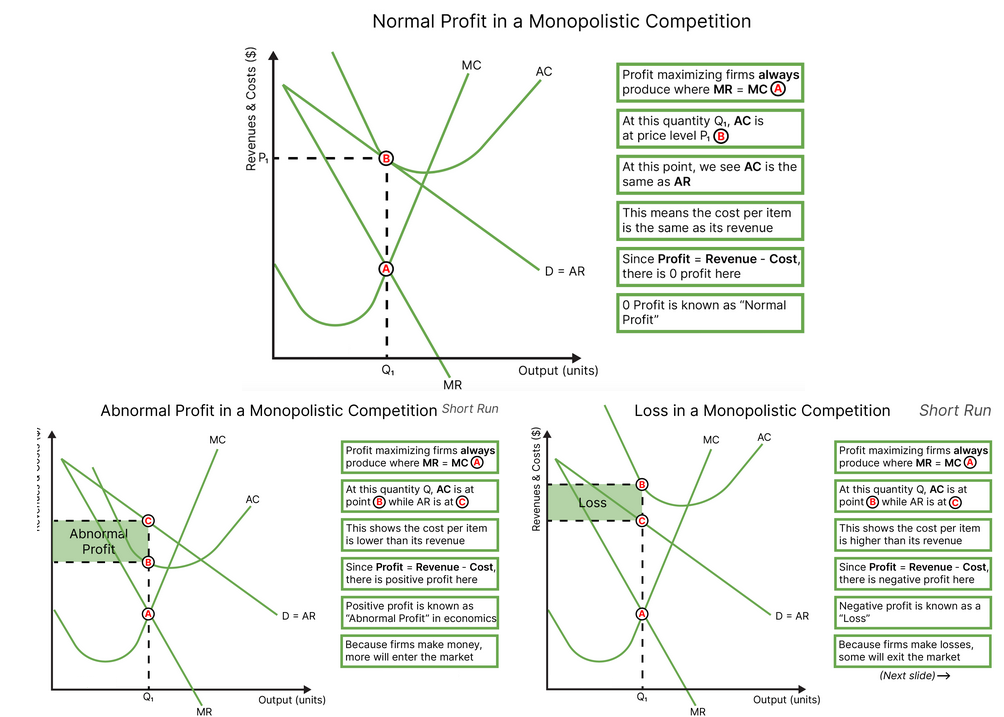
Explanation:
- Firm produces where MC = MR.
- Price is determined from the demand (AR) curve.
- Since demand is downward sloping:
P = AR > MR
Possible Outcomes:
- If AR > AC → Abnormal profit
- If AR = AC → Normal profit
- If AR < AC → Loss
Economic Logic:
- Product differentiation allows firms to earn abnormal profit in the short run.
- Firms have some market power.
2. Long Run Profit Maximization
In the long run, firms earn only normal profit due to free entry and exit.
Explanation:
- If firms earn abnormal profit → new firms enter the market.
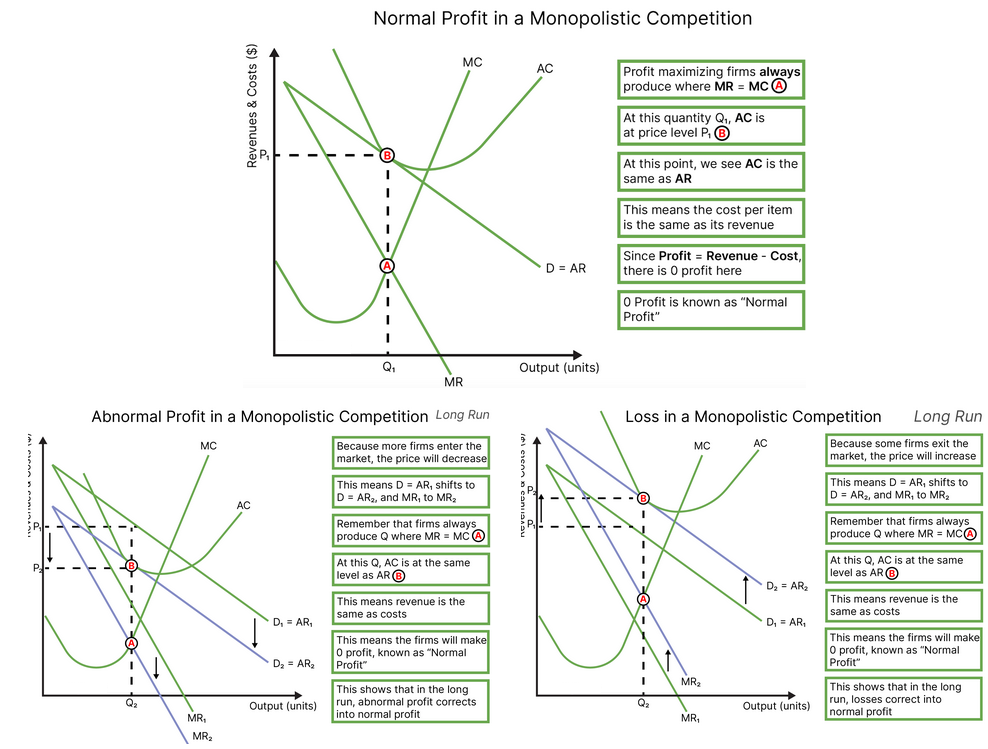
- Entry increases competition and reduces demand for each firm.
- The demand curve shifts left until:
AR = AC → Normal profit
Long Run Equilibrium Condition:
MC = MR and AR = AC
- Firms earn zero economic profit.
- However, price remains above marginal cost:
P > MC
Key Feature:
- Firms do not produce at minimum AC.
- This leads to excess capacity.
Economic Significance:
- Short run allows profit due to differentiation.
- Long run removes profit due to competition.
- Still allocatively inefficient because P > MC.
Example 1
Explain how a monopolistically competitive firm can earn abnormal profit in the short run.
▶️ Answer / Explanation
The firm produces where MC equals MR.
Due to product differentiation, it can charge a price above cost.
If AR is greater than AC, the firm earns abnormal profit.
Example 2
Explain why firms earn only normal profit in the long run in monopolistic competition.
▶️ Answer / Explanation
Free entry allows new firms to enter when profits exist.
This reduces demand for existing firms.
The demand curve shifts until AR equals AC.
Thus, only normal profit remains.
Less Market Power Due to Many Substitutes — More Elastic Demand Curve
Firms in monopolistic competition have less market power compared to monopoly because there are many close substitutes available in the market.
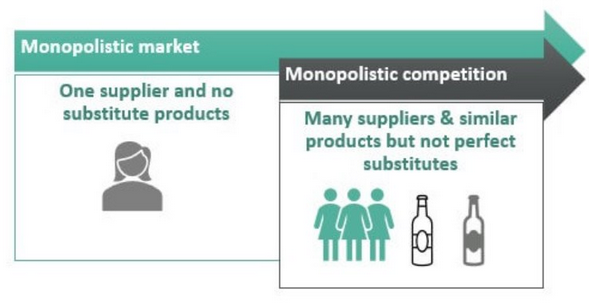
More substitutes → More elastic demand → Less market power
Explanation:
- Each firm produces a differentiated product, but similar alternatives exist.
- Consumers can easily switch between brands if price changes.
- This limits the firm’s ability to raise prices.
Elastic Demand Curve
- The demand curve faced by the firm is downward sloping but relatively elastic.
- A small increase in price leads to a large fall in quantity demanded.
- This is because consumers can switch to substitutes.
Elastic demand → High responsiveness to price changes
Comparison with Monopoly:
| Feature | Monopolistic Competition | Monopoly |
|---|---|---|
| Substitutes | Many close substitutes | No close substitutes |
| Demand Curve | More elastic | Less elastic |
| Market Power | Limited | High |
Economic Logic:
- Availability of substitutes increases price sensitivity.
- Firms cannot raise prices significantly without losing customers.
- This reduces their ability to earn long-term abnormal profit.
Implications:
- Prices are closer to competitive levels.
- Firms still have some market power due to differentiation.
- Encourages non-price competition.
Example 1
Explain why demand is more elastic in monopolistic competition.
▶️ Answer / Explanation
There are many close substitutes in the market.
If a firm raises price, consumers switch to other products.
This makes demand highly responsive to price changes.
Thus, demand is more elastic.
Example 2
Evaluate how the availability of substitutes affects market power.
▶️ Answer / Explanation
More substitutes increase competition.
Firms cannot raise prices without losing customers.
This reduces market power.
However, differentiation still provides some control.
Thus, market power is limited but not eliminated.
Allocative Inefficiency (Market Failure)
Firms in monopolistic competition are allocatively inefficient because they do not produce at the socially optimal level of output.
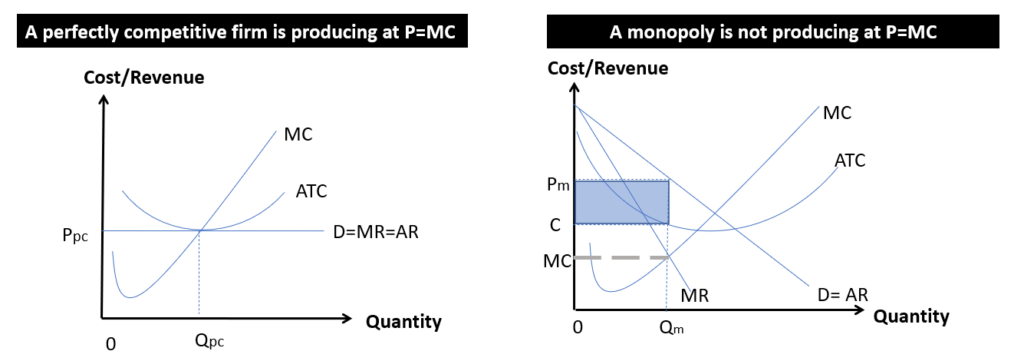
- Allocative efficiency → P = MC
- Monopolistic competition → P > MC
Explanation:
- Firms have some market power due to product differentiation.
- They set price above marginal cost:
P > MC
- This leads to underproduction relative to the socially optimal level.
- Some consumers who value the good more than its cost cannot purchase it.
Consequences:
- Loss of consumer and producer surplus
- Creation of deadweight loss
- Resources are not used optimally
Less Inefficiency, More Product Variety
Compared to monopoly, monopolistic competition results in less inefficiency and provides greater product variety.
Explanation:
- There are many firms competing in the market.
- Market power is limited due to availability of substitutes.
- Prices are closer to marginal cost than in monopoly.
- Deadweight loss is smaller compared to monopoly.
Product Variety:
- Firms differentiate products based on quality, design, branding, and features.
- Consumers benefit from a wider range of choices.
- Different preferences are better satisfied.
Trade-Off:
- Advantage: Greater variety and consumer choice.
- Disadvantage: Some inefficiency (P > MC).
More variety ✔
Perfect efficiency ✖
Economic Evaluation:
- Consumers may value variety more than perfect efficiency.
- Thus, monopolistic competition can be welfare-enhancing despite inefficiency.
- Represents a balance between competition and differentiation.
Example 1
Explain why monopolistic competition leads to allocative inefficiency.
▶️ Answer / Explanation
Firms set price above marginal cost.
This leads to underproduction.
Some consumers cannot buy the product.
Thus, allocative inefficiency occurs.
Example 2
Evaluate whether monopolistic competition is beneficial for consumers.
▶️ Answer / Explanation
Monopolistic competition provides a wide variety of products.
This increases consumer choice and satisfaction.
However, it leads to some inefficiency.
Thus, it benefits consumers but is not perfectly efficient.