
Monopoly (HL)
A monopoly is a market structure where a single firm dominates the entire market and has significant market power. Due to high barriers to entry, new firms cannot easily enter, allowing the monopolist to maintain control. The firm faces a downward-sloping demand curve, meaning it must lower price to increase sales. As a result, the monopolist acts as a price maker and can influence both price and output. This often leads to outcomes different from competitive markets.
1. Profit Maximization
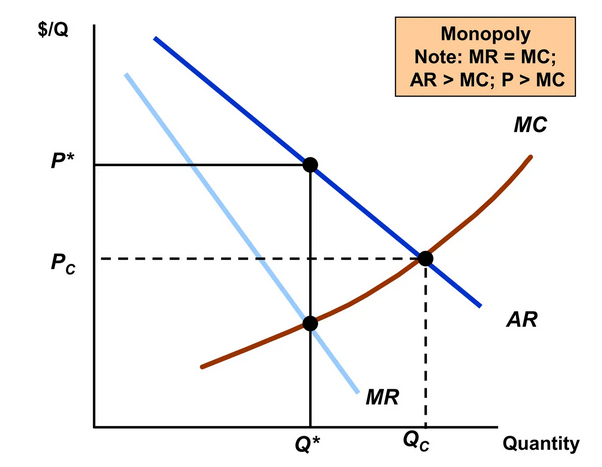
A monopoly firm maximizes profit by producing the level of output where marginal cost (MC) equals marginal revenue (MR).
MC = MR
Explanation:
- A monopolist faces a downward-sloping demand curve (AR curve).
- To sell more output, the firm must lower price.
- This means:
MR < AR (Price)
- The firm chooses output where MC = MR.
- The price is then determined from the demand (AR) curve.
Outcome:
- Price is set above marginal cost:
P > MC
- The firm can earn abnormal profit in both short run and long run.
- This is possible due to barriers to entry.
Economic Logic :
- Unlike perfect competition, the monopolist controls both price and output.
- Profit maximization leads to restricted output compared to competitive markets.
2. Allocative Inefficiency (Market Failure)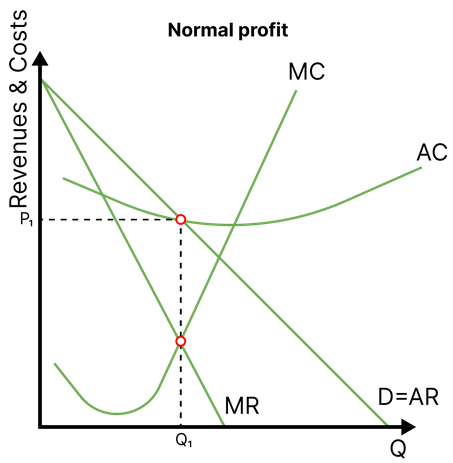
A monopoly leads to allocative inefficiency because it does not produce at the socially optimal level of output.
Explanation:
- Allocative efficiency requires:
P = MC
- However, in a monopoly:
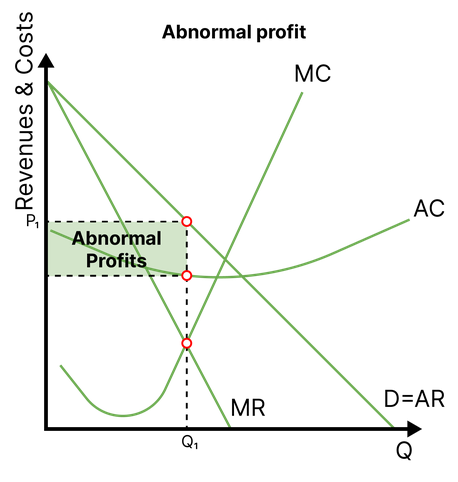
P > MC
- The price consumers pay is higher than the cost of producing the last unit.
- This means some beneficial trades do not occur.
Why This is Inefficient:
- Consumers value additional units more than their cost of production.
- But the firm restricts output to maximize profit.
- This leads to underproduction.
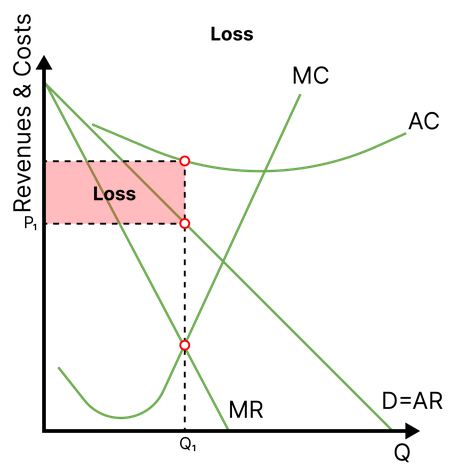
Consequences:
- Higher prices for consumers.
- Lower quantity produced.
- Loss of social welfare.
- Creation of deadweight loss.
P > MC → Allocative inefficiency
Example 1
Explain how a monopoly firm maximizes profit.
▶️ Answer / Explanation
A monopoly produces where marginal cost equals marginal revenue.
It then sets price from the demand curve.
Since price is greater than marginal cost, it earns profit.
Example 2
Explain why monopoly leads to allocative inefficiency.
▶️ Answer / Explanation
Allocative efficiency requires price to equal marginal cost.
In monopoly, price is greater than marginal cost.
This leads to underproduction.
Some beneficial trades do not occur.
Thus, the market is inefficient.
3. Welfare Loss in a Monopoly (Compared to Perfect Competition)
A monopoly leads to a welfare loss compared to perfect competition because it produces less output and charges a higher price.
Monopoly → Higher price + Lower output → Welfare loss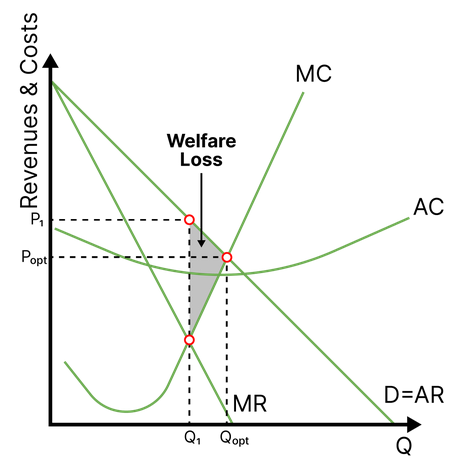
Explanation:
- In perfect competition, output is produced where:
P = MC (allocative efficiency)
- In a monopoly, output is produced where:
MC = MR
- Since MR < AR, this leads to:
P > MC
Key Difference:
- Monopoly output is lower than the socially optimal level.
- Monopoly price is higher than in perfect competition.
Welfare Loss (Deadweight Loss):
- Some consumers who are willing to pay more than the cost of production cannot buy the good.
- These lost transactions represent a loss of total surplus.
- This is called deadweight loss.
Lost trades → Loss of social welfare
Economic Logic:
- Monopolies restrict output to increase profit.
- This creates allocative inefficiency.
- Perfect competition maximizes social surplus, while monopoly reduces it.
4. Natural Monopoly
A natural monopoly occurs when a single firm can supply the entire market at a lower cost than multiple firms.
One firm → Lowest cost → Natural monopoly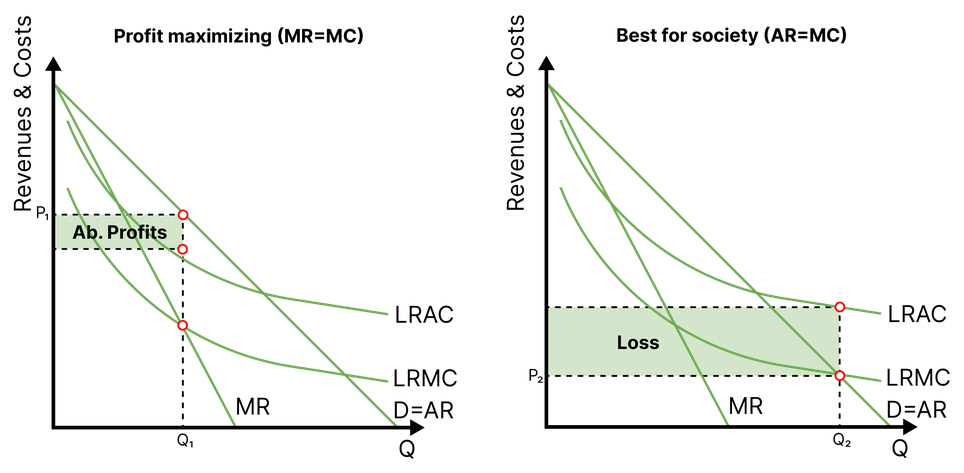
Explanation:
- Characterized by very high fixed costs and strong economies of scale.
- Average cost (AC) continues to fall as output increases.
- It is inefficient for multiple firms to operate in the market.
Examples:
- Electricity supply
- Water supply
- Railways
Implications:
- A single firm can produce at lower cost than many firms.
- However, it still has market power.
- This may lead to high prices and inefficiency.
Evaluation:
- Natural monopolies can be efficient in production (lower costs).
- But may be allocatively inefficient due to high prices.
- Often require government regulation.
Example 1
Explain why monopoly leads to welfare loss.
▶️ Answer / Explanation
A monopoly produces less output than the socially optimal level.
It charges a higher price.
Some consumers who value the good cannot buy it.
This results in deadweight loss.
Example 2
Evaluate whether natural monopolies are beneficial for society.
▶️ Answer / Explanation
Natural monopolies benefit from economies of scale and lower costs.
This can make production efficient.
However, they may charge high prices due to lack of competition.
Thus, they require regulation to protect consumers.