
Movements Along the Supply Curve and Shifts of the Supply Curve
In supply analysis, it is essential to clearly distinguish between:
- Movement along the supply curve (change in quantity supplied)
- Shift of the supply curve (change in supply)
This distinction is fundamental for analysing firm behaviour and market outcomes.
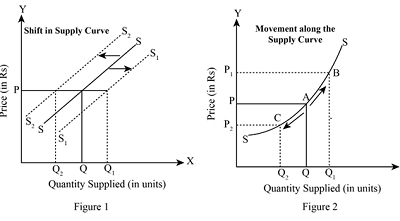
- Price change → Movement
- Non-price change → Shift
Movement Along the Supply Curve (Change in Quantity Supplied)
A movement along the supply curve occurs when there is a change in the price of the good itself, with all other factors held constant (ceteris paribus).
- Only price changes cause movement along the curve.
- Represents a change in quantity supplied, not supply.
- Shown as movement from one point to another on the same supply curve.
Types of Movement:
Extension in supply: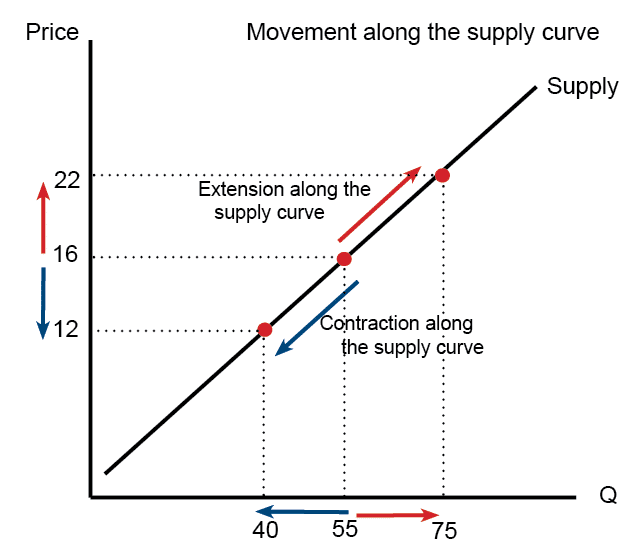
- Occurs when price rises.
- Quantity supplied increases.
- Movement upward along the curve.
Contraction in supply:
- Occurs when price falls.
- Quantity supplied decreases.
- Movement downward along the curve.
Economic Logic:
- Higher prices increase profitability, encouraging more production.
- Lower prices reduce profitability, discouraging production.
Same curve → Different point
Shift of the Supply Curve (Change in Supply)
A shift of the supply curve occurs when there is a change in any non-price determinant of supply, affecting supply at every price level.
- Caused by factors such as costs of production, taxes, subsidies, technology, expectations, and number of firms.
- Represents a change in supply, not just quantity supplied.
- The entire supply curve moves to a new position.
Types of Shift:
Increase in supply:
- Supply curve shifts to the right.

- More is supplied at every price level.
- Example: improvement in technology.
- Supply curve shifts to the right.
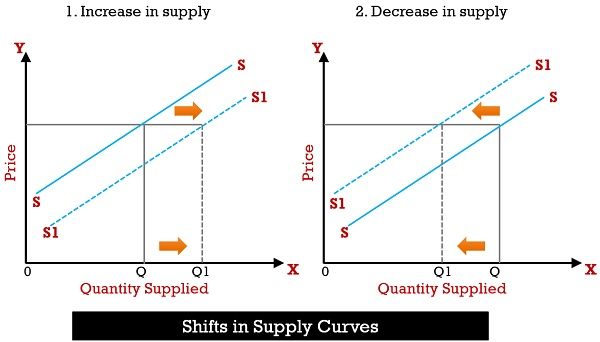
Decrease in supply:
- Supply curve shifts to the left.
- Less is supplied at every price level.
- Example: increase in production costs.
Economic Logic:
- Lower costs increase profitability and encourage production.
- Higher costs reduce profitability and discourage production.
New curve → Supply changes at all prices
Detailed Comparison
| Aspect | Movement Along Curve | Shift of Curve |
|---|---|---|
| Cause | Change in price | Change in non-price factors |
| What changes | Quantity supplied | Supply |
| Curve | Same supply curve | New supply curve |
| Direction | Up or down along curve | Left or right shift |
| Example | Price rise → more supplied | Tax increase → supply decreases |
Common Exam Mistakes (VERY IMPORTANT)
- Confusing “increase in supply” with “increase in quantity supplied”.
- Assuming price changes shift the supply curve (they do not).
- Not identifying the correct determinant (price vs non-price).
- Incorrect direction of shift.
Key Ideas:
- Price change → movement along supply curve
- Non-price change → shift of supply curve
- This distinction is critical for analysing market equilibrium.
- Always identify the cause before describing the effect.
Example 1
Explain the difference between extension in supply and increase in supply.
▶️ Answer / Explanation
Extension in supply occurs due to a rise in price, leading to movement along the supply curve.
Increase in supply occurs due to a non-price factor, such as improved technology, shifting the supply curve to the right.
Thus, extension is a movement, while increase is a shift.
Example 2
Evaluate how a decrease in production costs affects supply and quantity supplied.
▶️ Answer / Explanation
A decrease in production costs is a non-price factor.
It increases supply at all price levels, shifting the supply curve to the right.
This is a change in supply, not just quantity supplied.
However, if price also changes after the shift, there may be movement along the new curve.
Thus, cost changes shift supply, while price changes cause movement.