
Oligopoly (HL)
An oligopoly is a market structure dominated by a small number of large firms, where each firm has significant market power and firms are interdependent in their decision-making.
Few firms → Interdependence → Strategic behaviour
1. Collusive vs Non-Collusive Oligopoly
Firms in an oligopoly may either collude (cooperate) or act independently in a non-collusive manner.
Collusive Oligopoly
Collusion occurs when firms agree to coordinate their actions to reduce competition and increase profits.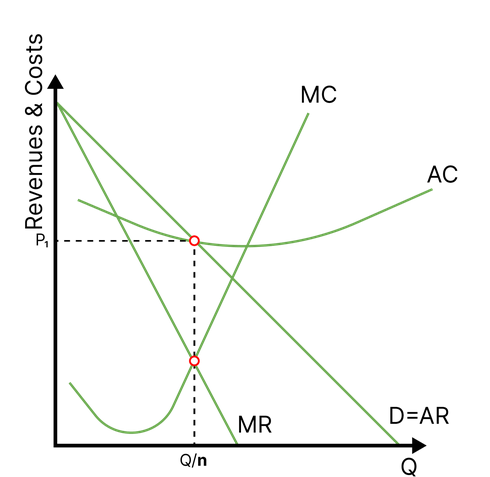
Explanation:
- Firms agree on price, output, or market share.
- They behave like a monopoly to maximize joint profits.
- Collusion can be:
- Formal (cartel) — explicit agreement
- Tacit — informal understanding
Impact:
- Higher prices
- Lower output
- Higher profits
- Loss of consumer welfare
Non-Collusive Oligopoly
In a non-collusive oligopoly, firms act independently but remain aware of competitors.
Explanation:
- Firms compete without formal agreements.
- Decisions are influenced by expected reactions of rivals.
- Competition may be based on price or non-price strategies.
Impact:
- More competitive outcomes than collusion
- Possibility of price wars
- Lower profits compared to collusion
2. Interdependence, Risk of Price War, Incentive to Collude, Incentive to Cheat
Interdependence
Firms in an oligopoly are interdependent, meaning each firm must consider how its decisions will affect rivals and how rivals will respond.
- Firms cannot act independently like in perfect competition.
- Strategic decision-making is essential.
- Actions by one firm trigger reactions from others.
Risk of Price War
A price war occurs when firms continuously lower prices to compete with each other.
- If one firm cuts price, others may follow.
- This can lead to falling prices and profits.
- Firms may avoid price competition to prevent this.
Incentive to Collude
Firms have an incentive to collude in order to increase joint profits.
- By cooperating, firms can behave like a monopoly.
- This allows them to charge higher prices.
- Reduces uncertainty and competition.
Incentive to Cheat
Even when firms collude, each firm has an incentive to cheat on the agreement.
- A firm may secretly lower prices to gain more market share.
- This increases its individual profit.
- However, if all firms cheat, collusion breaks down.
Economic Logic:
- Oligopoly behaviour is unstable due to conflicting incentives.
- Firms want to cooperate but also compete.
- This creates strategic tension in the market.
Example 1
Explain why firms in an oligopoly may choose to collude.
▶️ Answer / Explanation
Firms collude to reduce competition and increase profits.
By acting like a monopoly, they can charge higher prices.
This increases joint profits.
Example 2
Explain why collusion in an oligopoly may be unstable.
▶️ Answer / Explanation
Firms have an incentive to cheat by lowering prices.
This allows them to gain more customers.
If all firms cheat, collusion breaks down.
Thus, collusion is difficult to maintain.
3. Allocative Inefficiency (Market Failure)
Oligopolies can lead to allocative inefficiency, meaning resources are not allocated in the most socially optimal way.
Allocative efficiency requires → P = MC 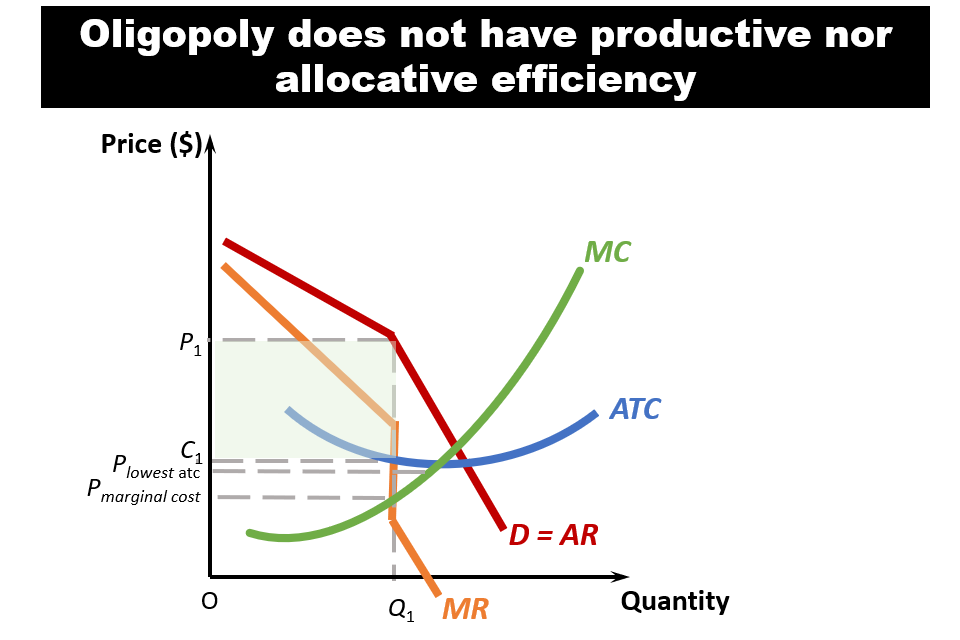
Oligopoly → P > MC → Inefficiency
Explanation:
- Firms in an oligopoly have market power.
- They set prices above marginal cost:
P > MC
- This leads to underproduction compared to the socially optimal level.
- Some consumers who value the good more than its cost cannot purchase it.
Consequences:
- Higher prices for consumers
- Lower output
- Loss of consumer and producer surplus
- Creation of deadweight loss
Economic Logic (HL Insight):
- Oligopolies behave closer to monopolies when collusion occurs.
- This increases inefficiency.
- Even without collusion, market power can still distort allocation.
Simple Game Theory Payoff Matrix
Game theory is used to analyze strategic decision-making between firms in an oligopoly.
Explanation:
- Firms must choose strategies while considering competitors’ actions.
- Outcomes depend on the decisions of all firms.
- A payoff matrix shows the possible outcomes.
Example: Price Strategy (High Price vs Low Price)
| Firm B: High Price | Firm B: Low Price | |
|---|---|---|
| Firm A: High Price | 10 , 10 | 2 , 15 |
| Firm A: Low Price | 15 , 2 | 5 , 5 |
(Numbers represent profits of Firm A , Firm B)
Interpretation:
- If both firms charge high price → high joint profits (collusion).
- If one firm cheats (low price) → it gains more profit.
- If both choose low price → profits fall for both.
Key Concept: Prisoner’s Dilemma
- Each firm has an incentive to cheat.
- Rational decision leads to low price outcome.
- This is worse than collusion.
Individual rationality → Worse collective outcome
Economic Significance:
- Explains why collusion is difficult to maintain.
- Shows strategic behaviour in oligopoly.
- Helps understand price rigidity and competition.
Example 1
Explain why oligopoly may lead to allocative inefficiency.
▶️ Answer / Explanation
Firms have market power and set prices above marginal cost.
This leads to underproduction.
Some consumers cannot buy the product.
Thus, allocative inefficiency occurs.
Example 2
Explain how game theory shows the instability of collusion.
▶️ Answer / Explanation
Each firm has an incentive to cheat by lowering price.
This increases its individual profit.
If both firms cheat, profits fall.
This shows collusion is unstable.
5. Price and Non-Price Competition
Firms in an oligopoly compete using both price competition and non-price competition, depending on market conditions and strategic considerations.
Price Competition
Price competition occurs when firms compete by changing the price of their products. 
Explanation:
- Firms lower prices to attract more customers.
- May increase market share.
- Often leads to price wars if rivals respond.
Impact:
- Lower prices for consumers
- Reduced profits for firms
- Can be unstable due to interdependence
Non-Price Competition
Non-price competition occurs when firms compete without changing price.
Explanation:
- Firms use advertising, branding, quality improvement, and customer service.
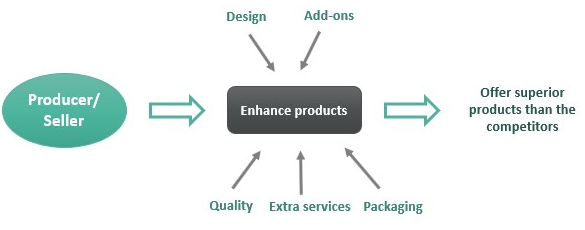
- Focus on product differentiation.
- Common in oligopolies to avoid price wars.
Impact:
- Builds brand loyalty
- Allows firms to maintain prices
- Increases costs (e.g. advertising)
Economic Logic:
- Due to interdependence, firms avoid aggressive price cuts.
- Non-price competition is often preferred.
- Helps maintain stable prices in oligopoly markets.
6. Measurement of Market Concentration — Concentration Ratios
Market concentration refers to the extent to which a market is dominated by a small number of firms.
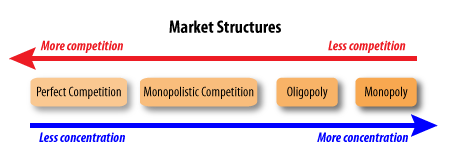
Concentration ratio measures the combined market share of the largest firms in an industry.
Explanation:
- The most common measure is the CR4 (four-firm concentration ratio).
- It shows the total market share of the largest four firms.
CR4 = Sum of market shares of top 4 firms
Interpretation:
- High concentration ratio → Few firms dominate → Oligopoly or monopoly
- Low concentration ratio → Many firms → Competitive market
Example:
- If top 4 firms have market shares of 30%, 25%, 20%, and 15%:
CR4 = 30 + 25 + 20 + 15 = 90%
- This indicates a highly concentrated market.
Economic Significance:
- Helps assess the degree of competition.
- Higher concentration → greater market power.
- Used by governments to monitor markets.
Limitations:
- Does not show distribution among firms.
- Ignores smaller firms.
- May not fully reflect competitive behaviour.
Example 1
Explain why firms in an oligopoly prefer non-price competition.
▶️ Answer / Explanation
Price competition may lead to price wars.
This reduces profits for all firms.
Non-price competition allows firms to attract customers without lowering prices.
Thus, it is preferred.
Example 2
Explain what a high concentration ratio indicates.
▶️ Answer / Explanation
A high concentration ratio means a few firms dominate the market.
This indicates high market power.
It suggests the market is likely an oligopoly or monopoly.