
Functions of the Price Mechanism
Resource Allocation
The price mechanism plays a central role in allocating scarce resources in an economy. It determines what to produce, how to produce, and for whom to produce through the interaction of demand and supply.
Price mechanism → Efficient allocation of scarce resources
Explanation:
- Resources such as land, labour, and capital are limited.
- The price mechanism ensures these resources are directed toward their most valued uses.
- Goods that are highly demanded (higher price) attract more resources.
- Goods with low demand (lower price) receive fewer resources.
How Resource Allocation Works:
- When demand for a good increases, its price rises.
- Higher prices signal higher profitability.
- Firms allocate more resources to produce that good.
- Less demanded goods see resources shift away.
Higher demand → Higher price → More resources allocated
Components of Resource Allocation:
This function operates through two key mechanisms:
- Signalling (price as information)
- Incentive (profit motivation)
- Rationing
These will be studied separately next.
Example 1
Explain how the price mechanism allocates resources in response to an increase in demand for electric cars.
▶️ Answer / Explanation
An increase in demand for electric cars raises their price.
This signals higher profitability to firms.
Firms allocate more resources such as labour and capital to electric car production.
As a result, output increases and resources shift away from less demanded goods.
Thus, the price mechanism allocates resources efficiently.
Example 2
Evaluate the effectiveness of the price mechanism in allocating resources in a free market.
▶️ Answer / Explanation
The price mechanism allocates resources efficiently by directing them toward goods with high demand.
Firms respond to higher prices by increasing production, ensuring resources are used where they are most valued.
However, it may fail in cases of market failure, such as public goods or externalities.
In such cases, resources may be over- or under-allocated.
Therefore, while effective in many situations, the price mechanism is not always perfect.
Resource Allocation – Signalling and Incentive Functions
The price mechanism allocates resources through two closely related functions:
- Signalling – prices provide information
- Incentive – prices motivate behaviour
Together, they ensure that resources are directed toward their most valued uses in the economy.
Signalling Function
The signalling function refers to the role of prices in conveying information about changes in demand and supply.
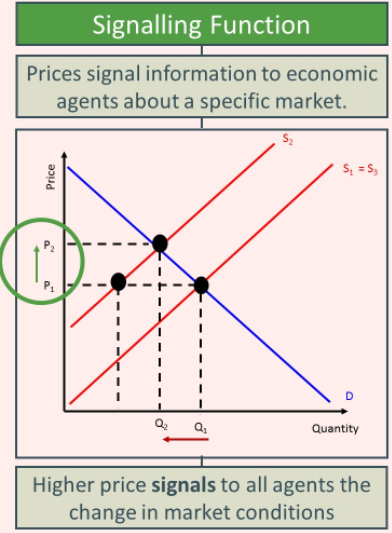
- A rise in price signals increased demand or scarcity.
- A fall in price signals decreased demand or excess supply.
- These signals help both producers and consumers make decisions.
Impact:
- Producers interpret higher prices as a signal to increase production.
- Consumers interpret higher prices as a signal to reduce consumption or switch goods.
Price change → Information → Decision-making
Incentive Function
The incentive function refers to how price changes motivate producers and consumers to change their behaviour.
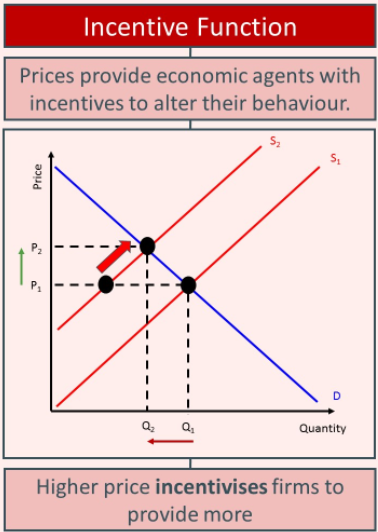
- Higher prices provide an incentive for firms to increase supply.
- Lower prices provide an incentive for consumers to increase demand.
- Falling prices discourage producers from supplying goods.
Impact:
- Firms respond to profit incentives by reallocating resources.
- Consumers respond by adjusting consumption based on affordability.
Price change → Motivation → Behaviour change
How Signalling and Incentives Work Together
- A price increase first acts as a signal of scarcity or higher demand.
- This signal creates an incentive for firms to produce more.
- At the same time, consumers are incentivized to reduce consumption.
- This dual effect helps restore market equilibrium.
Signal (information) + Incentive (motivation) → Resource allocation
Key Differences:
| Aspect | Signalling | Incentive |
|---|---|---|
| Role | Provides information | Motivates behaviour |
| Focus | Market conditions | Response to profit/utility |
| Effect | Guides decisions | Drives actions |
Example 1
Explain how signalling and incentive functions work together when the price of oil increases.
▶️ Answer / Explanation
A rise in oil prices signals increased demand or reduced supply.
This information encourages producers to increase output.
At the same time, higher prices provide an incentive for consumers to reduce usage.
Thus, signalling provides information, while incentives motivate behaviour changes.
Example 2
Evaluate the importance of signalling and incentives in achieving efficient resource allocation.
▶️ Answer / Explanation
Signalling ensures that producers and consumers are informed about market conditions.
Incentives ensure that they respond appropriately to these signals.
Together, they direct resources toward goods with high demand.
However, if prices are distorted due to market failure or government intervention, signals and incentives may be misleading.
This can result in inefficient allocation of resources.
Rationing Function
The rationing function of the price mechanism refers to the role of prices in allocating goods and services among consumers when there is scarcity.
Higher price → Fewer consumers can buy → Resources allocated
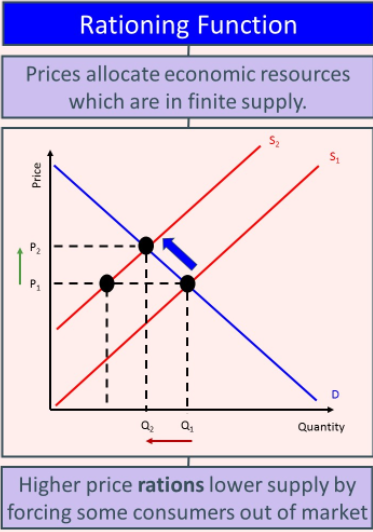
- Resources are limited, so not all consumers can obtain every good.
- Prices act as a rationing device, determining who can afford to buy a good.
- Only consumers who are willing and able to pay the price will obtain the good.
- Those who cannot afford it are excluded from consumption.
How Rationing Works:
- When demand exceeds supply, a shortage occurs.
- This pushes the price upward.
- As price rises:
- Some consumers drop out of the market.
- Quantity demanded decreases.
- Eventually, only those who value the good most (highest willingness to pay) purchase it.
Shortage → Price ↑ → Demand ↓ → Rationing
Advantages of Rationing by Price:
- Efficient allocation of scarce resources.
- No need for government intervention.
- Quick and automatic adjustment.
Limitations (Evaluation):
- Ignores equity – goods go to those who can pay, not those who need them most.
- May disadvantage low-income groups.
- Can lead to unequal access to essential goods (e.g. healthcare).
Example 1
Explain how the price mechanism rations scarce goods.
▶️ Answer / Explanation
When a good is scarce, demand exceeds supply, creating a shortage.
This pushes prices up.
As prices rise, some consumers can no longer afford the good.
Only those willing and able to pay continue to purchase it.
Thus, price rations the good among consumers.
Example 2
Evaluate the effectiveness of price as a rationing mechanism in the housing market.
▶️ Answer / Explanation
In the housing market, rising demand increases prices.
This rations housing by allowing only higher-income individuals to afford homes.
While this allocates housing efficiently to those willing to pay more, it creates inequality.
Lower-income groups may be excluded from essential housing.
Therefore, price is efficient but may be inequitable.