
Public Goods
Public goods are goods that are non-rivalrous and non-excludable, meaning they can be consumed by many people without reducing availability and no one can be prevented from using them.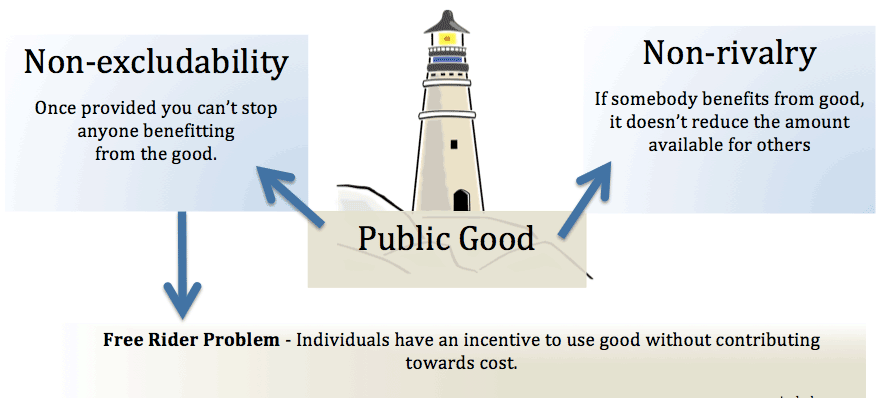
Non-rival + Non-excludable → Public good
Key Characteristics
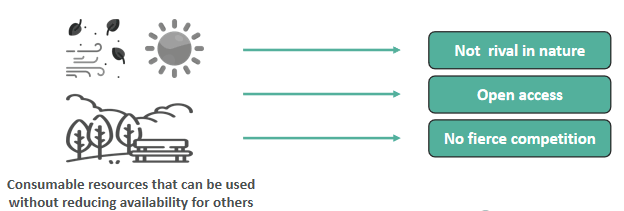
Non-rivalrous:
- Consumption by one person does not reduce the amount available for others.
- Example: Street lighting, national defence.
Non-excludable:
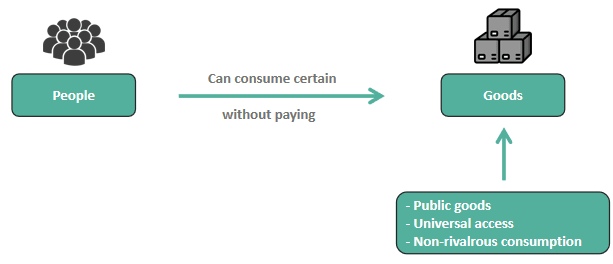
- It is not possible to exclude people from using the good.
- Once provided, everyone can benefit.
The Free Rider Problem
The free rider problem occurs when individuals benefit from a good without paying for it.
- Since people cannot be excluded, they have no incentive to pay.
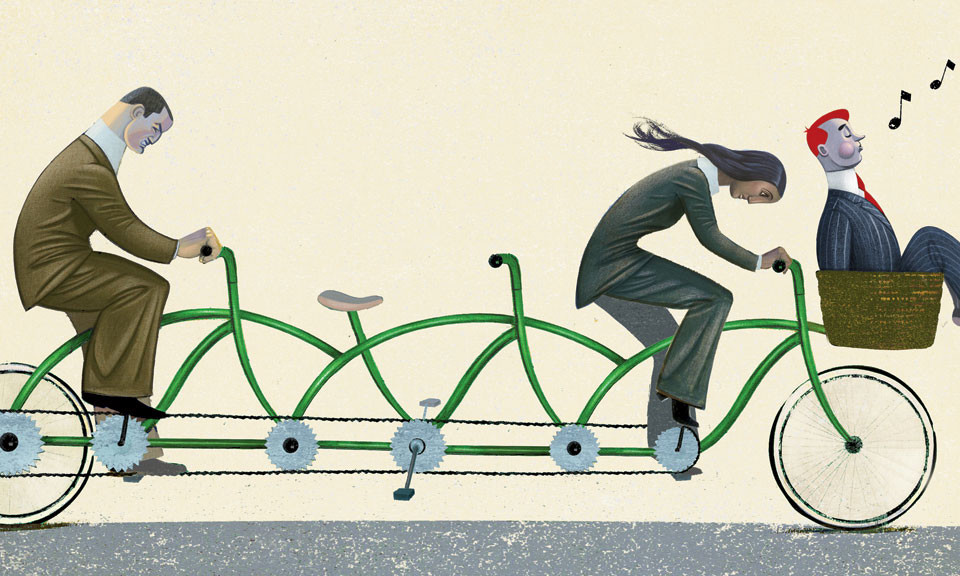
- They rely on others to fund the good.
- This leads to underprovision or no provision in a free market.
No incentive to pay → Market failure
Economic Explanation
- Firms cannot charge consumers effectively.
- Revenue cannot be generated despite demand.
- As a result, private firms will not supply public goods.
Thus:
- Market equilibrium leads to:
\( \mathrm{Q = 0} \) or underprovision
- Socially optimal level requires:
\( \mathrm{MSB = MSC} \)
Government Intervention
- Direct provision funded through taxation.
- Ensures the good is provided at or near the socially optimal level.
Government provides → Corrects market failure
Evaluation:
- Provision improves efficiency and social welfare.
- However, may lead to government failure (inefficiency, overprovision).
Key Point:
- Public goods are non-rivalrous and non-excludable.
- Free rider problem leads to underprovision.
- Private markets fail to supply these goods.
- Government intervention is necessary.
Example 1
Explain why public goods are not provided by the free market.
▶️ Answer / Explanation
Public goods are non-excludable, so people cannot be charged.
Consumers may free ride and avoid paying.
Firms cannot earn revenue.
Thus, the good is not provided by the market.
Example 2
Evaluate the role of government in providing public goods.
▶️ Answer / Explanation
Government funds public goods through taxation.
This ensures provision despite free rider problem.
Social welfare increases.
However, government provision may be inefficient.