
Rational Consumer Choice (HL)
Assumptions: Consumer Rationality, Utility Maximization, and Perfect Information
The theory of rational consumer choice explains how consumers make decisions to achieve the maximum satisfaction (utility) given their limited income and the prices of goods.
This theory is based on three key assumptions:
- Consumer rationality
- Utility maximization
- Perfect information
1. Consumer Rationality
Consumer rationality means that consumers make decisions in a logical and consistent way to achieve the highest possible satisfaction.
Explanation:
- Consumers have clear preferences and can rank different choices.
- They choose the option that provides the greatest benefit.
- They behave consistently when faced with similar choices.
- They aim to use their limited income in the most effective way.
HL Insight:
- Rationality assumes consumers are not influenced by emotions or irrational behaviour.
- In reality, behavioural economics shows that this assumption may not always hold.
2. Utility Maximization
Utility maximization means that consumers allocate their income in a way that maximizes total satisfaction from consumption.
Explanation:
- Consumers compare the marginal utility (MU) of goods with their prices.
- They choose a combination of goods where satisfaction is maximized.
- The condition for maximum utility is:
\( \mathrm{\frac{MU_x}{P_x} = \frac{MU_y}{P_y}} \)
- This ensures that the last unit of money spent on each good gives equal satisfaction.
HL Insight:
- This rule is known as the equimarginal principle.
- It explains how consumers distribute income across different goods.
3. Perfect Information
Perfect information means that consumers have complete and accurate knowledge about:
- Prices of goods

- Quality of products
- Available alternatives
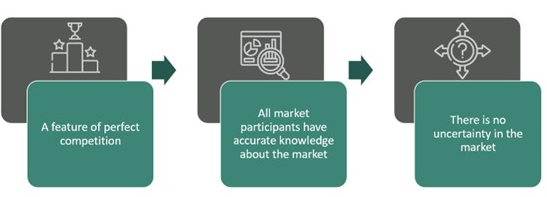
Explanation:
- Consumers can compare all options before making decisions.
- They are able to choose the best possible combination of goods.
- This ensures optimal decision-making.
HL Insight:
- In reality, information is often imperfect or incomplete.
- This can lead to poor decisions and market failure.
Example 1
Explain how a rational consumer allocates income to maximize utility.
▶️ Answer / Explanation
A rational consumer compares marginal utility per unit of money spent on different goods.
They allocate income such that MU/P is equal across all goods.
This ensures maximum total satisfaction from limited income.
Example 2
Evaluate the realism of the assumption of perfect information.
▶️ Answer / Explanation
The assumption of perfect information suggests consumers know all prices and product details.
In reality, information is often incomplete or misleading.
This can lead to poor choices and inefficiency.
Therefore, while useful for theory, the assumption is not fully realistic.
Behavioural Economics (HL)
Behavioural economics challenges the traditional view that consumers are fully rational. It suggests that real-world decision-making is often influenced by psychological, cognitive, and emotional factors.
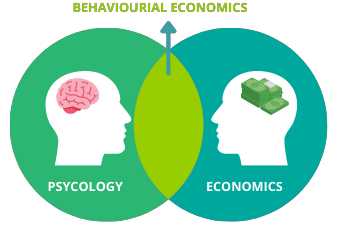
Real behaviour ≠ Fully rational behaviour
Overall Idea:
- Consumers do not always maximize utility.
- Decisions are often influenced by biases and limitations.
- This leads to deviations from traditional economic predictions.
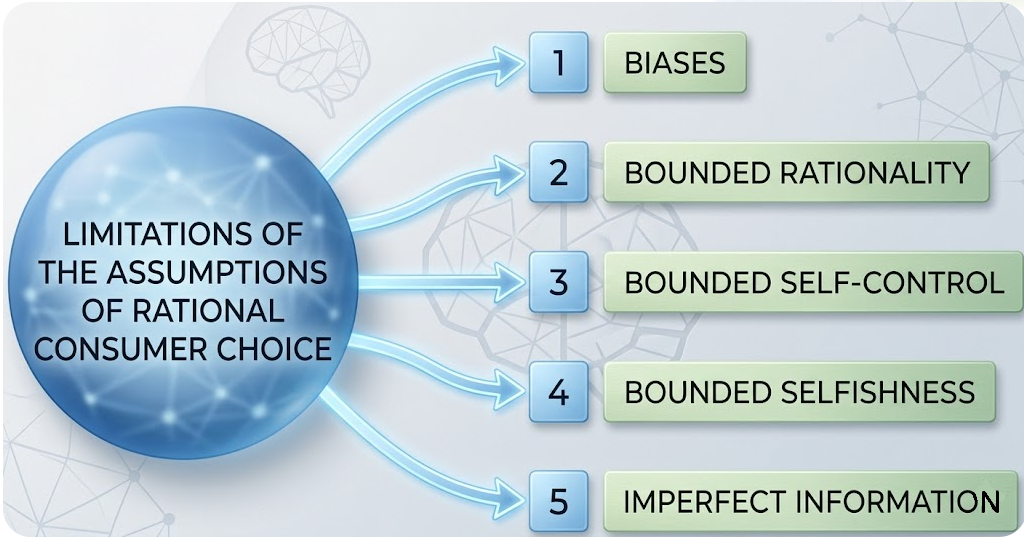
1. Biases
Biases are systematic patterns of deviation from rational decision-making.
a. Rule of Thumb (Heuristics)
- Consumers use simple shortcuts to make decisions quickly.
- Instead of analyzing all information, they rely on past experience.
- May lead to suboptimal decisions.
b. Anchoring
- Consumers rely heavily on an initial piece of information (anchor).
- Example: Original price shown before a discount influences perception of value.
- Leads to biased judgments about prices.
c. Framing
- Decisions depend on how information is presented.
- Same choice can lead to different decisions based on wording.
- Example: “90% fat-free” vs “10% fat”.
d. Availability Bias
- Consumers base decisions on information that is easily recalled.
- Recent or memorable events influence choices more than actual probabilities.
2. Bounded Rationality
Bounded rationality means consumers have limited ability to process information and make perfectly rational decisions.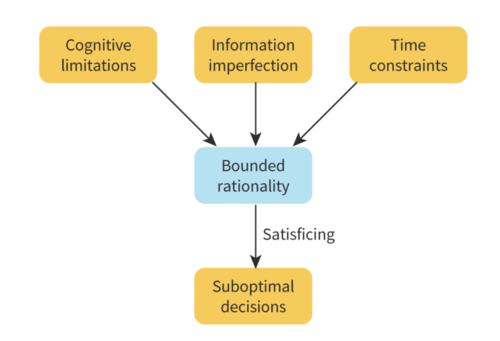
Explanation:
- Consumers do not have enough time or mental capacity to evaluate all options.
- They cannot compare every possible alternative in the market.
- Instead of maximizing utility, they choose a satisfactory option (satisficing).
- Decisions are influenced by limited information and cognitive constraints.
Why It Occurs:
- Information overload in modern markets.
- Limited time for decision-making.
- Cognitive limitations of individuals.
Impact:
- Consumers may not choose the best option.
- Leads to inefficiency in decision-making.
- Firms may exploit this through marketing strategies.
3. Bounded Self-Control
Bounded self-control refers to the inability of consumers to always act in their long-term best interest.
Explanation:
- Consumers may prioritize short-term satisfaction over long-term benefits.
- They may engage in impulsive or emotional purchases.
- This leads to decisions that contradict their long-term goals.
- Behaviour is often inconsistent over time.
Why It Occurs:
- Temptation and instant gratification.
- Lack of discipline in consumption decisions.
- Psychological factors influencing behaviour.
Impact:
- Overspending and debt accumulation.
- Under-saving for future needs.
- Consumption of harmful goods (e.g. unhealthy food).
4. Bounded Selfishness
Bounded selfishness means consumers are not always purely self-interested and may consider fairness, ethics, and social norms.
Explanation:
- Consumers may care about the welfare of others.
- They may make decisions based on fairness or moral values.
- Choices are influenced by social and cultural expectations.
- This contradicts the assumption of pure self-interest.
Why It Occurs:
- Social norms and ethical values.
- Desire for fairness and equality.
- Emotional and psychological influences.
Impact:
- Consumers may donate to charity.
- They may support ethical or sustainable products.
- Market outcomes may reflect social preferences, not just profit motives.
5. Imperfect Information
Imperfect information means consumers do not have complete or accurate knowledge about goods and services.
Explanation:
- Consumers may lack information about prices, quality, or alternatives.
- Information may be costly or difficult to obtain.
- Some information may be misleading or biased.
- This prevents optimal decision-making.
Why It Occurs:
- Information asymmetry between buyers and sellers.
- Complexity of products and markets.
- Advertising and misinformation.
Impact:
- Consumers may make poor choices.
- Firms may exploit lack of information.
- Can lead to market failure.
Example 1
Explain how anchoring bias affects consumer decision-making.
▶️ Answer / Explanation
Anchoring occurs when consumers rely on an initial reference point.
For example, if a product is shown as “$100 reduced to $60”, consumers perceive it as a good deal.
The original price acts as an anchor, influencing their judgment.
This may lead to irrational purchasing decisions.
Example 2
Evaluate the importance of bounded rationality in real-world consumer behaviour.
▶️ Answer / Explanation
Bounded rationality recognizes that consumers cannot process all information.
They make decisions based on limited knowledge and time.
This explains why consumers do not always choose the optimal option.
It makes economic models more realistic.
However, it reduces predictive accuracy compared to traditional models.