
Rational Producer Behaviour — Profit Maximization (HL)
1. Total Revenue − Total Cost (TR − TC)
Profit maximization means that a firm aims to produce at the level of output where the difference between total revenue (TR) and total cost (TC) is the greatest.
Profit = TR − TC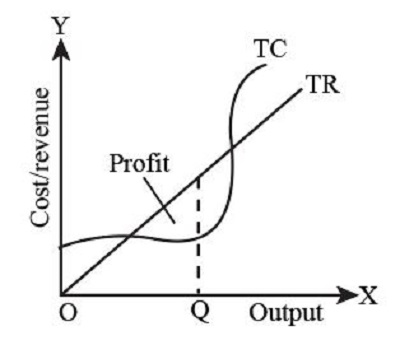
Explanation:
- Total revenue (TR) is the total income a firm receives from selling its output.
- Total cost (TC) is the total cost of producing that output.
- Profit is maximized at the output level where the gap between TR and TC is largest.
- Firms compare revenue and cost at different levels of output to find this point.
How It Works:
- If TR increases faster than TC → profit increases.
- If TC increases faster than TR → profit decreases.
- The optimal output is where profit reaches its maximum value.
Economic Logic (HL Insight):
- This approach focuses on total values, not changes at the margin.
- It is useful for understanding profit conceptually.
- However, firms often use marginal analysis for precision.
2. Marginal Cost = Marginal Revenue (MC = MR)
The profit-maximizing level of output occurs where marginal cost (MC) equals marginal revenue (MR).
MC = MR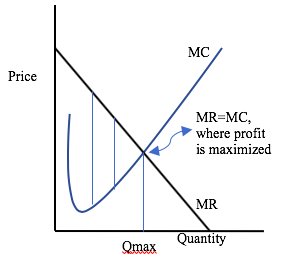
Explanation:
- Marginal revenue (MR) is the additional revenue from selling one more unit.
- Marginal cost (MC) is the additional cost of producing one more unit.
- Firms compare the revenue and cost of producing one extra unit.
Why MC = MR Maximizes Profit:
- If MR > MC → producing more adds more to revenue than cost → profit increases.
- If MR < MC → producing more adds more to cost than revenue → profit decreases.
- Therefore, profit is maximized where MR = MC.
MR > MC → Increase output
MR < MC → Decrease output
Important Condition:
- MC must be rising at the point where it equals MR.
- This ensures the firm is at a maximum, not a minimum.
Economic Logic (HL Insight):
- This is the most important rule for firm behaviour.
- Used in all market structures (perfect competition, monopoly, etc.).
- Provides a precise method to determine optimal output.
Example 1
Explain how a firm determines profit using TR and TC.
▶️ Answer / Explanation
A firm calculates total revenue and total cost at different output levels.
It finds the output where the difference between TR and TC is the greatest.
This output gives maximum profit.
Example 2
Explain why a firm produces where MC equals MR.
▶️ Answer / Explanation
If MR is greater than MC, producing more increases profit.
If MR is less than MC, producing more reduces profit.
Thus, profit is maximized where MC equals MR.
3. Abnormal Profit (AR > AC)
Abnormal profit (also called supernormal profit) occurs when a firm’s average revenue (AR) is greater than its average cost (AC).
Abnormal profit → AR > AC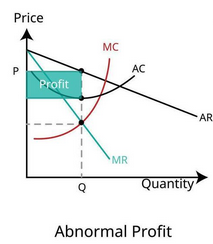
Explanation:
- The firm earns more revenue per unit than it costs to produce.
- This results in extra profit above normal levels.
- Indicates that the firm is highly efficient or has market power.
Economic Meaning:
- Firms are earning more than the minimum required to stay in business.
- Attracts new firms into the market (if entry is possible).
Impact:
- Encourages entry of new firms in competitive markets.
- In the long run, competition reduces abnormal profit.
- May persist in markets with barriers to entry (e.g. monopoly).
4. Normal Profit (AR = AC)
Normal profit occurs when a firm’s average revenue equals average cost.
Normal profit → AR = AC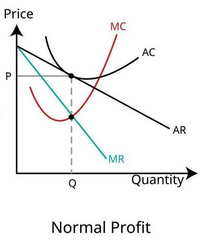
Explanation:
- The firm covers all its costs, including opportunity cost.
- There is no extra profit, but the firm is not making a loss.
- It is the minimum profit required to keep the firm in the market.
Economic Meaning:
- Firms are earning just enough to remain in operation.
- Typical outcome in the long run of competitive markets.
Impact:
- No incentive for firms to enter or leave the market.
- Market is in long-run equilibrium.
5. Losses (AR < AC)
A firm makes a loss when its average revenue is less than average cost.
Loss → AR < AC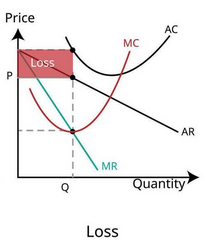
Explanation:
- The firm’s revenue is not enough to cover its costs.
- Results in negative profit.
- Firm is operating inefficiently or facing low demand.
Economic Meaning:
- Firms are not covering opportunity costs.
- Indicates poor performance or adverse market conditions.
Impact:
- Firms may exit the market in the long run.
- Reduction in supply may increase prices.
- Remaining firms may move toward normal profit.
Summary:
| Situation | Condition | Outcome |
|---|---|---|
| Abnormal Profit | AR > AC | Entry of firms |
| Normal Profit | AR = AC | No entry or exit |
| Loss | AR < AC | Exit of firms |
Example 1
Explain what happens when a firm earns abnormal profit.
▶️ Answer / Explanation
When AR is greater than AC, the firm earns abnormal profit.
This attracts new firms into the market.
Increased competition reduces price and profit.
In the long run, only normal profit remains.
Example 2
Evaluate the significance of normal profit for firms.
▶️ Answer / Explanation
Normal profit ensures that firms cover all costs including opportunity cost.
It allows firms to remain in the market.
However, it provides no extra reward.
Thus, it represents a stable but not highly profitable situation.