
Reasons for Government Intervention in Markets
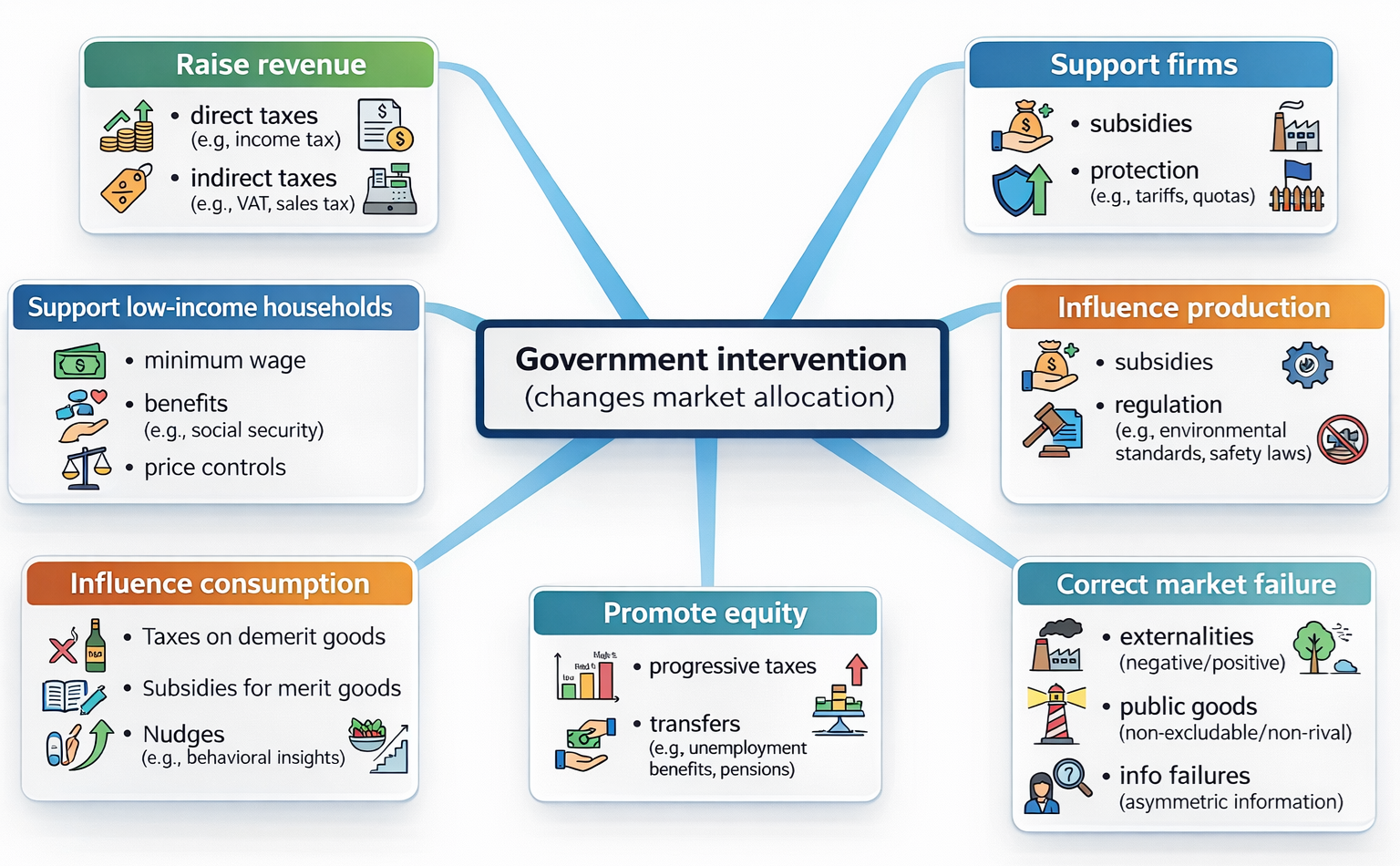
Governments intervene in markets to influence market outcomes when the free market does not achieve desired economic or social objectives. Two key reasons include earning revenue and supporting firms.
1. Earning Government Revenue
Governments impose indirect taxes on goods and services to generate revenue.
- Taxes such as VAT, excise duties, and tariffs provide a major source of government income.
- Revenue is used to fund public goods and services such as healthcare, education, and infrastructure.
Economic Explanation:
- Governments often tax goods with inelastic demand (\( \mathrm{PED < 1} \)).
- This ensures quantity demanded does not fall significantly.
- As a result, tax revenue remains high and stable.
Inelastic demand → Higher tax revenue
2. Supporting Firms
Governments intervene to support domestic firms and protect industries.
- Use of subsidies to reduce production costs.
- Provision of grants, tax relief, or financial assistance.
- Protection from foreign competition through tariffs or quotas.
Economic Explanation:
- Helps firms remain competitive in domestic and international markets.
- Encourages production, investment, and innovation.
- Prevents firm closures and protects employment.
Government support → Lower costs → Higher output
Evaluation Insight:
- High taxes may reduce consumer welfare and discourage consumption.
- Excessive support may lead to inefficiency and government failure.
- Policies must balance revenue generation and market efficiency.
Example 1
Explain why governments tax goods with inelastic demand.
▶️ Answer / Explanation
Goods with inelastic demand are less responsive to price changes.
When taxes increase prices, quantity demanded falls only slightly.
This allows governments to generate high revenue.
Therefore, such goods are preferred for taxation.
Example 2
Evaluate how subsidies help domestic firms.
▶️ Answer / Explanation
Subsidies reduce production costs for firms.
This allows firms to lower prices or increase output.
Firms become more competitive in the market.
However, subsidies may lead to inefficient allocation of resources.
Reasons for Government Intervention in Markets (Continued)
Governments also intervene to influence outcomes related to equity, production, and consumption in the economy.
3. Support Households on Low Incomes
Governments aim to improve equity by supporting low-income households.
- Provision of subsidies on essential goods (e.g. food, healthcare).
- Transfer payments such as unemployment benefits or pensions.
- Use of progressive taxation to redistribute income.
Economic Explanation:
- Low-income households have limited purchasing power.
- Government support increases their real income.
- Ensures access to basic necessities and improves living standards.
Support → Higher purchasing power → Greater equity
4. Influence the Level of Production
Governments intervene to increase or decrease production levels in the economy.
- Subsidies encourage production of beneficial goods (e.g. renewable energy).
- Taxes discourage production of harmful goods (e.g. pollution-intensive goods).
- Regulations set limits on production activities.
Economic Explanation:
- Markets may overproduce harmful goods or underproduce beneficial goods.
- Government intervention corrects these imbalances.
- Ensures production aligns with social welfare.
Policy → Change in costs → Change in output
5. Influence the Level of Consumption
Governments aim to change consumer behaviour by influencing consumption patterns.
- Indirect taxes reduce consumption of harmful goods (e.g. tobacco, alcohol).
- Subsidies encourage consumption of beneficial goods (e.g. education, healthcare).
- Regulations and campaigns influence consumer choices.
Economic Explanation:
- Consumers may overconsume demerit goods and underconsume merit goods.
- Government intervention helps achieve more socially optimal consumption.
Taxes ↓ consumption | Subsidies ↑ consumption
Key Ideas:
- Governments support low-income households to improve fairness.
- They influence production to correct market inefficiencies.
- They influence consumption to improve social welfare.
- Intervention shapes both market outcomes and behaviour.
Example 1
Explain how subsidies help low-income households.
▶️ Answer / Explanation
Subsidies lower the price of essential goods.
This increases affordability for low-income households.
Their real income effectively increases.
Thus, access to basic goods improves.
Example 2
Evaluate how taxes influence consumption of demerit goods.
▶️ Answer / Explanation
Taxes increase the price of demerit goods.
This reduces quantity demanded.
Consumption falls, improving social welfare.
However, if demand is inelastic, the reduction may be limited.
Reasons for Government Intervention in Markets (Continued)
Governments also intervene to address inefficiencies in markets and ensure a fair distribution of resources and income.
6. Correct Market Failure
Market failure occurs when the free market fails to allocate resources efficiently, leading to a loss of social welfare.
- Presence of externalities (e.g. pollution, public health issues).
- Underprovision of public goods (e.g. street lighting, national defence).
- Information failure leading to poor consumer choices.
Government Actions:
- Taxes to reduce negative externalities.
- Subsidies to encourage positive externalities.
- Regulation to control harmful activities.
- Direct provision of public goods.
Economic Explanation:
- Markets may overproduce harmful goods and underproduce beneficial goods.
- Intervention helps move output toward the socially optimal level.
Market failure → Government intervention → Improved efficiency
7. Promote Equity
Governments aim to achieve a more fair distribution of income and resources in society.
- Progressive taxation (higher income → higher tax rate).
- Transfer payments to support low-income groups.
- Provision of free or subsidised services (education, healthcare).
Economic Explanation:
- Free markets may result in income inequality.
- Government redistributes income to improve fairness and social welfare.
Redistribution → Greater equality → Improved welfare
Example 1
Explain how taxes can correct market failure caused by negative externalities.
▶️ Answer / Explanation
Negative externalities lead to overproduction of harmful goods.
Taxes increase production costs and price.
This reduces quantity produced and consumed.
Thus, output moves closer to the socially optimal level.
Example 2
Evaluate how government policies promote equity.
▶️ Answer / Explanation
Governments use progressive taxes and transfer payments.
This redistributes income from rich to poor.
It improves access to essential services and reduces inequality.
However, high taxes may reduce incentives to work and invest.