
Responses to Asymmetric Information
Asymmetric information can lead to market failure, but both governments and private agents can take actions to reduce its effects and improve market outcomes.
Asymmetric information → Intervention → Improved efficiency
1. Government Responses
Governments intervene to reduce information gaps and protect consumers.
a. Legislation and Regulation
Legislation and regulation involve laws and rules that require firms to meet certain standards and disclose information.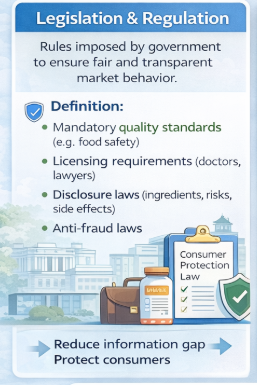
Explanation:
- Governments impose minimum quality standards for goods and services.
- Firms may be required to provide accurate product information.
- Regulation reduces the risk of fraud and misinformation.
- Helps protect consumers from exploitation.
Impact:
- Reduces adverse selection by improving transparency.
- Increases consumer confidence.
- However, may increase costs for firms.
b. Provision of Information
Provision of information involves governments supplying or requiring the disclosure of relevant information.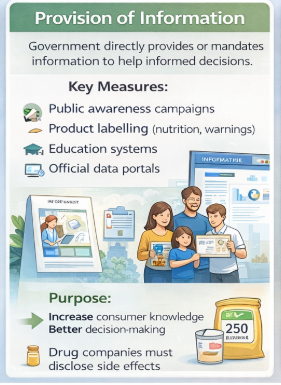
Explanation:
- Governments may provide public information campaigns.
- Require labeling (e.g. ingredients, safety warnings).
- Help consumers make more informed decisions.
- Reduces information asymmetry directly.
Impact:
- Improves market efficiency.
- Reduces risk of poor-quality choices.
- May involve administrative costs.
2. Private Responses
Firms and individuals also take actions to overcome asymmetric information.
a. Signalling
Signalling occurs when the informed party provides credible information to reveal their quality.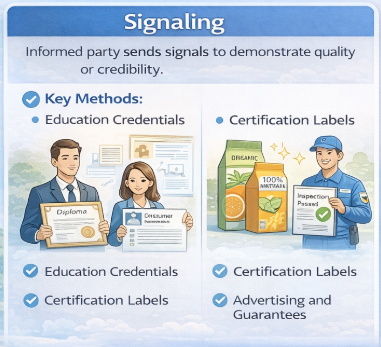
Explanation:
- High-quality sellers use signals to distinguish themselves.
- Examples include brand reputation, warranties, qualifications.
- Signals must be costly or difficult to fake to be credible.
Impact:
- Reduces adverse selection.
- Builds trust between buyers and sellers.
- Encourages higher-quality production.
b. Screening
Screening occurs when the uninformed party takes steps to obtain information from the informed party.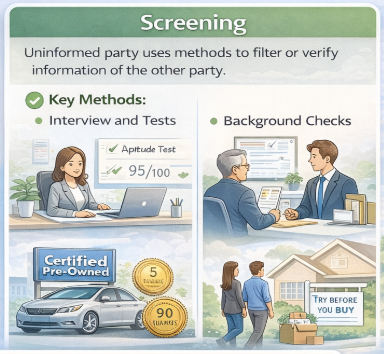
Explanation:
- Buyers or firms design methods to identify quality or risk.
- Examples include interviews, background checks, insurance questionnaires.
- Helps separate high-risk from low-risk individuals.
Impact:
- Reduces uncertainty in transactions.
- Improves decision-making.
- May involve additional costs and time.
Key Differences:
| Type | Method | Who Acts |
|---|---|---|
| Legislation | Rules and standards | Government |
| Information | Providing data | Government |
| Signalling | Revealing quality | Informed party |
| Screening | Extracting information | Uninformed party |
Key Points:
- Asymmetric information can be reduced through intervention.
- Governments use regulation and information provision.
- Private agents use signalling and screening.
- These responses improve market efficiency and trust.
Example 1
Explain how signalling helps reduce asymmetric information.
▶️ Answer / Explanation
Signalling occurs when informed sellers provide credible information about quality.
For example, offering warranties signals product reliability.
This helps buyers distinguish between high- and low-quality goods.
Thus, signalling reduces adverse selection.
Example 2
Evaluate the effectiveness of government regulation in addressing asymmetric information.
▶️ Answer / Explanation
Government regulation improves transparency and protects consumers.
It reduces information gaps and increases trust.
However, it may increase costs for firms and reduce efficiency.
Over-regulation can limit market flexibility.
Thus, it is effective but must be carefully designed.