
Risks in Markets Dominated by One or a Few Very Large Firms (HL)
Markets dominated by one firm (monopoly) or a few large firms (oligopoly) can create several risks due to high market power. These risks mainly affect output, price, and consumer choice.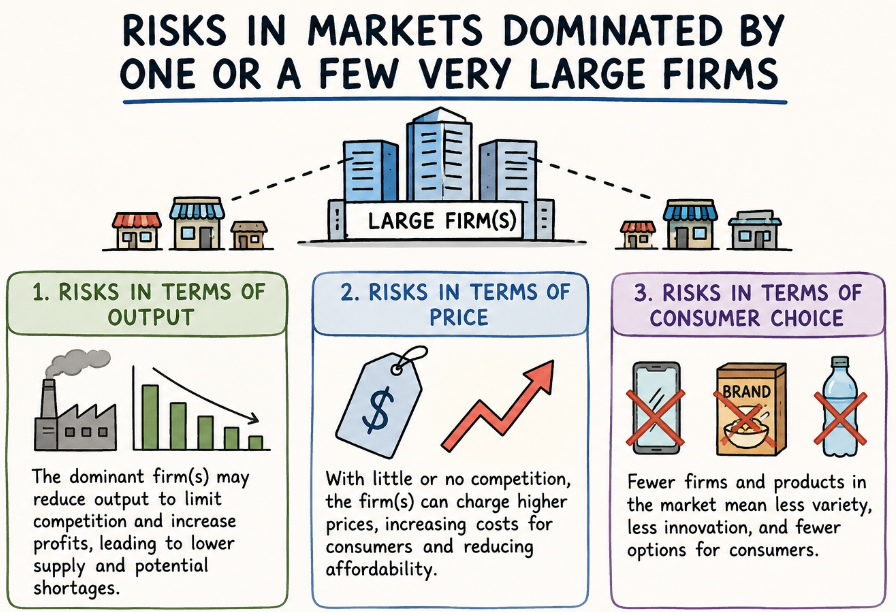
Market power → Control → Potential market failure
1. Risk in Terms of Output
Large firms may restrict output to maximize profits.
Explanation:
- Firms produce where MC = MR, not where socially optimal output occurs.
- This leads to output being lower than efficient levels.
- Some consumers who are willing to pay are unable to obtain the good.
Consequences:
- Underproduction of goods and services
- Loss of potential welfare (deadweight loss)
- Inefficient allocation of resources
Restricted output → Lost welfare
2. Risk in Terms of Price
Firms with market power can charge higher prices than in competitive markets.
Explanation:
- Price is set above marginal cost:
P > MC
- Lack of competition allows firms to increase prices.
- Consumers have limited alternatives.
Consequences:
- Higher cost of living for consumers
- Reduced consumer surplus
- Possible exploitation of consumers
3. Risk in Terms of Consumer Choice
Markets dominated by few firms often result in limited consumer choice.
Explanation:
- Fewer firms → fewer products available.
- Less competition reduces incentive to innovate or differentiate.
- Collusion may further limit variety.
Consequences:
- Reduced product variety
- Lower quality or innovation
- Consumers may not get products that best match their preferences
Economic Logic:
- Market power allows firms to act in their own interest rather than society’s.
- This leads to allocative inefficiency and welfare loss.
- These risks justify government intervention.
Key Points:
- Large firms may restrict output.
- They may charge higher prices.
- Consumer choice may be limited.
- Overall result is potential market failure.
Example 1
Explain why monopolies restrict output.
▶️ Answer / Explanation
Monopolies produce where marginal cost equals marginal revenue.
This results in lower output than the socially optimal level.
The firm restricts output to increase price and profit.
Example 2
Evaluate the impact of market dominance on consumers.
▶️ Answer / Explanation
Dominant firms may charge higher prices and reduce output.
This reduces consumer welfare.
However, they may benefit from economies of scale.
Thus, there are both costs and benefits.