
Social (Community) Surplus
Social surplus, also known as community surplus, is the total benefit to society from the production and consumption of a good or service.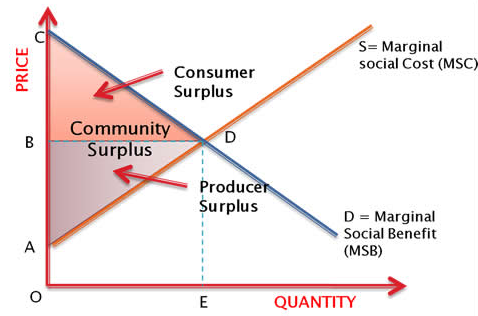
Social surplus = Consumer surplus + Producer surplus
Explanation:
- It represents the combined welfare of consumers and producers.
- Measures how efficiently resources are allocated in a market.
- Higher social surplus indicates greater overall economic welfare.
Graphical Interpretation:
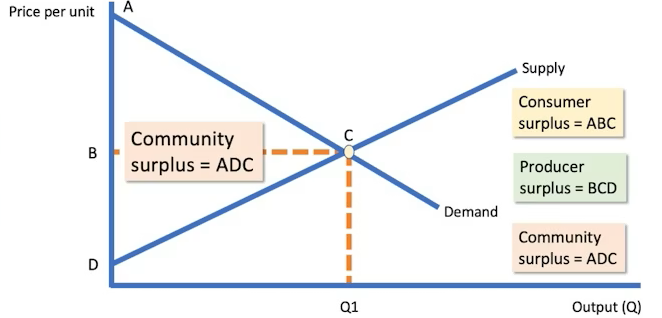
- Social surplus is the total area between the demand curve and supply curve up to the equilibrium quantity.
- It includes:
- Consumer surplus (above price, below demand)
- Producer surplus (below price, above supply)
At Market Equilibrium:
- Social surplus is maximized in a free market (under ideal conditions).
- This occurs where:
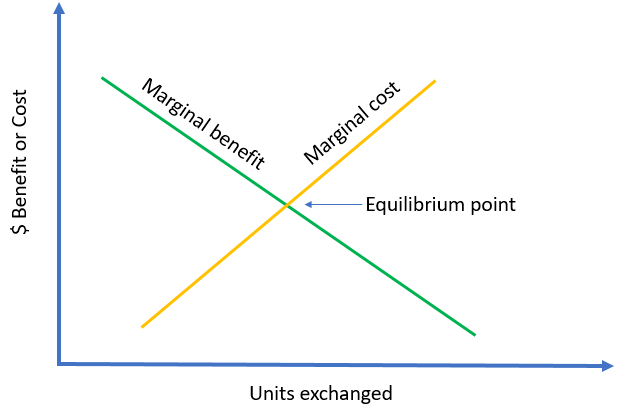
Marginal Benefit (MB) = Marginal Cost (MC)
- This point is known as allocative efficiency.
Economic Logic:
- Demand represents marginal benefit (MB).
- Supply represents marginal cost (MC).
- When MB = MC, resources are used in the most efficient way.
- No additional gains can be made without making someone worse off.
Impact of Disequilibrium and Intervention:
- If output is below equilibrium, potential surplus is lost.
- If output is above equilibrium, resources are overused inefficiently.
- Government intervention (taxes, subsidies, price controls) may increase or decrease social surplus.
- Inefficient allocation leads to deadweight loss
Example 1
Explain what is meant by social surplus.
▶️ Answer / Explanation
Social surplus is the total benefit gained by consumers and producers in a market.
It is the sum of consumer surplus and producer surplus.
It represents overall welfare in the economy.
Example 2
Evaluate how government intervention can affect social surplus.
▶️ Answer / Explanation
Government intervention such as taxes can reduce social surplus by increasing costs and reducing output.
This creates deadweight loss.
However, in cases of market failure, intervention may improve allocation and increase social surplus.
Thus, the effect depends on the situation.