
Strengths and Limitations of Government Policies to Correct Externalities and Manage Common Pool Resources (HL)
Markets often fail to allocate resources efficiently due to externalities and problems related to common pool resources. In such cases, the free market equilibrium:
\( \mathrm{MPB = MPC} \)
does not coincide with the socially optimal level:
\( \mathrm{MSB = MSC} \)
This leads to welfare loss, either through overproduction or underproduction.
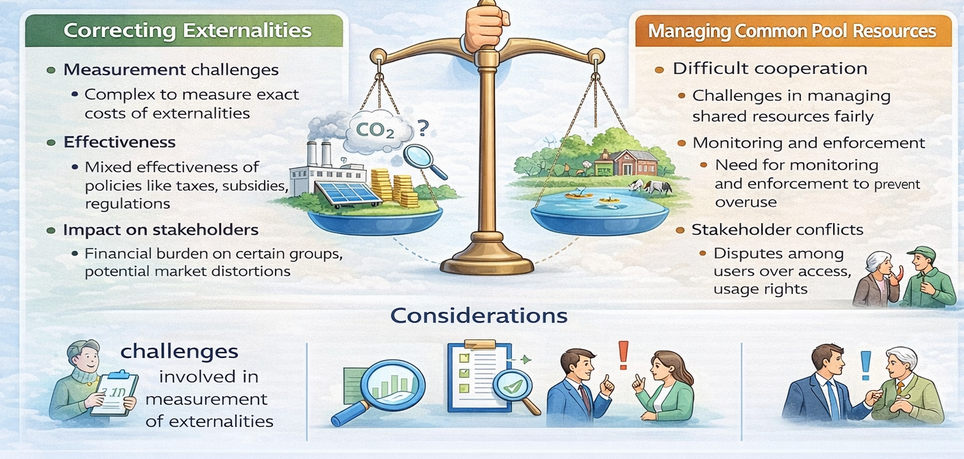
Governments intervene using policies such as taxes, subsidies, regulation, and permits to correct these failures. However, these policies have both strengths and limitations, which must be evaluated.
1. Challenges in Measuring Externalities
Explanation:
- Externalities involve social costs and benefits that are difficult to quantify.
- Governments must estimate:
- External cost (for taxes)
- External benefit (for subsidies)
- These values are often subjective and uncertain.
Implications:
- If external costs are underestimated → under-correction.
- If overestimated → over-correction.
- Policies may fail to achieve:
\( \mathrm{MSB = MSC} \)
Evaluation:
- Accurate measurement is complex and data-intensive.
- Reduces precision of Pigouvian taxes and subsidies.
2. Degree of Effectiveness
Effectiveness depends on:
- Elasticity of demand and supply
- Type of policy used
- Different policies vary in impact:
- Taxes:
- Effective if demand is elastic.
- Less effective if demand is inelastic.
- Subsidies:
- Encourage consumption of merit goods.
- Effectiveness depends on awareness and access.
- Regulation:
- Direct and often effective.
- But depends on enforcement.
- Tradable permits:
- Efficient but depend on correct cap setting.
Evaluation:
- No single policy is universally effective.
- Often requires a combination of policies.
3. Consequences for Stakeholders
Consumers:
- Taxes → higher prices → reduced welfare.
- Subsidies → lower prices → increased access.
- Regulation → improved health and safety.
Producers:
- Taxes → higher costs → reduced profits.
- Subsidies → increased revenue and output.
- Regulation → higher compliance costs.
Government:
- Taxes → generate revenue.
- Subsidies → increase expenditure.
- Regulation → requires monitoring and enforcement.
Society:
- Improved allocation of resources.
- Reduction in negative externalities.
- Potential improvement in equity and sustainability.
Evaluation:
- Trade-offs between efficiency and equity.
- Policies may benefit some groups while harming others.
Overall Evaluation :
- Government intervention can improve outcomes but may lead to government failure.
- Effectiveness depends on:
- Accurate measurement
- Proper implementation
- Stakeholder response
- Best results often come from a balanced policy mix.
Example 1
Explain why it is difficult to set the correct level of a Pigouvian tax.
▶️ Answer / Explanation
External costs are difficult to measure accurately.
They may vary over time and across locations.
If the tax is too low, externalities remain.
If too high, production may fall excessively.
Thus, setting the correct tax is challenging.
Example 2
Evaluate the impact of subsidies on different stakeholders.
▶️ Answer / Explanation
Subsidies lower prices for consumers and increase consumption.
Producers benefit from higher revenue.
Government faces increased expenditure.
Society benefits from increased provision of merit goods.
However, subsidies may lead to inefficiency if misused.