
2.12 The Market’s Inability to Achieve Equity (HL)
Workings of a Free Market Economy and Unequal Distribution of Income and Wealth
In a free market economy, resources and rewards are allocated through the price mechanism based on demand and supply. While this system promotes efficiency, it does not ensure equity (fairness), often resulting in an unequal distribution of income and wealth.
Efficiency in allocation ≠ Fairness in distribution → Inequality arises
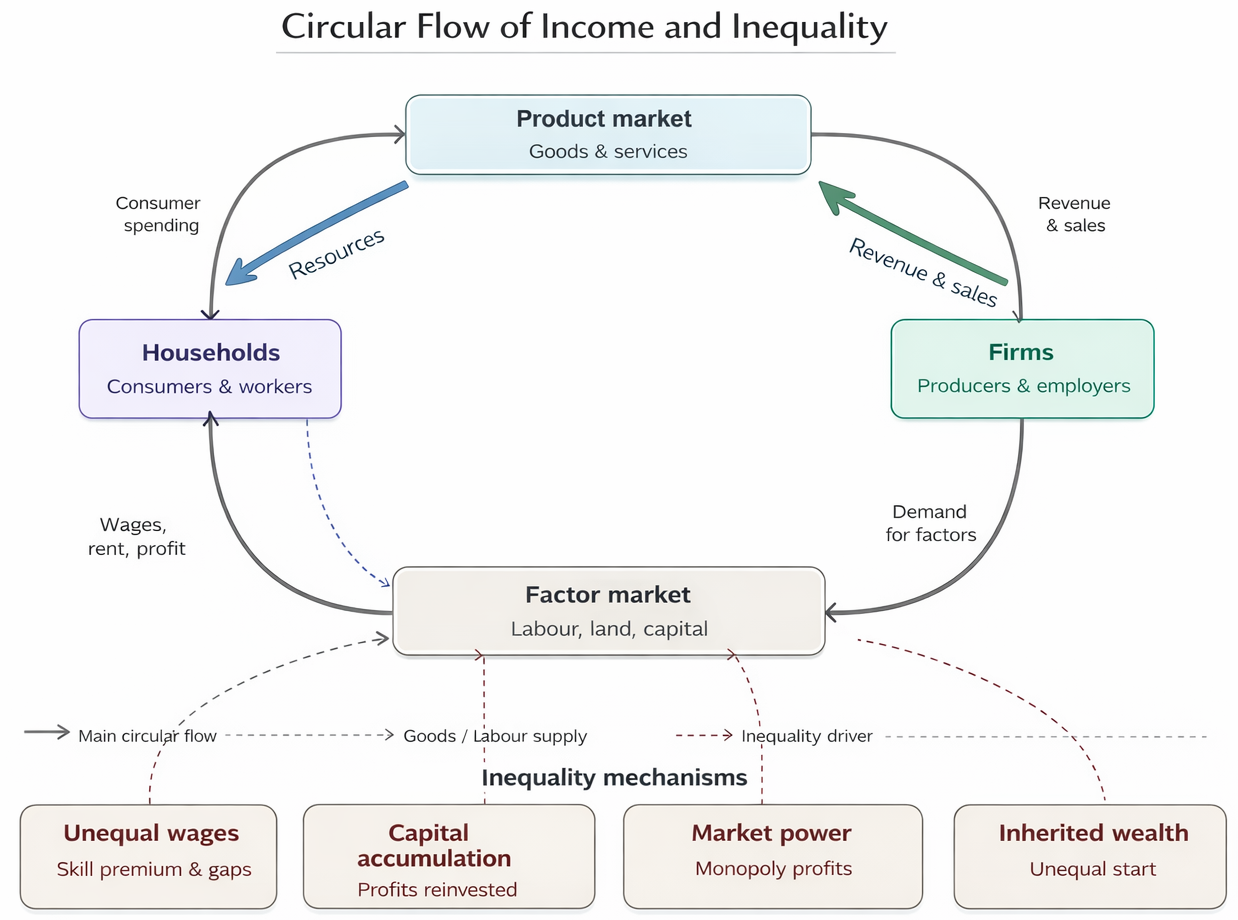
Explanation:
- Income is determined by the ownership and value of factors of production (land, labour, capital, entrepreneurship).
- Individuals with more valuable skills, education, or assets earn higher incomes.
- Those with fewer resources or lower productivity earn lower incomes.
- This results in inequality in both income (flow of earnings) and wealth (stock of assets).
Why Free Markets Lead to Inequality:
- Differences in skills and education Highly skilled and educated workers earn higher wages due to greater productivity.
- Ownership of resources Individuals owning land, capital, or businesses earn additional income such as rent, interest, and profit.
- Market demand Jobs with higher demand or scarcity offer higher wages.
- Inheritance of wealth Wealth passed across generations increases inequality over time.
- Unequal opportunities Not all individuals have equal access to education, healthcare, or resources.
- Discrimination Certain groups may face barriers, limiting income-earning opportunities.
Income vs Wealth:
| Aspect | Income | Wealth |
|---|---|---|
| Definition | Flow of earnings over time | Stock of assets owned |
| Examples | Wages, salaries, rent | Property, savings, investments |
Economic Logic :
- The price mechanism rewards individuals based on productivity, scarcity, and market value.
- There is no built-in mechanism to ensure a fair or equal distribution.
- Thus, efficient outcomes can still be socially inequitable.
Consequences of Inequality:
- Differences in standards of living.
- Limited access to education and healthcare for low-income groups.
- Persistence of poverty across generations.
- Social and economic instability.
Evaluation:
- Some inequality provides incentives for work, innovation, and investment.
- However, excessive inequality leads to unfair outcomes and reduced opportunities.
- It may also reduce overall economic welfare.
- This creates a strong case for government intervention (taxation, transfers, public services).
Important Point:
- Free markets prioritize efficiency over equity.
- Income and wealth are distributed based on market forces.
- This often leads to inequality.
- Important justification for government policies to redistribute income.
Example 1
Explain why a free market economy may lead to income inequality.
▶️ Answer / Explanation
In a free market, income depends on the value of factors of production.
Individuals with higher skills or valuable resources earn more.
Those with fewer resources earn less.
This leads to unequal income distribution.
Example 2
Evaluate whether inequality in a free market economy is necessarily undesirable.
▶️ Answer / Explanation
Inequality can provide incentives for individuals to work harder and innovate.
However, excessive inequality reduces access to opportunities and creates social problems.
It may also reduce overall welfare.
Thus, some inequality may be acceptable, but too much is harmful.