
Aggregate Demand (AD)
Aggregate demand (AD) refers to the total amount of goods and services demanded in an economy at different general price levels during a given period of time.
It represents the total spending in the economy by households, firms, the government, and the foreign sector.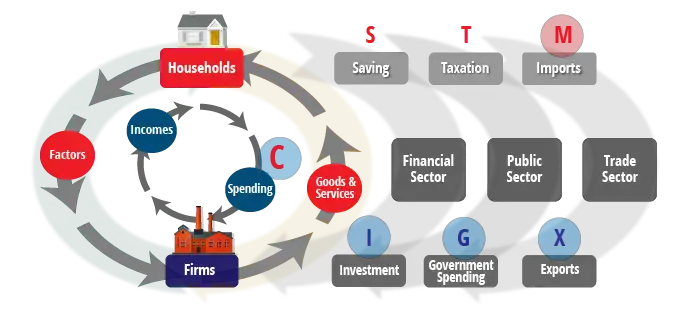
\( \mathrm{AD = C + I + G + (X – M)} \)
Where:
- \( \mathrm{C} \) = Consumption
- \( \mathrm{I} \) = Investment
- \( \mathrm{G} \) = Government spending
- \( \mathrm{X – M} \) = Net exports (exports minus imports)
Meaning of Aggregate Demand
Aggregate demand measures the total planned expenditure on domestically produced goods and services in the economy.
- Shows the relationship between the general price level and real output demanded.
- Includes demand from all sectors of the economy.
- Used in macroeconomics to analyse inflation, unemployment, and economic growth.
Key Idea:
- As the general price level changes, total spending and output demanded change.
The Aggregate Demand Curve
The aggregate demand curve shows the relationship between the general price level and the quantity of real output demanded in an economy.
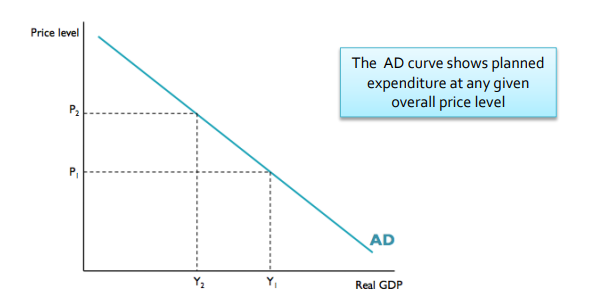
- The price level is shown on the vertical axis.
- Real GDP (real national output) is shown on the horizontal axis.
- The AD curve slopes downward from left to right.
Why the Aggregate Demand Curve Slopes Downward
The aggregate demand curve slopes downward because of three main effects.
1. Wealth Effect (Real Balance Effect)
- When the price level falls, the real value of money increases.
- Consumers feel wealthier and increase spending.
- This increases aggregate demand.
Price level ↓ → Real wealth ↑ → Consumption ↑ → AD ↑
2. Interest Rate Effect
- A lower price level reduces demand for money.
- Interest rates tend to fall.
- Lower interest rates encourage borrowing and investment.
- Consumption may also increase.
Price level ↓ → Interest rates ↓ → Investment ↑ → AD ↑
3. International Trade Effect
- Lower domestic price levels make exports more competitive.
- Exports rise and imports fall.
- Net exports increase.
Price level ↓ → Exports ↑ and Imports ↓ → AD ↑
Movements Along the AD Curve
A movement along the AD curve occurs due to a change in the general price level.
- Lower price level → higher quantity of real output demanded.
- Higher price level → lower quantity of real output demanded.
| Component | Description |
|---|---|
| \( \mathrm{C} \) | Household consumption spending |
| \( \mathrm{I} \) | Business investment spending |
| \( \mathrm{G} \) | Government spending |
| \( \mathrm{X – M} \) | Net exports |
Key Ideas:
- Aggregate demand measures total spending in the economy.
- The AD curve slopes downward due to wealth, interest rate, and trade effects.
- Changes in the price level cause movement along the AD curve.
- Changes in AD components shift the curve.
Example 1
Explain why the aggregate demand curve slopes downward.
▶️ Answer / Explanation
When the general price level falls, consumers’ real purchasing power increases.
Interest rates may also fall, encouraging investment and spending.
In addition, exports become more competitive.
These effects increase the quantity of real output demanded, causing a downward-sloping AD curve.
Example 2
Using an example, explain how government spending affects aggregate demand.
▶️ Answer / Explanation
If the government increases spending on infrastructure projects, firms receive more income and hire more workers.
Household income and consumption rise.
This increases total spending in the economy.
As a result, aggregate demand shifts to the right.