
Alternative Views of Aggregate Supply (AS)
Economists have different views about how the economy behaves in the short run and long run. These differences lead to different interpretations of the aggregate supply (AS) curve.
The two main approaches are:
- Monetarist/New Classical view
- Keynesian view
These views differ mainly in how they explain:
- The flexibility of wages and prices
- The ability of markets to self-correct
- The role of government intervention
- The causes of unemployment and inflation
Monetarist/New Classical View of the Long-Run Aggregate Supply (LRAS) Curve
The Monetarist/New Classical view argues that, in the long run, the economy naturally moves toward full employment equilibrium.
According to this view: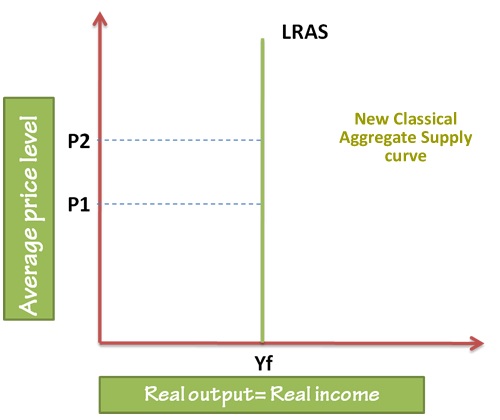
- Wages and prices are flexible.
- Markets adjust efficiently.
- Government intervention is usually unnecessary.
The Long-Run Aggregate Supply (LRAS) Curve
In the Monetarist/New Classical model, the LRAS curve is drawn as a vertical line.
Reason:
- Long-run output depends only on the economy’s productive capacity.
- Changes in the price level do not affect real output in the long run.
- The economy eventually operates at its potential output.
\( \mathrm{LRAS} \) is vertical at full employment output
Determinants of LRAS
The position of the LRAS curve depends on factors affecting productive capacity.
- Quantity and quality of labour
- Capital stock
- Technology
- Productivity
- Natural resources
These are supply-side factors.
Implications of the Monetarist/New Classical View
- Increases in aggregate demand only cause inflation in the long run.
- Unemployment above the natural rate is temporary.
- The economy self-corrects through wage and price adjustments.
- Government demand-management policies have limited long-run effects.
Keynesian View of the Aggregate Supply Curve
The Keynesian view argues that wages and prices may be inflexible, especially downward.
As a result:
- The economy may remain below full employment for long periods.
- Markets may not automatically self-correct.
- Government intervention may be necessary to stabilize the economy.
Shape of the Keynesian AS Curve
The Keynesian AS curve has three sections.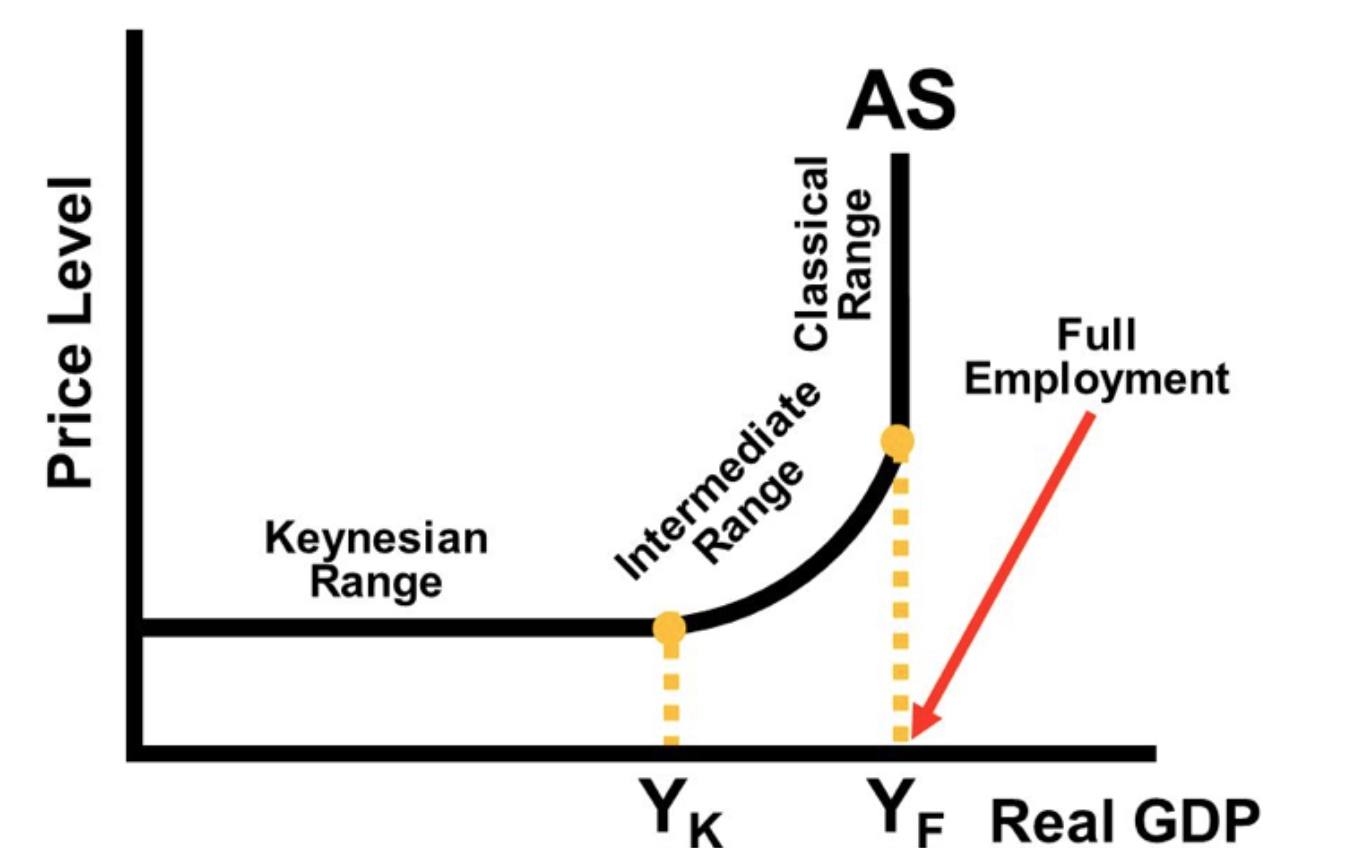
1. Horizontal Section
Occurs at very low levels of output during deep recession.
- Large amounts of unemployed resources exist.
- Firms can increase output without increasing prices.
- AS is highly elastic.
Key Idea:
- Increase in AD mainly increases output and employment.
2. Upward-Sloping Section
Occurs when the economy is approaching full employment.
- Some resources become scarce.
- Costs of production begin to rise.
- Both output and price level increase.
3. Vertical Section
Occurs at full employment output.
- All resources are fully employed.
- Output cannot increase further in the short run.
- Any increase in AD causes only inflation.
Comparison Between Monetarist and Keynesian Views
| Aspect | Monetarist/New Classical | Keynesian |
|---|---|---|
| Wages and Prices | Flexible | Often inflexible |
| Self-Correction | Economy self-corrects quickly | Economy may remain unstable |
| Role of Government | Limited | Important for stabilization |
| LRAS Curve | Vertical | Different AS sections |
| Unemployment | Temporary above natural rate | Can persist long term |
Inflationary Gap
An inflationary gap occurs when actual output exceeds the economy’s potential output.
This means: 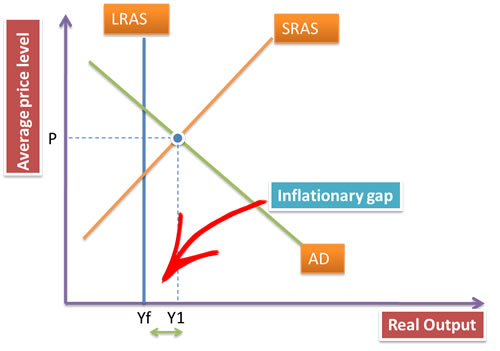
- Aggregate demand is greater than full employment output.
- The economy is operating beyond sustainable capacity.
- Strong inflationary pressure develops.
Actual output > Potential output
Effects of an Inflationary Gap:
- Demand-pull inflation
- Labour shortages
- Rising wages and production costs
- Overheating economy
Deflationary/Recessionary Gap
A deflationary gap or recessionary gap occurs when actual output is below potential output.
This means: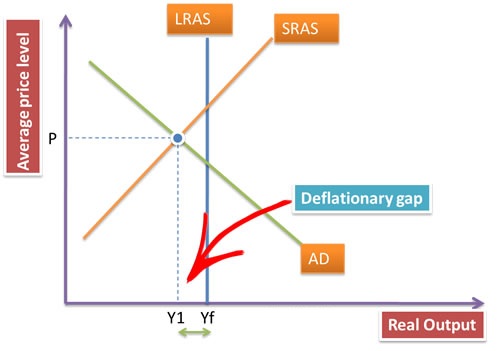
- Aggregate demand is insufficient.
- Resources are underutilized.
- High unemployment exists.
Actual output < Potential output
Effects of a Deflationary/Recessionary Gap:
- Cyclical unemployment
- Lower income and output
- Weak economic growth
- Possible deflationary pressure
Importance of Inflationary and Recessionary Gaps
- Help governments identify macroeconomic problems.
- Used to design fiscal and monetary policies.
- Important for understanding inflation and unemployment.
Summary Table
| Concept | Main Idea |
|---|---|
| Monetarist LRAS | Vertical at potential output |
| Keynesian AS | Horizontal, upward-sloping, vertical sections |
| Inflationary Gap | Actual output above potential output |
| Recessionary Gap | Actual output below potential output |
Key Ideas:
- Different economic schools have different views about AS.
- Monetarists emphasize self-correcting markets.
- Keynesians emphasize market instability and government intervention.
- Inflationary and recessionary gaps explain macroeconomic instability.
Example 1
Explain why the Monetarist LRAS curve is vertical.
▶️ Answer / Explanation
According to Monetarists, long-run output depends only on productive capacity and available resources.
Changes in the price level do not affect real output in the long run.
Therefore, the economy operates at potential output, causing the LRAS curve to be vertical.
Example 2
Using an example, explain a recessionary gap.
▶️ Answer / Explanation
During a recession, consumer spending and investment may fall sharply.
Aggregate demand decreases, causing actual output to fall below potential output.
Firms reduce production and unemployment rises.
This situation is called a recessionary or deflationary gap.