
Appropriateness of Using GDP or GNI Statistics to Measure Economic Well-Being
GDP and GNI are widely used indicators of economic activity and are often used to assess a country’s economic well-being. However, while these statistics provide useful information about output and income, they have both strengths and limitations when used to measure the actual well-being of people.
Economic well-being refers to the extent to which people enjoy a good standard of living, including income, access to goods and services, health, education, and quality of life.
Higher GDP or GNI does not always mean higher well-being
Using GDP and GNI to Measure Economic Well-Being
GDP measures the value of output produced within a country, while GNI measures income earned by residents of a country.
- Higher GDP or GNI usually indicates greater economic activity.
- Higher output and income often allow greater consumption of goods and services.
- This may improve living standards and economic welfare.
Key Insight:
- GDP and GNI are useful indicators of material living standards, but they do not fully measure quality of life.
Appropriateness for Comparisons Over Time
GDP and GNI statistics are useful for comparing economic performance and living standards within a country over time.
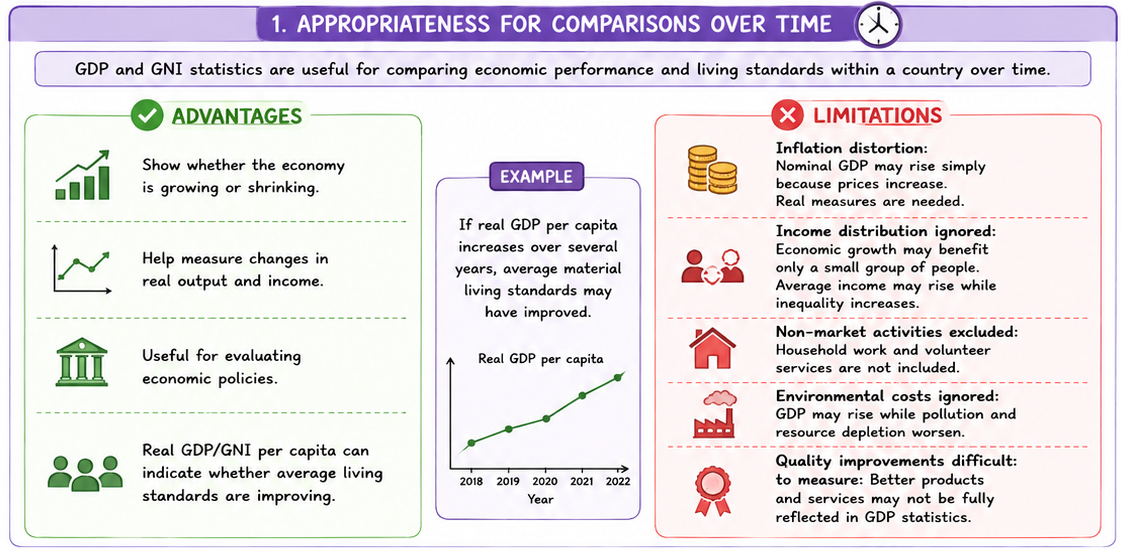
Advantages:
- Show whether the economy is growing or shrinking.
- Help measure changes in real output and income.
- Useful for evaluating economic policies.
- Real GDP/GNI per capita can indicate whether average living standards are improving.
Example:
- If real GDP per capita increases over several years, average material living standards may have improved.
Limitations of Comparisons Over Time
Although useful, GDP and GNI statistics have several limitations when comparing well-being over time.
- Inflation distortion:
- Nominal GDP may rise simply because prices increase.
- Real measures are needed for accurate comparison.
- Income distribution ignored:
- Economic growth may benefit only a small group of people.
- Average income may rise while inequality increases.
- Non-market activities excluded:
- Household work and volunteer services are not included.
- Environmental costs ignored:
- GDP may rise while pollution and resource depletion worsen.
- Quality improvements difficult to measure:
- Better products and services may not be fully reflected in GDP statistics.
Appropriateness for Comparisons Between Countries
GDP and GNI statistics are also used to compare economic performance and living standards between countries.
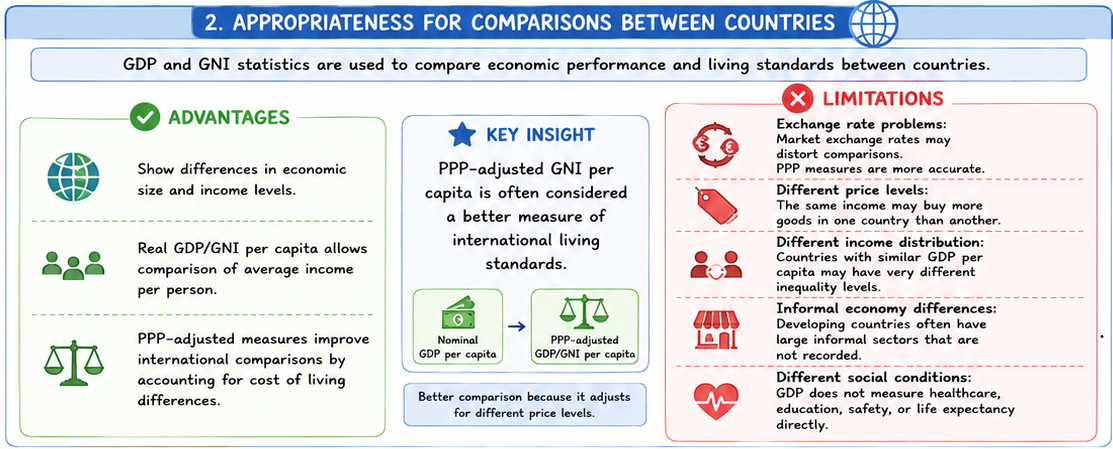
Advantages:
- Show differences in economic size and income levels.
- Real GDP/GNI per capita allows comparison of average income per person.
- PPP-adjusted measures improve international comparisons by accounting for cost of living differences.
Key Insight:
- PPP-adjusted GNI per capita is often considered a better measure of international living standards.
Limitations of Comparisons Between Countries
- Exchange rate problems
- Market exchange rates may distort comparisons.
- PPP measures are more accurate.
- Different price levels
- The same income may buy more goods in one country than another.
- Different income distribution
- Countries with similar GDP per capita may have very different inequality levels.
- Informal economy differences
- Developing countries often have large informal sectors that are not recorded.
- Different social conditions
- GDP does not measure healthcare, education, safety, or life expectancy directly.
GDP vs GNI in Measuring Well-Being
In some situations, GNI may be a better measure of economic well-being than GDP.
- GDP measures production within borders.
- GNI measures income earned by residents.
- If large profits are sent abroad by foreign companies, GDP may overstate domestic well-being.
Example:
- A country with many foreign-owned firms may have high GDP but lower GNI.
Alternative Measures of Well-Being
Because GDP and GNI have limitations, economists also use broader indicators.
- Human Development Index (HDI)
- Multidimensional Poverty Index (MPI)
- Gini coefficient
- Measures of happiness and sustainability
These indicators include factors such as education, health, inequality, and environmental sustainability.
Summary Table
| Aspect | Advantages | Limitations |
|---|---|---|
| Comparisons Over Time | Measures economic growth | Ignores inequality and environment |
| Comparisons Between Countries | Compares income and output levels | Exchange rate and PPP issues |
| GDP | Measures domestic production | May not reflect resident income |
| GNI | Measures resident income | Still limited as welfare indicator |
Key Ideas:
- GDP and GNI are useful but incomplete measures of economic well-being.
- Real per capita and PPP-adjusted measures improve accuracy.
- Economic well-being depends on more than income and output.
- Factors such as inequality, health, education, and sustainability are also important.
Example 1
Explain why real GDP per capita is more useful than nominal GDP for comparisons over time.
▶️ Answer / Explanation
Nominal GDP may increase because of inflation rather than higher production.
Real GDP per capita adjusts for inflation and population changes.
Therefore, it provides a more accurate measure of changes in average living standards over time.
Example 2
Using an example, explain why PPP-adjusted GNI per capita may be better for comparing living standards between countries.
▶️ Answer / Explanation
Different countries have different costs of living.
For example, the same amount of income may buy more goods and services in India than in the United States.
PPP-adjusted GNI per capita accounts for these price differences.
Therefore, it gives a more accurate comparison of actual purchasing power and living standards.