
Assumptions and Implications of the Monetarist/New Classical and Keynesian Models
The Monetarist/New Classical and Keynesian models provide different explanations of how the economy operates and how macroeconomic problems such as unemployment and inflation should be addressed.
These differences arise because each model is based on different assumptions about:
- How markets function
- How wages and prices behave
- The role of aggregate demand
- The effectiveness of government intervention
Monetarist/New Classical Model
The Monetarist/New Classical model emphasizes the efficiency of markets and the economy’s ability to self-correct.
Main Assumptions of the Monetarist/New Classical Model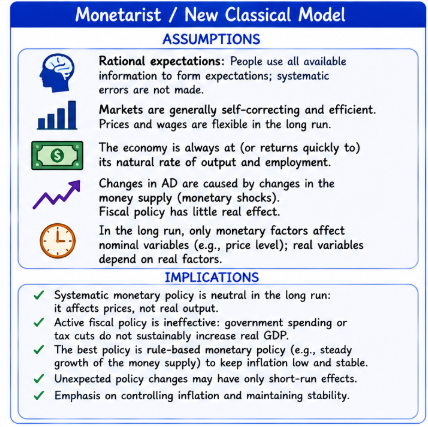
1. Wages and Prices Are Flexible
- Wages and prices adjust quickly in response to changes in demand and supply.
- Labour and product markets clear automatically.
Implication:
- Unemployment above the natural rate is temporary.
- The economy returns to full employment automatically.
2. Markets Are Efficient and Self-Correcting
- Competitive markets allocate resources efficiently.
- Economic imbalances are corrected through market forces.
Implication:
- Government intervention is generally unnecessary.
- Long-term stability is achieved naturally.
3. Long-Run Aggregate Supply Is Vertical
- Long-run output depends only on productive capacity.
- Changes in aggregate demand affect only the price level in the long run.
\( \mathrm{LRAS} \) is vertical at potential output
Implication:
- Expansionary demand policies mainly create inflation in the long run.
4. Rational Behaviour and Expectations
- Consumers and firms behave rationally.
- People adjust expectations using available information.
Implication:
- Government policies may have limited effects because people anticipate them.
5. Natural Rate of Unemployment Exists
- Some unemployment always exists due to frictional and structural factors.
- Cyclical unemployment is temporary.
Implication:
- Attempts to reduce unemployment below the natural rate create inflation.
Overall Implications of the Monetarist/New Classical Model
- The economy naturally returns to full employment.
- Government stabilization policies are often ineffective or harmful.
- Inflation is mainly caused by excessive growth in aggregate demand or money supply.
- Supply-side policies are more effective for long-run growth.
Keynesian Model
The Keynesian model emphasizes the instability of markets and the importance of aggregate demand.
Main Assumptions of the Keynesian Model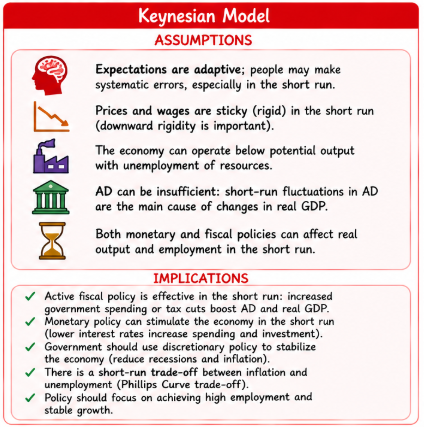
1. Wages and Prices Are Inflexible
- Wages and prices do not adjust quickly, especially downward.
- Labour markets may not clear automatically.
Implication:
- High unemployment may persist.
- The economy may remain below full employment equilibrium.
2. Aggregate Demand Determines Output and Employment
- Insufficient aggregate demand causes recession and unemployment.
- Strong aggregate demand increases output and employment.
Implication:
- Demand-management policies are important for economic stability.
3. Markets May Not Self-Correct Quickly
- Economic downturns can persist for long periods.
- Confidence and expectations strongly influence spending behaviour.
Implication:
- Government intervention may be necessary to restore full employment.
4. Recessionary Gaps Can Persist
- Equilibrium can occur below potential output.
- Idle resources and cyclical unemployment may remain for long periods.
Implication:
- Expansionary fiscal and monetary policies may be needed.
5. Government Has an Important Stabilization Role
- Governments can influence aggregate demand through policy.
- Fiscal policy is especially important during recessions.
Implication:
- Government spending and taxation can reduce unemployment and stabilize output.
Overall Implications of the Keynesian Model
- Economies may experience prolonged recessions.
- Government intervention is necessary during downturns.
- Aggregate demand management is important.
- Policies can increase output and employment in the short run.
Comparison Between the Two Models
| Aspect | Monetarist/New Classical | Keynesian |
|---|---|---|
| Wages and Prices | Flexible | Inflexible |
| Self-Correction | Strong and automatic | Weak or slow |
| Main Cause of Unemployment | Market distortions | Insufficient AD |
| Role of Government | Limited | Important |
| LRAS Curve | Vertical | Different AS sections |
| Policy Focus | Supply-side policies | Demand-management policies |
Importance of These Models
- Help economists understand inflation, unemployment, and economic growth.
- Influence government economic policies.
- Provide different approaches to handling recessions and inflation.
Key Ideas:
- The Monetarist/New Classical model emphasizes self-correcting markets.
- The Keynesian model emphasizes instability and weak aggregate demand.
- The two models differ mainly in assumptions about wages, prices, and government intervention.
- These assumptions lead to different policy recommendations.
Example 1
Explain why Monetarists believe expansionary demand policies mainly cause inflation in the long run.
▶️ Answer / Explanation
Monetarists believe the economy naturally operates at potential output in the long run.
If aggregate demand increases beyond this level, real output cannot increase permanently.
As a result, excess demand mainly causes the general price level to rise.
Therefore, expansionary demand policies mainly create inflation in the long run.
Example 2
Using an example, explain why Keynesians support government intervention during recessions.
▶️ Answer / Explanation
During a recession, households and firms may reduce spending because of low confidence.
Aggregate demand falls and unemployment rises.
Keynesians believe the economy may not recover quickly on its own.
Therefore, governments may increase spending or reduce taxes to increase aggregate demand and restore output and employment.