
Business Cycle: Short-Term Fluctuations and Long-Term Growth Trend (Potential Output)
The business cycle refers to the short-term fluctuations in the level of economic activity around the economy’s long-term growth trend. Economies do not grow smoothly over time; instead, they experience alternating periods of expansion and contraction.
The long-term growth trend represents the increase in the economy’s potential output, while the business cycle shows temporary deviations from this trend.
Business cycle = Short-term fluctuations around long-term economic growth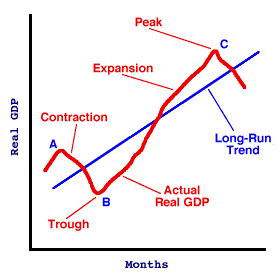
Meaning of the Business Cycle
The business cycle shows changes in real GDP over time.
- Economic activity rises during expansions.
- Economic activity falls during recessions.
- These fluctuations occur around the economy’s long-term growth path.
Key Idea:
- Actual output may be above or below potential output in the short run.
Short-Term Fluctuations
Short-term fluctuations are temporary increases and decreases in real GDP caused by changes in aggregate demand and aggregate supply.
Main phases of the business cycle:
Expansion (Recovery/Boom)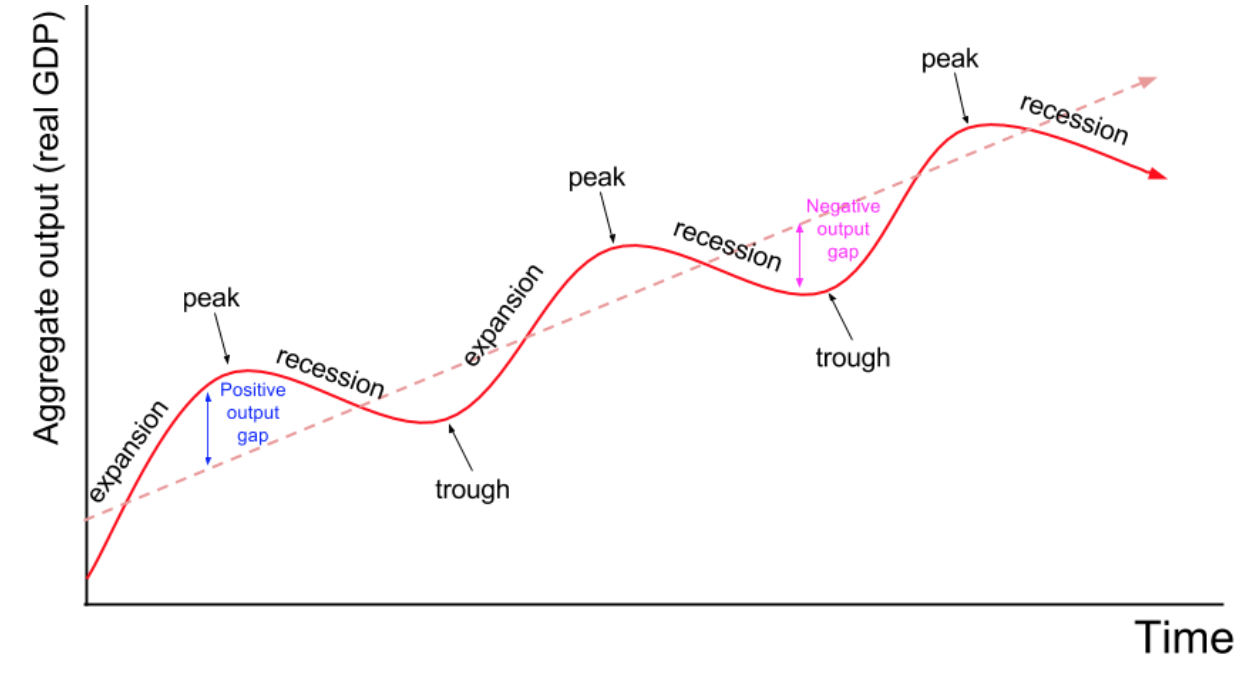
- Real GDP increases.
- Employment rises.
- Consumer spending and investment increase.
- Business confidence improves.
Peak
- Highest point of economic activity.
- Economy may operate close to full employment.
- Inflationary pressures may increase.
Contraction (Recession)
- Real GDP falls.
- Unemployment increases.
- Consumer spending and investment decline.
- Business confidence weakens.
Trough
- Lowest point of economic activity.
- Output and employment are at low levels.
- Recovery may begin from this stage.
Long-Term Growth Trend
The long-term growth trend represents the gradual increase in the economy’s productive capacity over time.
- Shows the growth of potential output.
- Caused by increases in:
- Quantity and quality of labour
- Capital stock
- Technology
- Productivity
- Reflects sustainable economic growth.
Potential output = Maximum sustainable level of output
Potential Output
Potential output is the maximum level of real GDP an economy can produce when resources are fully and efficiently employed without causing accelerating inflation.
- Represents the economy’s productive capacity.
- Associated with full employment.
- Does not mean zero unemployment, since some frictional and structural unemployment always exist.
Key Insight:
- If actual output exceeds potential output, inflationary pressure may occur.
- If actual output is below potential output, recessionary gaps and unemployment exist.
Relationship Between Business Cycle and Potential Output
The business cycle shows actual GDP fluctuating around the long-term trend of potential GDP.
- During booms, actual output may temporarily exceed potential output.
- During recessions, actual output falls below potential output.
- In the long run, the economy tends to move back toward potential output.
Causes of Business Cycles
Business cycles may be caused by changes in:
- Consumer confidence
- Investment spending
- Government policies
- Interest rates
- External shocks such as oil price changes or global crises
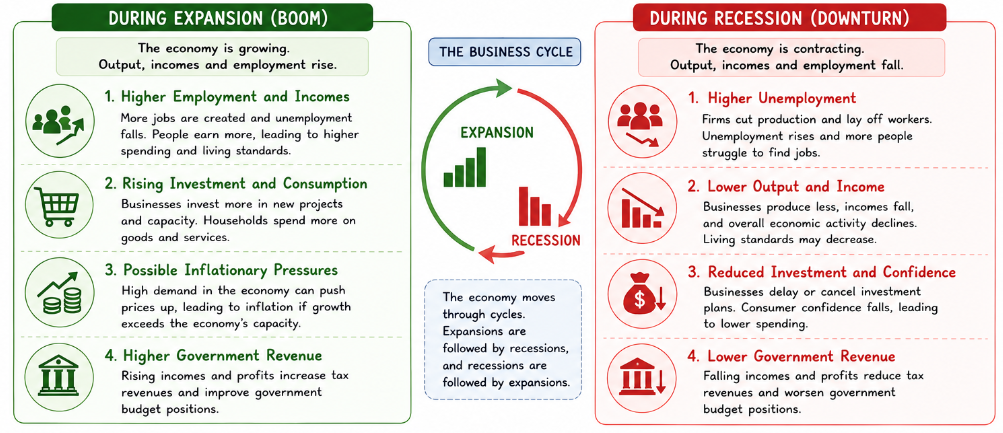
Economic Effects of Business Cycles
Importance of Understanding Business Cycles
- Helps governments design stabilization policies.
- Allows businesses to plan production and investment.
- Important for understanding unemployment and inflation.
- Helps explain short-run macroeconomic instability.
Summary of Business Cycle Phases
| Phase | Main Features |
|---|---|
| Expansion | Rising GDP, employment, investment |
| Peak | Highest economic activity, inflation pressure |
| Contraction | Falling GDP, rising unemployment |
| Trough | Lowest point before recovery |
Key Ideas:
- Business cycles are short-term fluctuations in economic activity.
- Potential output represents long-run productive capacity.
- Actual GDP fluctuates around the long-term growth trend.
- Governments use policies to reduce instability caused by business cycles.
Example 1
Explain the difference between actual output and potential output.
▶️ Answer / Explanation
Actual output is the current level of real GDP produced in the economy.
Potential output is the maximum sustainable level of output when resources are fully employed.
If actual output is below potential output, unemployment and unused resources exist.
If actual output exceeds potential output, inflationary pressure may arise.
Example 2
Using an example, explain one effect of a recession on the economy.
▶️ Answer / Explanation
During a recession, firms reduce production due to lower demand.
This may lead to layoffs and rising unemployment.
For example, during an economic downturn, consumer spending may fall, causing businesses to reduce investment and employment.
As a result, economic activity contracts.