
Causes of Economic Inequality and Poverty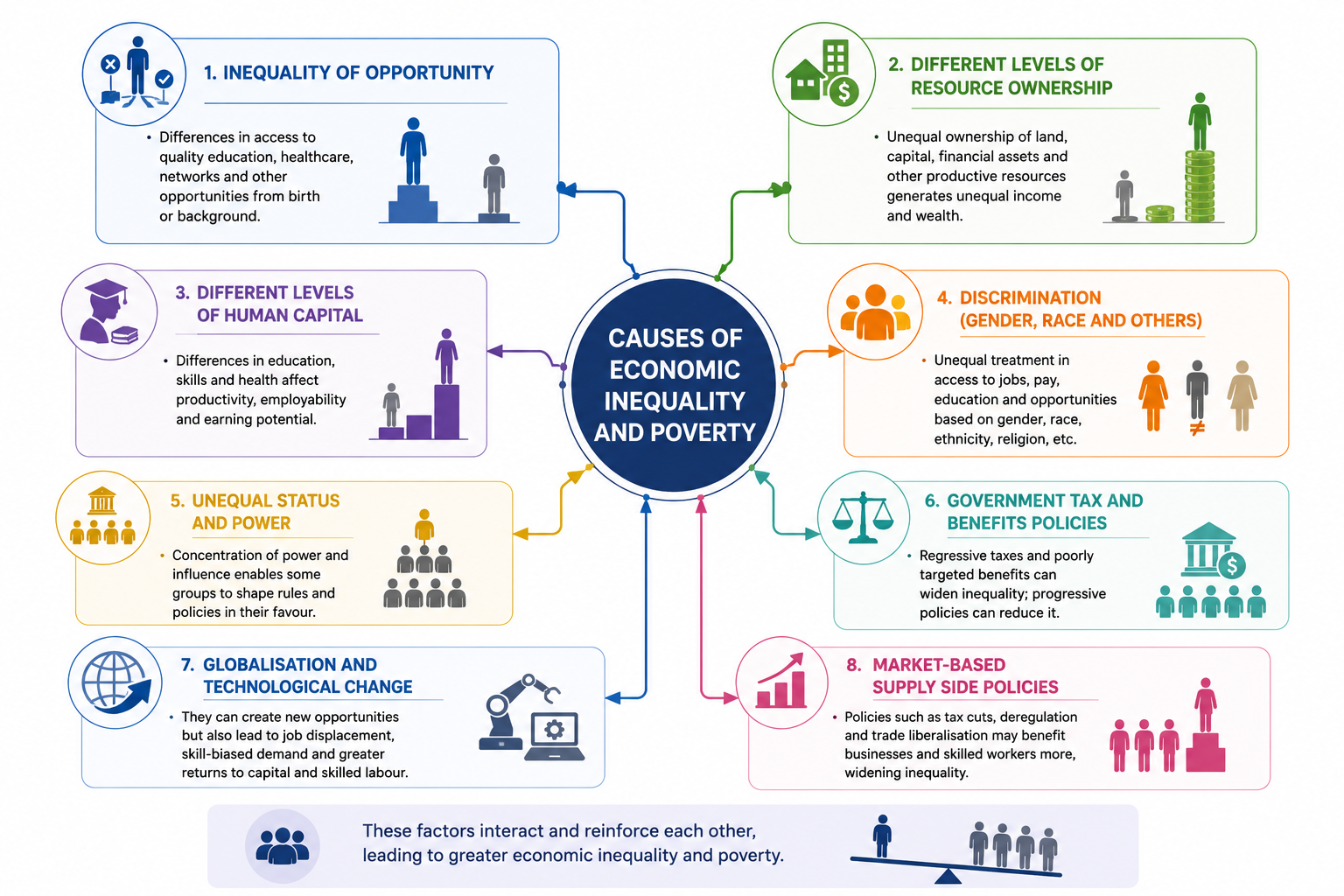
Economic inequality and poverty arise because income, wealth, opportunities, and resources are distributed unevenly within an economy.
Different individuals and groups may have unequal access to:
- Education
- Employment opportunities
- Assets and wealth
- Political influence
- Healthcare and public services
Several important factors contribute to economic inequality and poverty.
1. Inequality of Opportunity
Inequality of opportunity occurs when individuals do not have equal access to opportunities that allow them to improve their economic situation.
Opportunities may differ because of:
- Family background
- Education quality
- Healthcare access
- Location
- Social class
How Inequality of Opportunity Causes Inequality and Poverty
If some individuals receive better opportunities than others:
- They may gain higher education and skills.
- They may access better jobs and higher incomes.
- Others may remain trapped in low-income employment or unemployment.
This widens income and wealth differences over time.
Intergenerational Poverty
Inequality of opportunity may create intergenerational poverty.
This means poverty passes from one generation to another.
Example:
- Children from poor households may receive weaker education and fewer opportunities.
- As adults, they may also experience low incomes and poverty.
Examples of Inequality of Opportunity
- Unequal access to quality schools
- Limited healthcare in poor regions
- Rural populations having fewer employment opportunities
Effects of Inequality of Opportunity
- Persistent poverty
- Reduced social mobility
- Wider income inequality
- Lower economic efficiency because talent may be underutilized
2. Different Levels of Resource Ownership
Resource ownership refers to ownership of factors of production and assets such as:
- Land
- Property
- Businesses
- Shares and investments
- Natural resources
How Resource Ownership Causes Inequality
Individuals who own more resources often receive more income and wealth.
Resource ownership generates income through:
- Rent
- Interest
- Dividends
- Profits
More assets → More income generation → Greater wealth accumulation
Wealth Concentration
Wealth often becomes concentrated among a small group of people.
This may increase both:
- Wealth inequality
- Income inequality
Inheritance and Resource Ownership
Assets may be passed through inheritance.
This allows wealthy families to maintain economic advantages across generations.
Result:
- Persistent inequality over time
Examples of Unequal Resource Ownership
- A small percentage of the population owning most land in a country.
- Large corporations owned by wealthy shareholders.
Effects of Unequal Resource Ownership
- Large differences in wealth and income
- Concentration of economic power
- Reduced equality of opportunity
- Greater poverty among those without assets
3. Different Levels of Human Capital
Human capital refers to the skills, education, training, experience, and health possessed by workers.
Human capital increases worker productivity and earning potential.
How Human Capital Causes Inequality
Workers with higher levels of human capital usually:
- Earn higher wages
- Access better jobs
- Experience lower unemployment
Workers with lower levels of human capital may:
- Receive low wages
- Work in unstable jobs
- Face unemployment
Role of Education and Training
Education and training improve human capital.
However, access to education may be unequal.
This reinforces income inequality.
Technological Change and Human Capital
Modern economies increasingly reward highly skilled labour.
Technological change often increases demand for:
- Highly educated workers
- Technical and digital skills
Low-skilled workers may experience:
- Lower wages
- Job insecurity
- Structural unemployment
Examples of Human Capital Differences
- Doctors and engineers earning more than unskilled labourers.
- Workers with advanced digital skills receiving higher salaries.
Effects of Human Capital Differences
- Income inequality
- Unequal employment opportunities
- Persistent poverty among low-skilled workers
- Differences in living standards
Comparison of the Causes
| Cause | Main Reason for Inequality |
|---|---|
| Inequality of Opportunity | Unequal access to opportunities |
| Different Resource Ownership | Unequal ownership of assets and wealth |
| Different Human Capital | Differences in skills, education, and productivity |
Key Ideas:
- Inequality of opportunity limits social mobility and economic advancement.
- Ownership of assets generates wealth and income advantages.
- Human capital strongly influences wages and employment opportunities.
- These factors may reinforce poverty and economic inequality across generations.
Example 1
Explain how inequality of opportunity may lead to persistent poverty.
▶️ Answer / Explanation
If poor households cannot access quality education or healthcare, children may develop fewer skills and qualifications.
As adults, they may receive low wages or face unemployment.
This may cause poverty to continue across generations.
Example 2
Using an example, explain how human capital differences create income inequality.
▶️ Answer / Explanation
Workers with advanced education and technical skills are usually more productive.
For example, software engineers may earn much higher salaries than low-skilled workers.
As a result, differences in education and skills contribute to income inequality.
4. Discrimination (Gender, Race and Others)
Discrimination occurs when individuals or groups are treated unfairly because of characteristics such as:
- Gender
- Race or ethnicity
- Religion
- Age
- Disability
- Social background
Discrimination can limit access to employment, education, promotions, and income opportunities.
How Discrimination Causes Economic Inequality and Poverty
When discrimination exists:
- Some groups may receive lower wages.
- Employment opportunities may be restricted.
- Access to education and training may be limited.
- Career advancement may become more difficult.
This creates unequal economic outcomes between groups.
Gender Discrimination
Gender discrimination may result in:
- Women receiving lower wages than men for similar work.
- Lower female labour force participation.
- Limited access to leadership positions.
This contributes to income inequality and higher poverty rates among women.
Racial and Ethnic Discrimination
Racial or ethnic discrimination may limit:
- Employment opportunities
- Educational access
- Housing opportunities
- Access to credit and finance
Disadvantaged groups may therefore experience lower incomes and persistent poverty.
Occupational Segregation
Discrimination may also create occupational segregation.
This means certain groups become concentrated in lower-paying jobs.
Result:
- Long-term wage inequality
Effects of Discrimination
- Higher poverty rates among disadvantaged groups
- Reduced social mobility
- Lower economic efficiency because talent is underutilized
- Social tensions and inequality
5. Unequal Status and Power
Status and power refer to the ability of individuals or groups to influence economic and political decisions.
Some groups possess greater:
- Political influence
- Economic power
- Social status
- Access to decision-making
How Unequal Status and Power Cause Inequality
Groups with greater power may influence policies and markets in ways that benefit themselves.
Examples:
- Large corporations influencing government policies.
- Powerful groups receiving favourable regulations or tax benefits.
Labour Market Power Differences
Some workers possess stronger bargaining power than others.
Highly skilled or unionized workers may negotiate:
- Higher wages
- Better working conditions
- Greater job security
Low-skilled workers may have weaker bargaining power and lower incomes.
Political and Social Influence
Wealthy individuals or groups may have greater influence over:
- Government decisions
- Access to quality education
- Financial opportunities
This may reinforce inequality over time.
Cycle of Power and Wealth
More wealth → More influence and power → Greater economic advantages
This cycle may increase inequality further.
Effects of Unequal Status and Power
- Persistent inequality
- Unequal access to opportunities
- Reduced social mobility
- Concentration of economic and political influence
6. Government Tax and Benefits Policies
Government policies strongly influence income distribution and poverty levels.
Taxation and welfare policies may either:
- Reduce inequality
- Increase inequality
Tax Policies
Governments collect taxes to finance public spending.
The structure of the tax system affects income distribution.
Progressive Taxes
Under a progressive tax system:
- Higher-income earners pay a larger percentage of income in taxes.
Progressive taxation may reduce inequality by redistributing income.
Regressive Taxes
Some taxes, such as indirect taxes, may be regressive.
Low-income households spend a larger proportion of income on consumption.
Result:
- Regressive taxes may increase inequality and poverty.
Benefits and Transfer Payments
Governments may provide:
- Unemployment benefits
- Pensions
- Housing support
- Food assistance
- Healthcare support
These transfer payments may reduce poverty and inequality.
Public Services
Government spending on:
- Education
- Healthcare
- Infrastructure
may improve equality of opportunity and reduce long-term poverty.
How Government Policies May Increase Inequality
If governments:
- Reduce welfare spending
- Lower taxes mainly for wealthy groups
- Cut public services
income inequality and poverty may increase.
Effects of Government Policies
- Can reduce poverty through redistribution.
- May improve equality of opportunity.
- May also widen inequality depending on policy choices.
Comparison of the Causes
| Cause | Main Reason for Inequality |
|---|---|
| Discrimination | Unequal treatment and restricted opportunities |
| Unequal Status and Power | Differences in influence and bargaining power |
| Government Tax and Benefits Policies | Redistribution policies may reduce or increase inequality |
Key Ideas:
- Discrimination restricts economic opportunities and income.
- Unequal status and power reinforce economic advantages for some groups.
- Government taxation and welfare policies strongly influence income distribution.
- Policy choices may either reduce or worsen poverty and inequality.
Example 1
Explain how discrimination may contribute to economic inequality.
▶️ Answer / Explanation
If certain groups face discrimination in education or employment, they may receive lower wages and fewer career opportunities.
This reduces income and increases the likelihood of poverty.
As a result, discrimination contributes to economic inequality.
Example 2
Using an example, explain how progressive taxation may reduce inequality.
▶️ Answer / Explanation
Under progressive taxation, high-income earners pay a larger percentage of income in taxes.
The government may use this tax revenue to provide healthcare, education, and welfare support for lower-income groups.
This redistributes income and helps reduce economic inequality.
7. Globalisation and Technological Change
Globalisation refers to the increasing integration of economies through:
- International trade
- Foreign investment
- Movement of capital
- Technology transfer
- Global production networks
Technological change refers to improvements in production methods, machinery, digital systems, and innovation.
Both globalisation and technological change can increase economic growth, but they may also increase inequality and poverty for some groups.
How Globalisation Causes Economic Inequality
Globalisation may benefit some workers and industries more than others.
Workers and firms that are internationally competitive may experience:
- Higher incomes
- Greater profits
- More employment opportunities
However, less competitive industries and workers may face economic difficulties.
Wage Differences
Globalisation often increases demand for:
- Highly skilled labour
- Professional and technical workers
At the same time, low-skilled workers may experience:
- Lower wages
- Job insecurity
- Unemployment
Result:
- Income inequality may increase.
Outsourcing and Job Losses
Firms may move production to countries with lower labour costs.
This process is called outsourcing.
Outsourcing may reduce costs and increase profits, but it can also:
- Cause unemployment in higher-cost countries.
- Reduce incomes for low-skilled workers.
Technological Change and Inequality
Technological progress often increases productivity and economic growth.
However, technology may replace some forms of labour.
Automation and Structural Unemployment
Machines, robots, and artificial intelligence may replace routine jobs.
Low-skilled workers may experience:
- Structural unemployment
- Lower wages
- Reduced job opportunities
Skill-Biased Technological Change
Modern technology often rewards workers with advanced education and digital skills.
This is called skill-biased technological change.
Result:
- Wage gaps between skilled and unskilled workers widen.
Examples of Globalisation and Technological Change
- Factory workers losing jobs because production moves overseas.
- Automation replacing routine manufacturing jobs.
- Technology firms paying high salaries to highly skilled workers.
Positive Effects of Globalisation and Technology
Although inequality may increase, globalisation and technology may also:
- Reduce global poverty through economic growth.
- Create new industries and jobs.
- Increase productivity and efficiency.
- Improve living standards.
Effects on Economic Inequality and Poverty
- May widen wage inequality.
- Can create structural unemployment.
- May increase regional inequality.
- Benefits may be distributed unevenly.
8. Market-Based Supply Side Policies
Market-based supply side policies are government policies designed to increase economic efficiency and improve market performance by reducing government intervention.
These policies aim to encourage:
- Competition
- Investment
- Labour market flexibility
- Entrepreneurship
Examples of Market-Based Supply Side Policies
- Privatisation
- Deregulation
- Reduction in trade union power
- Lower taxes on businesses and high-income earners
- Labour market liberalisation
How Market-Based Policies May Increase Inequality
These policies often increase rewards for productive and highly skilled individuals.
However, benefits may not be distributed equally.
Labour Market Flexibility
Policies that increase labour market flexibility may:
- Reduce job protection
- Lower minimum wages
- Reduce trade union influence
While firms may become more efficient, low-skilled workers may experience:
- Lower wages
- Less job security
- Greater income inequality
Lower Taxes on High Incomes
Governments may reduce taxes on businesses and wealthy individuals to encourage:
- Investment
- Entrepreneurship
- Economic growth
However:
- High-income groups may benefit more than low-income groups.
- Income inequality may widen.
Privatisation
Privatisation transfers ownership of industries from the public sector to the private sector.
Private firms may become more efficient and profitable.
However:
- Some workers may lose jobs.
- Income differences may increase.
Potential Benefits of Market-Based Supply Side Policies
- Higher economic growth
- Greater efficiency
- Higher productivity
- More business investment
Potential Negative Effects
- Greater wage inequality
- Reduced job security
- Higher poverty for some groups
- Weaker income redistribution
Comparison of the Causes
| Cause | Main Reason for Inequality |
|---|---|
| Globalisation and Technological Change | Higher rewards for skilled workers and job losses for low-skilled workers |
| Market-Based Supply Side Policies | Greater market rewards and reduced redistribution |
Key Ideas:
- Globalisation and technology may increase inequality by rewarding skilled workers more heavily.
- Automation may create structural unemployment for low-skilled workers.
- Market-based supply side policies may improve efficiency but also widen income inequality.
- Economic growth benefits are not always distributed equally across society.
Example 1
Explain how technological change may increase economic inequality.
▶️ Answer / Explanation
Technological change often increases demand for highly skilled workers.
Workers with advanced digital and technical skills may receive much higher wages.
At the same time, automation may replace low-skilled jobs.
This widens income inequality between skilled and unskilled workers.
Example 2
Using an example, explain how market-based supply side policies may increase inequality.
▶️ Answer / Explanation
If the government reduces taxes on high-income earners and businesses, investment and entrepreneurship may increase.
However, wealthy groups may benefit more than low-income households.
As a result, income inequality may widen.