
Components of Aggregate Demand (AD)
Aggregate demand (AD) represents the total spending on domestically produced goods and services in an economy during a given period of time.
It is made up of four main components: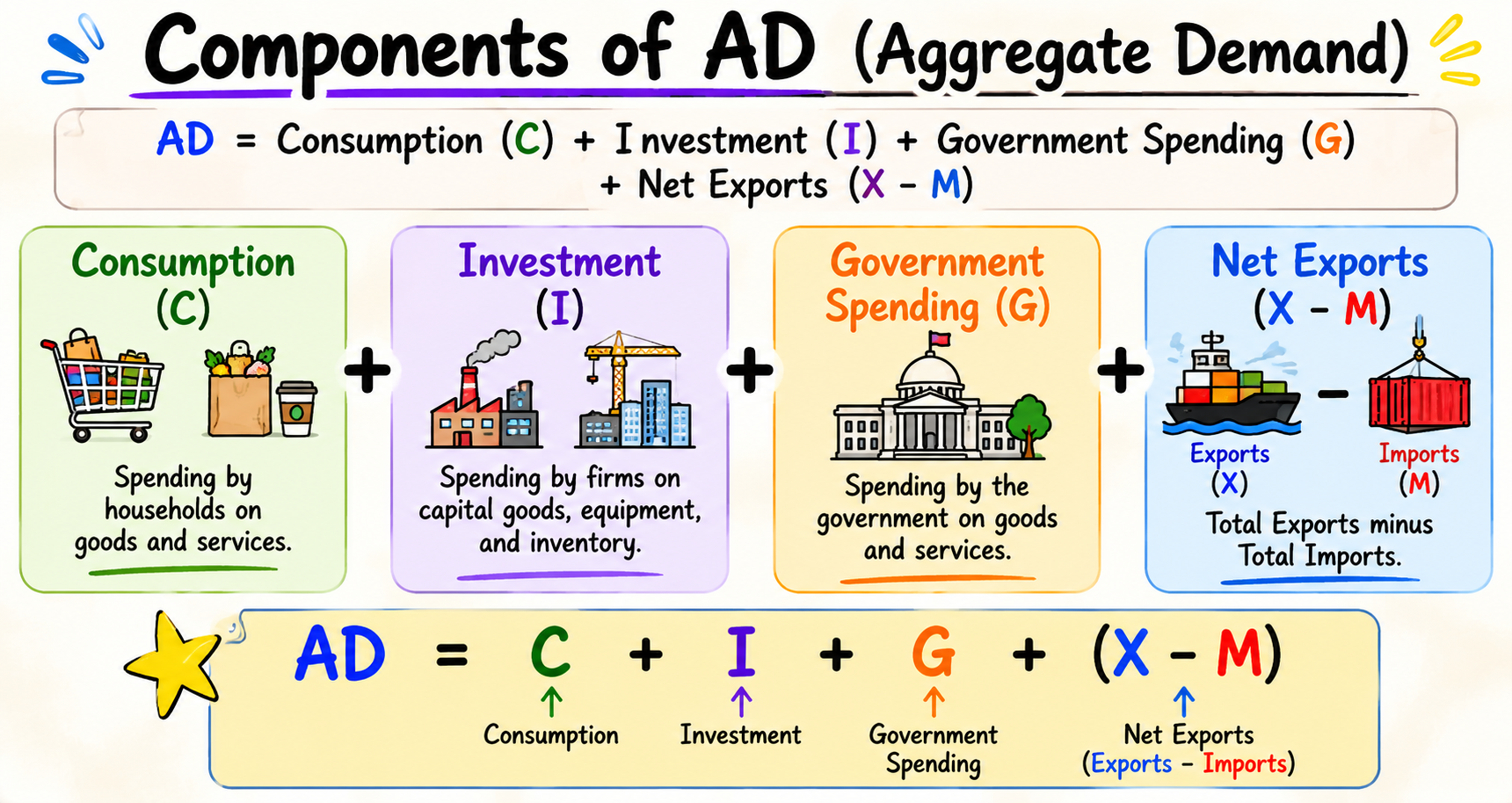
\( \mathrm{AD = C + I + G + (X – M)} \)
Where:
- \( \mathrm{C} \) = Consumption
- \( \mathrm{I} \) = Investment
- \( \mathrm{G} \) = Government spending
- \( \mathrm{X – M} \) = Net exports
These components together determine the total level of spending and economic activity in the economy.
Consumption (\( \mathrm{C} \))
Consumption refers to spending by households on goods and services.
It is usually the largest component of aggregate demand in most economies.
Examples of consumption spending:
- Food and clothing
- Transport and communication
- Healthcare and education services
- Durable goods such as cars and appliances
Determinants of Consumption:
- Income levels
- Higher disposable income increases consumption.
- Consumer confidence
- Optimistic consumers spend more.
- Interest rates
- Lower interest rates encourage borrowing and spending.
- Wealth
- Higher wealth increases spending.
- Taxes
- Higher taxes reduce disposable income and consumption.
Importance of Consumption:
- Strongly influences economic growth.
- Changes in consumption significantly affect aggregate demand.
- Important for employment and business revenue.
Investment (\( \mathrm{I} \))
Investment refers to spending by firms on capital goods used for future production.
Examples of investment spending:
- Factories and machinery
- Technology and equipment
- Commercial buildings
- Inventory accumulation
Determinants of Investment:
- Interest rates
- Lower interest rates reduce borrowing costs and increase investment.
- Business confidence
- Optimistic firms invest more.
- Expected profitability
- Higher expected profits encourage investment.
- Economic growth expectations
- Firms invest more when future demand is expected to rise.
- Government policies
- Tax incentives and subsidies may encourage investment.
Importance of Investment:
- Increases productive capacity.
- Drives long-term economic growth.
- Highly volatile and a major cause of business cycle fluctuations.
Government Spending (\( \mathrm{G} \))
Government spending refers to expenditure by the government on goods and services.
Examples:
- Healthcare and education
- Roads and infrastructure
- Defence and public administration
- Public sector wages
Important Clarification:
- Transfer payments such as pensions and unemployment benefits are not included directly because they are not payments for current production.
Determinants of Government Spending:
- Fiscal policy decisions
- Economic conditions
- Political priorities
- Public service requirements
Importance of Government Spending:
- Used to stabilize the economy.
- Can increase employment and output.
- Important during recessions when private sector demand is weak.
Net Exports (\( \mathrm{X – M} \))
Net exports represent the difference between exports and imports.
\( \mathrm{Net\ Exports = X – M} \)
Exports (\( \mathrm{X} \))
Exports are goods and services produced domestically and sold abroad.
- Bring foreign income into the economy.
- Increase aggregate demand.
Determinants of Exports:
- Foreign income levels
- Exchange rates
- Competitiveness of domestic products
- Trade policies
Imports (\( \mathrm{M} \))
Imports are goods and services purchased from abroad.
- Represent spending leaving the domestic economy.
- Reduce aggregate demand for domestic output.
Determinants of Imports:
- Domestic income levels
- Exchange rates
- Consumer preferences
- Relative prices of foreign goods
Importance of Net Exports:
- Influence economic growth and employment.
- A trade surplus increases AD.
- A trade deficit reduces AD.
- Important for open economies involved in international trade.
Relationship Between Components of AD
The total level of aggregate demand depends on the combined behaviour of all four components.
- Increase in any component increases AD.
- Decrease in any component reduces AD.
- Changes in AD affect output, employment, and price levels.
Key Ideas:
- Aggregate demand is the sum of four spending components.
- Consumption is usually the largest component.
- Investment is volatile and important for growth.
- Government spending and net exports also strongly affect economic activity.
Example 1
Explain how lower interest rates may increase aggregate demand.
▶️ Answer / Explanation
Lower interest rates reduce the cost of borrowing.
Households may increase consumption spending, while firms may increase investment spending.
This increases both \( \mathrm{C} \) and \( \mathrm{I} \), causing aggregate demand to rise.
Example 2
Using an example, explain why imports are subtracted from aggregate demand.
▶️ Answer / Explanation
Imports represent spending on foreign-produced goods rather than domestic output.
For example, if consumers buy imported cars, the spending does not contribute to domestic production.
Therefore, imports are subtracted when calculating aggregate demand.