
Consequences of Economic Growth
Economic growth can have important effects on individuals, businesses, governments, and the environment.
Although economic growth is generally associated with rising output and higher incomes, its effects are not always entirely positive.
The consequences of economic growth include impacts on:
- Living standards
- The environment
- Income distribution
Impact of Economic Growth on Living Standards
Living standards refer to the level of material well-being enjoyed by people in an economy.
Economic growth often improves living standards because more goods and services become available.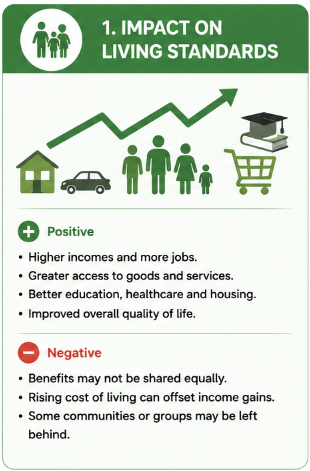
Positive Impacts on Living Standards
1. Higher Real Incomes
- Economic growth increases national income and employment opportunities.
- Households may experience higher wages and purchasing power.
- Consumers can afford more goods and services.
Economic growth → Higher incomes → Higher consumption
2. Lower Unemployment
- Growing economies usually require more labour.
- More jobs reduce cyclical unemployment.
- Employment improves economic security and quality of life.
3. Improved Public Services
- Economic growth increases government tax revenue.
- Governments may spend more on:
- Healthcare
- Education
- Infrastructure
- Social welfare programs
4. Greater Consumer Choice
- Firms produce more goods and services.
- Consumers enjoy greater variety and improved product quality.
5. Reduction in Poverty
- Economic growth may increase employment and income opportunities.
- Poverty levels may decrease if growth benefits a large part of the population.
Possible Negative Effects on Living Standards
- Inflation may reduce purchasing power.
- Urban congestion may increase.
- Stress and longer working hours may affect quality of life.
- Benefits of growth may not be shared equally.
Impact of Economic Growth on the Environment
Economic growth often increases the use of natural resources and industrial production.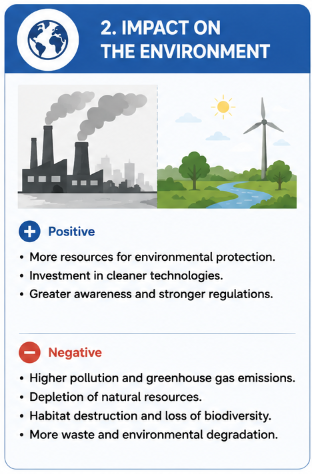
This may create environmental problems if growth is not sustainable.
Negative Environmental Impacts
1. Pollution
- Industrial production and transportation may increase air and water pollution.
- Carbon emissions may rise.
2. Resource Depletion
- Economic growth increases demand for natural resources.
- Non-renewable resources such as fossil fuels may become depleted.
3. Deforestation and Habitat Destruction
- Urban expansion and industrial activity may destroy ecosystems.
- Biodiversity may decline.
4. Climate Change
- Higher greenhouse gas emissions contribute to global warming.
- Climate-related problems such as floods and droughts may worsen.
Possible Positive Environmental Effects
Economic growth may also improve environmental protection if income and technology increase.
- Governments may invest in renewable energy.
- Cleaner technologies may reduce pollution.
- Environmental regulations may become stronger.
Key Idea:
- Sustainable growth aims to balance economic growth with environmental protection.
Impact of Economic Growth on Income Distribution
Income distribution refers to how income is shared among individuals or households in an economy.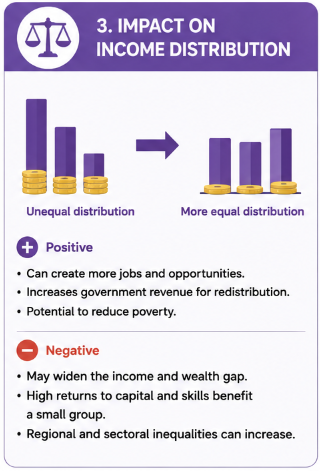
Economic growth can affect income inequality in different ways.
Positive Effects on Income Distribution
- More employment opportunities may reduce poverty.
- Rising wages may improve incomes for low-income workers.
- Government tax revenue may support redistribution policies.
Negative Effects on Income Distribution
Economic growth may increase inequality if benefits are unevenly distributed.
1. Unequal Access to Opportunities
- Highly skilled workers may benefit more from growth.
- Low-skilled workers may experience slower income growth.
2. Capital Owners May Benefit More
- Business owners and investors may receive large increases in income and wealth.
- Income inequality may widen.
3. Regional Inequality
- Some regions may grow faster than others.
- Urban areas may benefit more than rural areas.
4. Technological Change
- Technology may increase demand for skilled labour.
- Workers without advanced skills may be left behind.
Government Role in Managing Income Distribution
Governments may use policies to reduce inequality during economic growth.
Examples:
- Progressive taxation
- Transfer payments
- Education and training programs
- Minimum wage laws
Trade-Offs of Economic Growth
| Positive Consequences | Negative Consequences |
|---|---|
| Higher incomes | Environmental damage |
| Lower unemployment | Resource depletion |
| Improved public services | Income inequality |
| Higher living standards | Inflationary pressure |
Importance of Sustainable Economic Growth
Sustainable economic growth refers to growth that meets present needs without reducing the ability of future generations to meet their own needs.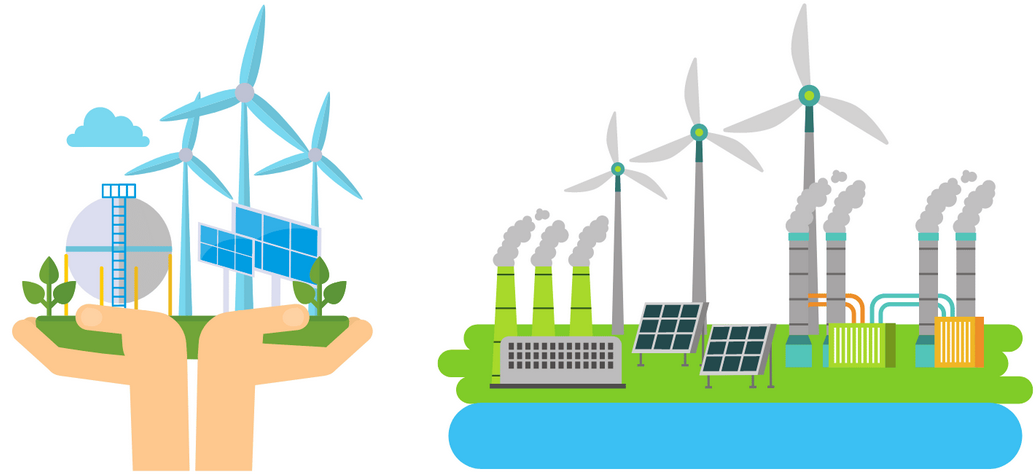
Sustainable growth aims to:
- Improve living standards
- Protect the environment
- Promote equitable income distribution
Key Ideas:
- Economic growth usually improves living standards and employment.
- Growth may create environmental problems if unmanaged.
- Income inequality may increase if growth benefits only certain groups.
- Sustainable growth seeks balance between growth, equity, and environmental protection.
Example 1
Explain how economic growth may improve living standards.
▶️ Answer / Explanation
Economic growth increases real output and national income.
Firms may hire more workers and wages may increase.
Higher incomes allow consumers to buy more goods and services.
Governments may also improve healthcare, education, and infrastructure using higher tax revenue.
Example 2
Using an example, explain how economic growth may worsen income inequality.
▶️ Answer / Explanation
Technological growth may increase demand for highly skilled workers.
Skilled workers may receive much higher wages, while low-skilled workers experience little income growth.
Business owners and investors may also receive large profits.
As a result, income inequality may increase during economic growth.
Example 3
A country’s real GDP was:
- \( \mathrm{2.4\ trillion} \) dollars in 2024
- \( \mathrm{2.58\ trillion} \) dollars in 2025
Calculate the rate of economic growth for 2025.
▶️ Answer / Explanation
\( \mathrm{Rate\ of\ economic\ growth = \frac{New\ Real\ GDP – Old\ Real\ GDP}{Old\ Real\ GDP} \times 100} \)
\( \mathrm{Rate\ of\ growth = \frac{2.58 – 2.40}{2.40} \times 100} \)
\( \mathrm{2.58 – 2.40 = 0.18} \)
\( \mathrm{\frac{0.18}{2.40} = 0.075} \)
\( \mathrm{0.075 \times 100 = 7.5\%} \)
Final Answer:
\( \mathrm{Rate\ of\ economic\ growth = 7.5\%} \)
Interpretation:
The economy’s real output increased by 7.5% from 2024 to 2025.