
Demand and Supply of Money — Determination of Equilibrium Interest Rates
The rate of interest in an economy is determined through the interaction of: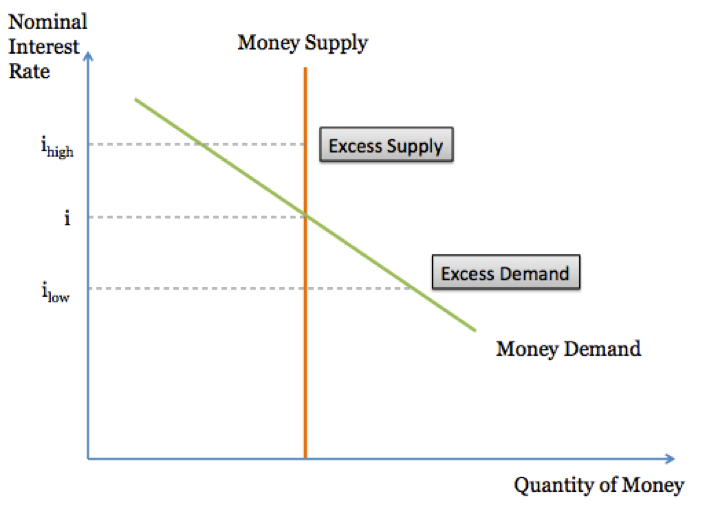
- Demand for money
- Supply of money
The money market explains how equilibrium interest rates are established.
Interest rates play an important role in influencing:
- Consumption
- Investment
- Saving
- Aggregate demand
- Economic growth
The Money Market
The money market is the market where the demand for money interacts with the supply of money.
The equilibrium interest rate is determined where:
Money demand = Money supply
Demand for Money
Demand for money refers to the amount of money people wish to hold rather than use for spending or investing.
People demand money mainly because money is needed for transactions and financial security.
Motives for Holding Money
According to Keynesian theory, there are three main motives for demanding money:
- Transactions motive
- Precautionary motive
- Speculative motive
1. Transactions Motive
People hold money to carry out everyday purchases of:
- Goods
- Services
The transactions demand for money depends mainly on:
- Level of income
- Level of economic activity
Relationship with Income
As income increases:
- People buy more goods and services.
- Demand for money increases.
Income ↑ → Transactions demand for money ↑
2. Precautionary Motive
People also hold money for unexpected situations such as:
- Medical emergencies
- Unexpected expenses
- Income uncertainty
Higher income usually increases precautionary money demand.
3. Speculative Motive
People may hold money instead of financial assets if they expect:
- Bond prices to fall
- Interest rates to rise in the future
The speculative demand for money depends mainly on interest rates.
Relationship Between Interest Rates and Speculative Demand
When interest rates are low:
- People may expect rates to rise later.
- Bond prices may fall in the future.
- People prefer holding money instead of bonds.
Result:
- Money demand increases.
Inverse Relationship Between Interest Rates and Money Demand
The overall demand for money usually has an inverse relationship with interest rates.
Interest rate ↑ → Demand for money ↓
Interest rate ↓ → Demand for money ↑
Why Higher Interest Rates Reduce Money Demand
Higher interest rates increase the opportunity cost of holding money.
People may prefer to hold:
- Bonds
- Savings accounts
- Financial assets
instead of holding cash.
Supply of Money
Money supply refers to the total quantity of money available in the economy.
The supply of money is mainly controlled by the central bank through monetary policy.
Characteristics of Money Supply
In many economic models, the money supply is shown as fixed at a given point in time.
This means the money supply curve is vertical.
Why the Money Supply Curve is Vertical
The central bank determines the quantity of money supplied independently of interest rates.
Therefore:
- The money supply does not automatically change when interest rates change.
Equilibrium Interest Rate
The equilibrium interest rate occurs where:
Demand for money = Supply of money
At equilibrium:
- The amount of money people wish to hold equals the amount supplied.
Money Market Equilibrium
If:
Money demand > Money supply
there is excess demand for money.
This pushes interest rates upward.
Why Interest Rates Rise
People sell financial assets to obtain money.
Bond prices fall and interest rates rise.
If Money Supply Exceeds Money Demand
If:
Money supply > Money demand
there is excess supply of money.
People use excess money to buy financial assets.
Bond prices rise and interest rates fall.
Graphical Interpretation 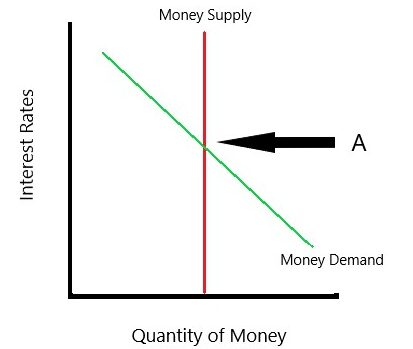
In the money market diagram:
- The vertical axis shows interest rates.
- The horizontal axis shows quantity of money.
- The money demand curve slopes downward.
- The money supply curve is vertical.
The intersection determines equilibrium interest rates.
Shifts in Money Demand
The demand for money may shift because of changes in:
- Income
- Economic activity
- Price level
- Consumer expectations
Increase in Money Demand
If money demand increases:
- The money demand curve shifts right.
- Interest rates rise.
Example:
Higher national income increases transactions demand for money.
Decrease in Money Demand
If money demand decreases:
- The money demand curve shifts left.
- Interest rates fall.
Shifts in Money Supply
The central bank may change money supply through monetary policy.
Increase in Money Supply
If the central bank increases money supply:
- The money supply curve shifts right.
- Interest rates decrease.
Result:
- Borrowing and investment may increase.
Decrease in Money Supply
If the central bank reduces money supply:
- The money supply curve shifts left.
- Interest rates rise.
Result:
- Borrowing and spending may decrease.
Importance of Interest Rates
Interest rates affect:
- Consumption
- Investment
- Saving
- Exchange rates
- Aggregate demand
Therefore, equilibrium interest rates are important for overall economic stability.
Liquidity Trap
A liquidity trap occurs when interest rates are extremely low and people prefer holding cash instead of financial assets.
In this situation:
- Expansionary monetary policy may become less effective.
Comparison of Changes in the Money Market
| Change | Effect on Interest Rates |
|---|---|
| Increase in Money Demand | Interest rates rise |
| Decrease in Money Demand | Interest rates fall |
| Increase in Money Supply | Interest rates fall |
| Decrease in Money Supply | Interest rates rise |
Summary of Money Demand Motives
| Motive | Reason for Holding Money |
|---|---|
| Transactions Motive | Everyday purchases |
| Precautionary Motive | Unexpected expenses |
| Speculative Motive | Expectations about interest rates and asset prices |
Key Ideas:
- Interest rates are determined by demand and supply of money.
- Money demand has transactions, precautionary, and speculative motives.
- Money demand usually has an inverse relationship with interest rates.
- The central bank controls money supply through monetary policy.
- Equilibrium interest rates occur where money demand equals money supply.
Example 1
Explain why an increase in money supply may reduce interest rates.
▶️ Answer / Explanation
If the central bank increases money supply, banks have more reserves available for lending.
The supply of money in the money market increases.
This creates downward pressure on interest rates.
Lower interest rates may increase borrowing and investment.
Example 2
Using an example, explain why money demand may increase when national income rises.
▶️ Answer / Explanation
Higher national income increases spending on goods and services.
People therefore need more money for transactions.
As a result, the demand for money increases.