
Demand-Side Effects of Supply-Side Policies
Although supply-side policies mainly aim to increase the economy’s productive capacity and improve long-run aggregate supply (LRAS), they can also create important demand-side effects by influencing aggregate demand (AD).
Supply-side policy → Changes in income, spending, and investment → Changes in AD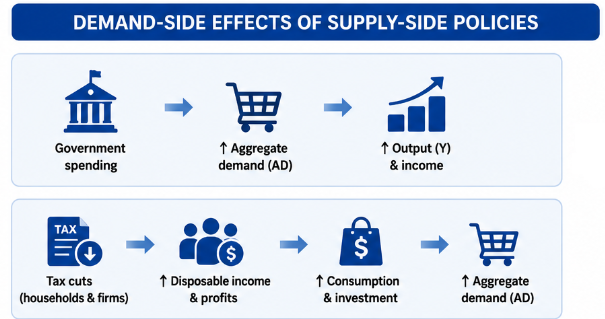
Explanation:
- Some supply-side policies increase employment, income, and investment.
- This raises consumption and investment spending in the economy.
- As a result, aggregate demand may increase alongside long-run aggregate supply.
How Supply-Side Policies Affect Aggregate Demand
1. Higher Employment and Income
- Policies such as education, training, and labour market reforms reduce unemployment.
- More people become employed and earn income.
- Households increase consumption spending.
Higher employment → Higher income → Higher consumption → Higher AD
2. Increased Business Investment
- Lower business taxes and deregulation increase expected profitability.
- Firms become more willing to invest in capital and expansion.
- Investment spending increases aggregate demand.
Higher profitability → More investment → Higher AD
3. Government Spending on Supply-Side Policies
- Interventionist policies often involve government spending.
- Examples include:
- Infrastructure projects
- Education spending
- Healthcare investment
- This directly increases aggregate demand.
4. Increased Consumer and Business Confidence
- Successful supply-side reforms improve economic expectations.
- Consumers may spend more.
- Firms may invest more confidently.
Economic Significance:
- Supply-side policies can stimulate both short-run and long-run growth.
- Higher AD can reduce cyclical unemployment.
- Multiplier effects may further increase GDP.
Potential Problems:
- If AD rises too quickly, inflationary pressure may occur.
- Government spending may increase budget deficits.
- Demand-side effects may occur before long-run supply benefits appear.
Key Point:
- Supply-side policies may increase aggregate demand.
- Higher employment and investment increase spending.
- Government spending on infrastructure directly raises AD.
- Policies can affect both short-run and long-run economic performance.
Example 1
Explain how supply-side policies may increase aggregate demand.
▶️ Answer / Explanation
Supply-side policies may increase employment and incomes.
This raises consumer spending.
Government spending on infrastructure also directly increases aggregate demand.
Thus, supply-side policies can create demand-side effects.
Example 2
Evaluate the possible disadvantages of demand-side effects of supply-side policies.
▶️ Answer / Explanation
Higher aggregate demand may increase economic growth and employment.
However, if demand rises too quickly, inflation may occur.
Government spending may also increase public debt.
Thus, demand-side effects can create both benefits and costs.