
Determinants of Aggregate Demand (AD) Components
The level of aggregate demand (AD) depends on the behaviour of its four components:

Changes in the determinants of these components cause changes in total spending and therefore shift the aggregate demand curve.
Determinants of Consumption (\( \mathrm{C} \))
Consumption refers to household spending on goods and services. It is usually the largest component of AD.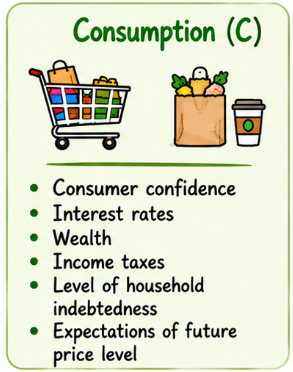
1. Consumer Confidence
Consumer confidence refers to how optimistic households are about future economic conditions.
- If consumers feel optimistic about income and employment, they spend more.
- If consumers fear unemployment or recession, they reduce spending and increase saving.
Higher confidence → Consumption ↑ → AD ↑
2. Interest Rates
Interest rates affect the cost of borrowing and the reward for saving.
- Lower interest rates encourage borrowing and spending.
- Higher interest rates encourage saving and reduce consumption.
- Particularly important for purchases of durable goods such as cars and houses.
Interest rates ↓ → Consumption ↑
3. Wealth
Wealth refers to the value of assets owned by households, such as property and shares.
- Rising house prices and stock prices increase household wealth.
- Consumers feel financially secure and spend more.
- Falling asset values reduce confidence and consumption.
Wealth ↑ → Consumption ↑
4. Income Taxes
Income taxes affect disposable income available for spending.
- Lower income taxes increase disposable income and consumption.
- Higher taxes reduce household purchasing power.
Income taxes ↓ → Disposable income ↑ → Consumption ↑
5. Level of Household Indebtedness
Household indebtedness refers to the amount of debt households owe.
- Highly indebted households may reduce spending to repay debt.
- High debt can make consumers cautious about borrowing more.
Key Insight:
- Excessive debt may weaken consumption and economic growth.
6. Expectations of Future Price Level
Expectations about future inflation affect current spending behaviour.
- If consumers expect prices to rise in the future, they may spend more now.
- If prices are expected to fall, consumers may delay purchases.
Expected future prices ↑ → Current consumption ↑
Determinants of Investment (\( \mathrm{I} \))
Investment refers to spending by firms on capital goods and productive capacity.
1. Interest Rates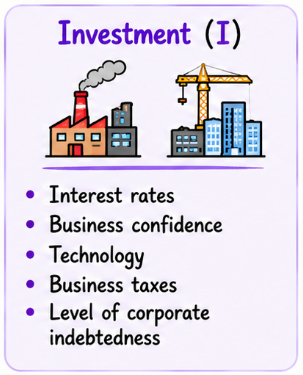
Interest rates strongly influence investment decisions.
- Lower interest rates reduce borrowing costs.
- Firms are more willing to invest in machinery and expansion.
- Higher interest rates discourage borrowing and investment.
Interest rates ↓ → Investment ↑
2. Business Confidence
Business confidence reflects firms’ expectations about future profitability and economic conditions.
- Optimistic firms invest more.
- During recessions or uncertainty, firms reduce investment spending.
Key Insight:
- Investment is highly sensitive to expectations.
3. Technology
Technological improvements encourage firms to invest in new equipment and production methods.
- New technology increases productivity and efficiency.
- Firms invest to remain competitive.
Technology improvement → Investment ↑
4. Business Taxes
Taxes on firms affect profitability.
- Lower business taxes increase after-tax profits and investment incentives.
- Higher taxes may discourage investment.
Business taxes ↓ → Investment ↑
5. Level of Corporate Indebtedness
Corporate indebtedness refers to the amount of debt owed by firms.
- Highly indebted firms may avoid further borrowing.
- Debt repayment obligations may reduce investment spending.
Determinants of Government Spending (\( \mathrm{G} \))
Government spending depends mainly on government decisions and policy priorities.
1. Political Priorities
Governments allocate spending according to political objectives.
- Some governments prioritize healthcare and education.
- Others may focus on defence or infrastructure.
Example:
- A government aiming to improve public transport may increase infrastructure spending.
2. Economic Priorities
Government spending may change depending on economic conditions.
- During recessions, governments may increase spending to stimulate AD.
- During inflationary periods, governments may reduce spending.
Expansionary fiscal policy → Government spending ↑ → AD ↑
Determinants of Net Exports (\( \mathrm{X – M} \))
Net exports depend on exports and imports.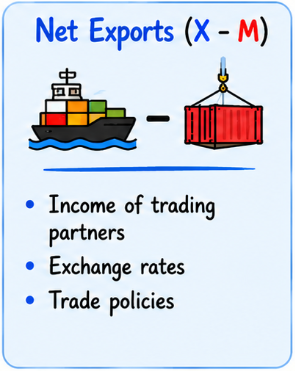
1. Income of Trading Partners
The income levels of foreign countries affect demand for exports.
- If trading partners experience economic growth, they demand more imports.
- This increases exports of domestic firms.
Foreign income ↑ → Exports ↑
2. Exchange Rates
Exchange rates affect international competitiveness.
- A depreciation makes exports cheaper and imports more expensive.
- An appreciation makes exports more expensive and imports cheaper.
Currency depreciation → Exports ↑ and Imports ↓ → Net exports ↑
3. Trade Policies
Government trade policies influence exports and imports.
- Tariffs and quotas reduce imports.
- Trade agreements may increase exports.
- Protectionist policies affect international trade flows.
Relationship Between Determinants and AD
Changes in these determinants affect one or more components of AD and therefore shift the aggregate demand curve.
- Increase in spending components → AD shifts right.
- Decrease in spending components → AD shifts left.
Summary Table
| AD Component | Main Determinants |
|---|---|
| \( \mathrm{C} \) | Confidence, interest rates, wealth, taxes, debt, inflation expectations |
| \( \mathrm{I} \) | Interest rates, confidence, technology, taxes, debt |
| \( \mathrm{G} \) | Political and economic priorities |
| \( \mathrm{X – M} \) | Foreign income, exchange rates, trade policies |
Key Ideas:
- Determinants of AD influence spending behaviour in the economy.
- Consumption and investment are strongly affected by confidence and interest rates.
- Government spending depends on policy priorities.
- Net exports depend on global economic conditions and exchange rates.
Example 1
Explain how lower interest rates may affect both consumption and investment.
▶️ Answer / Explanation
Lower interest rates reduce the cost of borrowing.
Households may borrow more to purchase goods such as cars and houses, increasing consumption.
Firms may also borrow more to finance expansion and machinery purchases, increasing investment.
As a result, aggregate demand increases.
Example 2
Using an example, explain how exchange rate changes affect net exports.
▶️ Answer / Explanation
If a country’s currency depreciates, domestic goods become cheaper for foreign buyers.
Exports increase while imports become more expensive and may decrease.
This increases net exports and aggregate demand.