
Difficulties in Measuring Poverty
Measuring poverty is complex because poverty is a multidimensional concept.
Poverty involves more than just low income and may include:
- Poor health
- Lack of education
- Inadequate housing
- Social exclusion
- Limited opportunities
As a result, economists and governments face several difficulties when attempting to measure poverty accurately.
1. Defining Poverty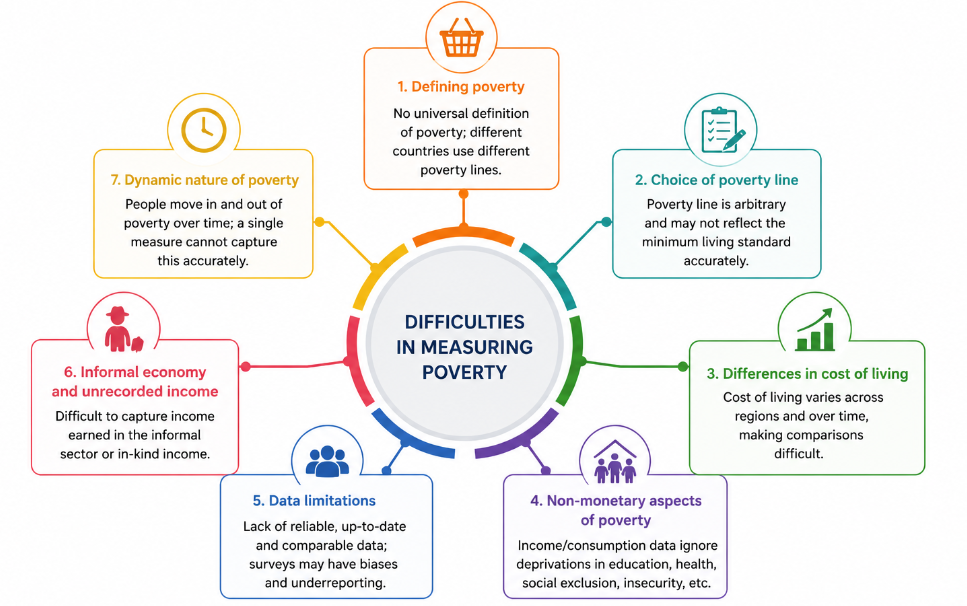
One major difficulty is deciding what poverty actually means.
Poverty may be measured as:
- Absolute poverty
- Relative poverty
Different definitions produce different measurements.
Absolute vs Relative Poverty
- Absolute poverty focuses on basic survival needs.
- Relative poverty focuses on living standards compared to society.
A person may not be absolutely poor but may still experience relative poverty.
This makes poverty measurement subjective and dependent on definitions used.
2. Difficulty Setting Poverty Lines
Choosing an appropriate poverty line is difficult.
Governments and organizations must decide:
- What level of income represents poverty
- What goods and services are essential
These decisions often involve value judgments.
Variation Between Countries
Living costs and standards differ across countries.
- A poverty line suitable for one country may not be appropriate for another.
This complicates international comparisons.
3. Changes in Living Standards Over Time
Living standards and social expectations change over time.
Goods considered luxuries in the past may become necessities today.
Example:
- Internet access and mobile phones may now be considered essential in many societies.
Poverty measures may therefore become outdated.
4. Income Does Not Fully Reflect Well-Being
Many poverty measures focus mainly on income.
However, income alone may not accurately represent quality of life.
Two households with similar incomes may experience very different living conditions.
Example:
- One household may have free healthcare and housing support, while another may not.
This means income-based measures may overlook important differences.
5. Difficulty Measuring Non-Monetary Deprivation
Poverty also includes non-income factors such as:
- Health
- Education
- Nutrition
- Housing quality
- Access to clean water
These factors are difficult to quantify accurately.
6. Informal Economy and Unreported Income
In many countries, especially developing economies:
- People work in the informal sector.
- Income may not be officially recorded.
This creates difficulties in collecting accurate income data.
Examples of Informal Employment
- Street vendors
- Casual labour
- Small family businesses
7. Regional Differences in Living Costs
Living costs may vary greatly within a country.
- Urban areas may have much higher living costs than rural areas.
A single national poverty line may therefore not reflect local realities accurately.
8. Temporary vs Persistent Poverty
Some individuals experience temporary poverty, while others experience long-term poverty.
Temporary poverty:
- Short-term unemployment or temporary income loss.
Persistent poverty:
- Long-term lack of resources and opportunities.
Standard measurements may not distinguish clearly between the two.
9. Household Composition Differences
Households differ in:
- Size
- Age structure
- Number of dependents
The same income may provide very different living standards for different households.
Example:
- A family with four children requires more resources than a single adult household.
10. Data Collection Problems
Accurate poverty measurement requires reliable data.
However:
- Some countries lack accurate statistical systems.
- Surveys may contain errors.
- People may underreport or overreport income.
11. Subjectivity in Composite Measures
Composite indicators such as the Multidimensional Poverty Index (MPI) involve selecting:
- Indicators
- Weights
- Thresholds
These choices may involve subjective judgments.
Example:
- Different economists may disagree about how important education or healthcare should be within the MPI.
Difficulty Comparing Poverty Internationally
International comparisons are difficult because countries differ in:
- Price levels
- Living standards
- Economic structures
- Social expectations
Even PPP adjustments may not fully solve these differences.
Comparison Between Income-Based and Multidimensional Measures
| Aspect | Income-Based Measures | Multidimensional Measures |
|---|---|---|
| Main Focus | Income | Multiple deprivations |
| Advantages | Simpler and easier to compare | More comprehensive |
| Limitations | Ignores non-income factors | More complex and subjective |
Importance of Accurate Poverty Measurement
Accurate measurement is important because it helps governments:
- Target welfare programs
- Reduce inequality
- Improve living standards
- Allocate resources effectively
Key Ideas:
- Poverty is difficult to measure because it is multidimensional.
- Different definitions of poverty produce different results.
- Income alone may not reflect quality of life accurately.
- Living standards and social expectations vary between societies.
- Data collection and informal economic activity create additional difficulties.
Example 1
Explain why income alone may not accurately measure poverty.
▶️ Answer / Explanation
Income does not fully reflect living conditions or access to services.
Two households with the same income may have different healthcare, education, or housing conditions.
Therefore, poverty involves more than income alone.
Example 2
Using an example, explain why a single poverty line may not accurately measure poverty within a country.
▶️ Answer / Explanation
Living costs may differ greatly between urban and rural areas.
A household income that is sufficient in a rural area may be inadequate in a major city with higher housing and transportation costs.
Therefore, a single national poverty line may not accurately reflect actual living conditions for all households.